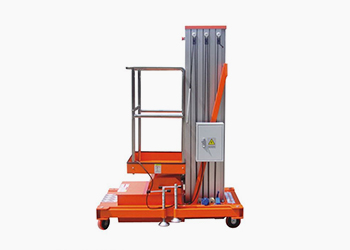
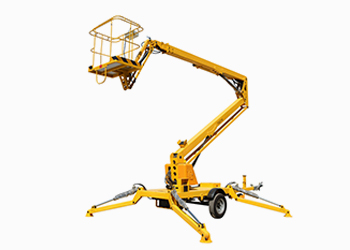
A scissor lift is a type of aerial work platform that achieves vertical lifting of the work platform through the extension and retraction of crossed arms (scissor structure). It offers stable structure, high load capacity, and simple operation, and is widely used in construction, renovation, and maintenance. It can replace traditional scaffolding, significantly improving work safety and efficiency.
Based on mobility, traveling mechanism, and functional characteristics, scissor lifts can be mainly divided into five types: towable scissor lifts, crawler scissor lifts, electric scissor lifts, rough terrain scissor lifts, and stationary scissor lifts. Each type has its own strengths in various construction projects.

Core logic: convenient relocation + low-cost towing
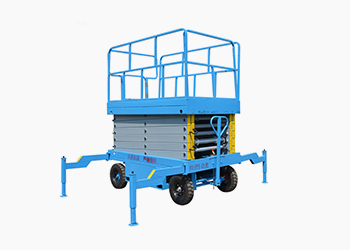
Key characteristics: Uses a trailer-type chassis, no self-propelled power, can be towed by trucks, pickups, or tractors. Compact structure, high towing speed, suitable for frequent relocation between multiple dispersed work sites. Once on site, stabilizes the machine with hydraulic or manual outriggers, still uses hydraulic system to drive scissor lift during operation. Simple maintenance, relatively low purchase cost.
Typical parameters:
Maximum platform height: 6 - 14 m
Rated load: 300 - 800 kg
Construction application scenarios:
Road and bridge maintenance: multi-point repair and inspection along highways, national roads, and bridges.
Temporary aerial work: quick switching between multiple individual buildings on a construction site.
Rental and emergency scenarios: common in rental market, suitable for short-term, low-frequency projects requiring fast transportation.
Decision advice: When a project requires frequent movement of equipment between different locations and the site has a towing vehicle, the towable scissor lift is a cost-effective choice. Particularly suitable for linear operations such as municipal maintenance and road construction.

Core logic: all-terrain mobility + low ground damage
Key characteristics: Uses rubber crawler traveling mechanism, large ground contact area, low ground pressure, does not damage sensitive surfaces such as lawns, tiles, or asphalt. Excellent climbing ability (up to 30° or more) and ability to turn in place. Can operate stably on soft or slippery surfaces such as mud, snow, gravel, and grass. Power is typically a diesel engine or high-power electric motor, with strong endurance.
Typical parameters:
Maximum working height: 6 - 16 m
Platform capacity: 450 - 680 kg
Construction application scenarios:
Landscape and landscaping projects: tree trimming, light fixture installation in parks, golf courses, green belts.
Muddy construction sites: foundation construction phase, unhardened building sites after rain.
Sloped and hillside projects: exterior construction of hillside villas, terraced buildings.
Decision advice: When ground protection is required or the site has soft, slippery, or uneven ground conditions, crawler scissor lifts are safer and more mobile than ordinary wheeled units. Ideal for projects with strict requirements on ground damage (e.g., areas with already laid lawn or finished flooring).

Core logic: zero emissions + low noise, indoor operation expert
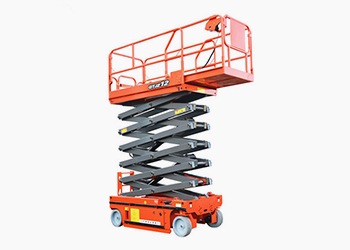
Key characteristics: Powered by battery-driven electric motors, zero exhaust emissions during operation, extremely low noise (approx. 65-75 dB). Flexible movement, simple operation, low maintenance cost. Ideal choice for indoor and crowded areas.
Typical parameters:
Maximum platform height: 6 - 12 m
Load capacity: 227 - 680 kg
Endurance: 8-10 hours of continuous work on a single charge
Construction application scenarios:
Interior finishing: installation of ceilings, lighting fixtures, fire sprinklers, air conditioning vents in shopping malls, office buildings, hotels.
High-standard environments: maintenance work in hospitals, laboratories, data centers with strict requirements for cleanliness and quietness.
MEP work: installation and inspection of mechanical, electrical, and plumbing systems, cable routing.
Decision advice: The absolute first choice for indoor work. In enclosed spaces, where environmental protection is required, or where noise interference must be avoided during fine construction, electric scissor lifts have an irreplaceable advantage.

Core logic: powerful capability on complex terrain
Key characteristics: Enhanced and upgraded from diesel or electric scissor lifts, typically equipped with four-wheel drive, large off-road tires, high ground clearance, and oscillating axles. Strong climbing ability (up to 45°) and bump resistance, can drive and operate stably on dirt slopes, grass, and potholed surfaces.
Typical parameters:
Maximum working height: 6 - 18 m
Platform capacity: 450 - 1130 kg
Construction application scenarios:
Unhardened ground construction: earthwork stage, landscaping, hillside building projects.
Complex terrain projects: exterior construction of mountain resorts, hillside villa clusters.
Comprehensive construction sites: material transport and aerial work on large integrated sites requiring frequent crossing of trenches and rubble piles.
Decision advice: When site ground conditions are harsh and uneven, making it difficult or risky for ordinary equipment to move, a rough terrain scissor lift must be used to ensure work safety and efficiency.

Core logic: fixed installation + frequent lifting
Key characteristics: No traveling mechanism, must be fixedly installed in a specific location (e.g., pit, production line side, or loading dock) using anchor bolts or embedded parts. Driven by hydraulic system or electric screw, smooth lifting, high positioning accuracy. Can be designed for extra-large loads and custom platform sizes, suitable for continuous, frequent vertical transport. Long maintenance interval, long service life.
Typical parameters:
Maximum platform height: 2 - 8 m (can be higher with non-standard design)
Load capacity: 500 - 5000 kg
Requires prepared foundation and power supply
Construction application scenarios:
Factory assembly lines: material or personnel lifting between workstations in automotive, home appliance production lines.
Warehouses and logistics: vertical transport of goods on multi-story racks, height adjustment at loading docks.
Building ancillary facilities: theater lift stages, pit-type lifting equipment in maintenance workshops.
Decision advice: Suitable for locations requiring long-term, fixed-position frequent vertical lifting. Not suitable for scenarios needing mobility. When selecting, focus on load capacity, travel distance, platform size, and safety devices (e.g., fall prevention, anti-pinch devices).
| Key Requirement | Priority Recommendation |
|---|---|
| Frequent relocation, multi-point work, needs towing | Towable scissor lift |
| Soft muddy ground, lawn protection, climbing | Crawler scissor lift |
| Indoor, environmental, low noise, fine work | Electric scissor lift |
| Muddy, sloping, complex rugged terrain | Rough terrain scissor lift |
| Fixed station, heavy load, frequent vertical lifting | Stationary scissor lift |
Final Advice: In actual large-scale projects, it is often necessary to combine multiple types of scissor lifts according to different construction phases and work surfaces. When selecting, comprehensively consider five core factors: working height, load capacity, ground conditions, power source, and environmental requirements. Always prioritize operator safety training, pre-operation equipment inspection, and strict compliance with aerial work safety regulations.
Q1: For indoor work, how to choose between electric scissor lift and diesel scissor lift?
A: You must choose an electric scissor lift. Diesel engines produce large amounts of harmful exhaust (e.g., carbon monoxide) that quickly accumulate in poorly ventilated indoor spaces, causing poisoning and fatal danger. In addition, the noise and vibration of diesel engines are far greater than those of electric units. Therefore, diesel-powered equipment is strictly prohibited for indoor work. (Note: If using a crawler scissor lift, pay attention to its power type as well; for indoor use, choose an electric crawler model.)
Q2: Is there an "all-purpose" scissor lift that can be used both indoors and outdoors on muddy ground?
A: There are "hybrid" or "all-terrain" models available, such as the rough terrain electric scissor lift. It combines the environmental and quiet characteristics of electric equipment with the four-wheel drive and large tires for off-road capability, making it suitable for a wide range of scenarios from indoor workshops to light unhardened outdoor ground. It is a highly adaptable choice. However, for extremely harsh muddy terrain, high-power diesel rough terrain scissor lifts or crawler scissor lifts remain more reliable options.
Q3: What are the main differences between a scissor lift and a self-propelled aerial work platform (e.g., boom lift)?
A: The main difference lies in mobility range and flexibility.
Scissor lift: Can only perform strict vertical lifting, cannot move the work platform laterally in the air. Advantages are stable structure, high load capacity, large platform area, suitable for large-area, heavy-load work at a fixed point.
Self-propelled boom lift: Has telescopic and articulating arms that allow the work platform to move forward/backward, up/down, and rotate 360 degrees in the air, and can cross certain obstacles. Suitable for flexible, multi-point work in complex spaces, but platform area and load capacity are typically smaller than scissor lifts.
Simply put, a scissor lift is a "vertical elevator," and a boom lift is an "aerial crane."
Q4: How do the prices of different types of scissor lifts compare? What should be considered when budgeting?
A: Approximate purchase price ranges (USD) for new equipment, from low to high:
Stationary scissor lift: from approx. $2,500 (2 m lift height, 1 ton load capacity, excluding civil works and installation)
Towable scissor lift: from approx. $1,500 (6 m lift height, no self-propelled power)
Electric scissor lift: from approx. $4,500 (6 m lift height, self-propelled, mainstream indoor model)
Crawler scissor lift: from approx. $5,000 (6 m lift height, rubber tracks, can handle muddy ground)
Rough terrain scissor lift: from approx. $9,000 (6 m lift height, large tires, complex terrain)
These are rough reference prices for new products. Higher specifications (greater height, load capacity, lithium batteries, etc.) will increase the price accordingly.
Budgeting advice:
Do not look only at the purchase price. Consider the total cost of ownership (purchase + transport + energy + maintenance + labor efficiency).
>How many hours is a scissor lift good for?
Contact our team today for a customized quote, factory price, and fast global delivery.
We help you lift smarter — safely, efficiently, and affordably.
Email: info@cnsinolift.com