Can a scissor lift be used on grass? The answer is yes, but strict conditions must be met.
Whether it is a scissor lift or other personnel lifts or aerial work platforms, grass cannot be treated like ordinary hard ground.
The grass surface may look flat, but in reality it often has these problems: soft soil, unstable moisture content, uneven load-bearing capacity, and may even hide irrigation pipes, tree roots, or backfilled areas. If equipment is driven onto the grass without preparation and then raised or subjected to eccentric loads, it is prone to sinking, slipping, tilting, or even overturning.
Therefore, the core problem this article addresses is not whether a scissor lift can be used on grass, but how to make a scissor lift work safely, stably, and efficiently on grass.
Many customers think that grass is just a bit softer than concrete, so it should be fine.
But from field experience, the biggest difference between grass and concrete is not "softness", but whether the support is stable.
Concrete ground provides continuous, uniform, predictable support.
Grass ground typically has several distinct characteristics:
The surface looks firm, but underneath may be loose.
Moisture content changes greatly; load-bearing capacity drops significantly after rain.
Load-bearing capacity varies greatly across different spots on the same grass area.
Equipment weight is concentrated on a few points like tires or outriggers, creating very high ground pressure.
This is why many machines look fine when first driven on, but problems start as soon as the platform rises. It's not that the machine suddenly becomes heavier, but that the soft ground becomes unstable as the center of gravity shifts.
Core understanding: Working on grass is not a question of "can the machine drive onto it", but "can the ground continuously support the machine".
Therefore, the truly effective approach is not to gamble on luck, but to use outrigger pads, low-speed operation, and site inspection to temporarily turn the grass into a more reliable support surface.
Not all scissor lifts are suitable for grass. If you choose the wrong equipment, no amount of later remediation will reduce the risk.
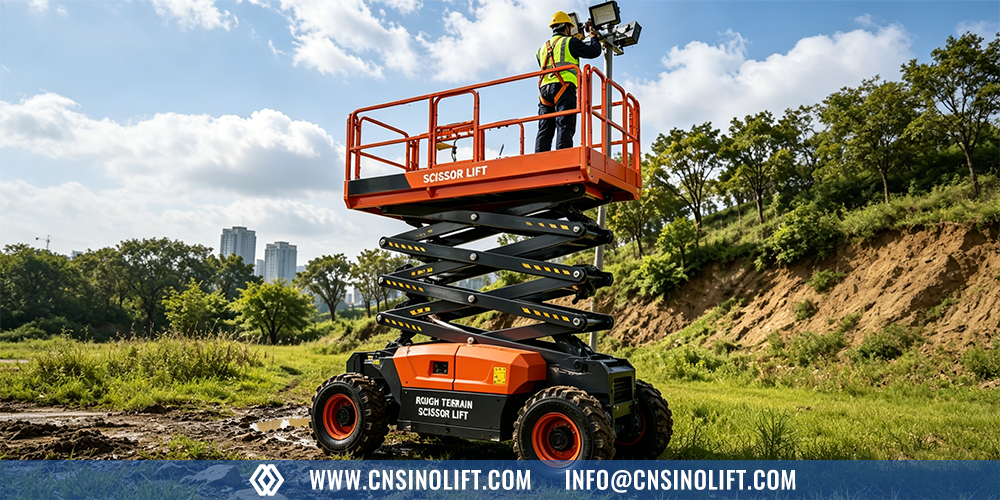
If the working environment is mainly grass, mud, gravel, or other outdoor surfaces, a rough-terrain scissor lift is an option.
Such equipment generally features:
Large-diameter tires
Four-wheel drive
Higher ground clearance
Better flotation
Better suited for complex outdoor terrain
For grass, the advantage of this type of aerial work platform is that its ground contact method is better for soft ground, and stability is higher.
They can be used on grass, but not just driven on and worked immediately.
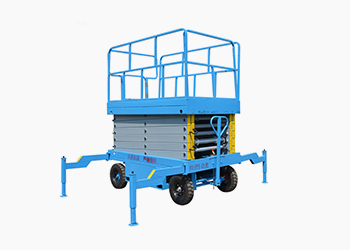
Compared to standard electric scissor lifts, those with outriggers have certain advantages: once the outriggers are deployed, they can distribute part of the load and improve overall machine stability, especially at medium to high working heights.
However, even such machines usually have narrow tires and relatively high ground pressure. They are inherently better suited for flat, hard surfaces. If driven directly onto grass without using outriggers or pads, problems can still occur:
Damaged grass
Localized sinking
Tilting when raised
If you must use an electric scissor lift with outriggers, at least these conditions should be met:
The grass is relatively firm.
All outriggers must be fully deployed and placed on pads of sufficient area (outrigger feet cannot bear directly on the grass).
Continuous pads are laid in advance for the tires to travel on.
Load is controlled within 80% of rated capacity.
The machine is always kept low and moved slowly.
Continuous observation of ground changes before, during, and after work.
Key reminder: Outriggers improve stability but do not replace pads. When outriggers are deployed, the machine's weight concentrates on a few support points. If the outrigger feet are not fitted with large-area pads (wood, steel, or dedicated outrigger mats), the point pressure becomes even greater, increasing the risk of sinking.
Some tracked scissor lifts can be equipped with outriggers. This combination has clear advantages on grass, soft ground, garden edges, and similar conditions.
Tracked lifts have large ground contact area and low ground pressure, causing far less damage to grass than wheeled machines. With outriggers added, stability improves further, making them especially suitable for higher working heights or gently sloping grass areas.
For many customers, this is not a minor detail—it directly determines whether they can access certain outdoor sites.
But be clear:
Key reminder (same as above): Outriggers improve stability but do not replace pads. When outriggers are deployed, the machine's weight concentrates on a few support points. If the outrigger feet are not fitted with large-area pads, point pressure increases and the risk of sinking rises. Although the tracks themselves have low pressure, the outrigger positions still need separate treatment.
If the site has any of these conditions:
Permanently wet, soft grass
Obvious slopes
Complex underground structures
High grass protection requirements
Impossible to lay a continuous path of pads
Then, besides scissor lifts, consider:
Spider lifts (tracked aerial platforms)
Truck-mounted aerial work platforms
In some projects, switching equipment is more professional and safer than forcing a scissor lift.
Many accidents do not happen at height, but before the machine has even fully entered working condition.
Therefore, before any scissor lift or other aerial work platform enters the grass, it is advisable to do a simple but effective on-site assessment.
| Check item | What to focus on | Risk indicator |
|---|---|---|
| Soil hardness | Foot test, shovel test – obvious sinking | Sinking >3–5 cm = high risk |
| Underground hazards | Irrigation pipes, backfill, tree roots, voids | High risk of localized collapse |
| Weather & moisture | After rain, just watered, dry surface but wet inside | Significant drop in load-bearing capacity |
| Overhead space | Power lines, branches, light poles, signs | High risk of collision when raised |
The simplest method is to step on it or use a shovel.
If the surface is soft underfoot, or if sinking is already noticeable, do not treat it as normal supporting ground.
A more practical criterion:
If after stepping or pressing with a tool, the ground sinks more than 3–5 cm, do not operate directly on it.
Common hidden hazards under lawns include:
Irrigation pipes
Cables
Drainage ditches
Old tree roots
Backfilled areas
Decayed flowerbed edges
These areas may look normal on the surface, but problems appear when equipment drives over them.
Many cases of "sudden sinking" are not due to the entire lawn being too soft, but hitting a localized weak zone.
Be cautious right after rain, just after watering, or after consecutive cloudy days.
Because lawns often have a dangerous state: the surface looks dry, but the inside is actually very wet.
Key reminder:
Do not perform aerial work on grass within 24 hours after rain.
Even if the surface looks recovered, re-test the hardness before bringing in equipment.
Many people overlook this, but it is critical in real-world sites.
In lawn scenarios, the most common overhead obstacles are not factory beams, but:
Power lines
Tree branches
Light poles
Edges of signs
Eaves of canopies
Therefore, before raising any scissor lift or other aerial work platform, you must first look up and check the overhead space.
A safer practice is: test-raise about 1 meter to confirm no contact with wires or trees, then continue raising.
If only one core action is kept in this entire article, it is this: lay pads.
Regardless of whether you are using a rough-terrain scissor lift, a tracked scissor lift, or an electric self-propelled scissor lift with outriggers, as long as you enter a grass scenario, outrigger pads are not an optional extra – they are a fundamental requirement.
Because tires and outriggers have small contact areas with the ground, the equipment's weight is concentrated, resulting in high point pressure.
This directly leads to several consequences:
Grass is crushed
Tires slowly sink
Outriggers become unevenly loaded
Chassis loses level
Increased sway at height
Many accidents do not happen as soon as the equipment drives onto the grass, but when the platform is halfway up and the machine begins to tilt slightly.
It is this kind of "slowly tilting" situation that is most easily ignored.
Understand it by work intensity:
Light load, short-term work: 18–20 mm+ plywood or OSB boards, with wooden beams underneath for rigidity.
Medium to heavy load or frequent work: 30 mm+ steel plates, high-strength composite pads, dedicated outrigger mats.
When grass protection is important: Add old carpet, anti-grass mats, or anti-slip buffer layers under the boards.
Many people just temporarily put two boards under the tires—this is usually insufficient. A better approach:
Lay pads in the parking area.
Also lay pads along the travel path.
Try to form a continuous "temporary road".
Fix boards together where possible to prevent shifting.
Use larger area pads under outriggers.
Key conclusion:
The purpose of outrigger pads is not just to "pad" something, but to turn point pressure into surface pressure.
Only by temporarily turning the grass into a relatively continuous and stable force-bearing surface can the equipment have a better chance of standing safely.
This section is closest to what users really want to search for. Customers don't just want theory; they want to know: once on site, what is the correct sequence?
Whether it is a rough-terrain scissor lift, a scissor lift with outriggers, or any other personnel lift or aerial work platform, in a grass environment the ground must be prepared before the machine enters.
First plan the main travel path, parking spot, and outrigger placement points, then lay pads. If the machine has outriggers, place extra larger support pads under them.
Do not skip this or rush it.
Keep the platform at minimum height.
Drive very slowly.
Have a ground guide if possible.
Avoid sudden stops, sharp turns, or aggressive steering.
Grass is inherently unstable under changing forces; fast actions only magnify the risk.
Once the machine is in place, check several key points:
Have the pads shifted?
Is the ground continuing to sink?
Are all outriggers fully deployed and locked?
Is the chassis level?
Is the emergency stop functional?
Is the operator wearing a harness?
Are there overhead obstacles like wires or branches?
Key reminder:
Safety harness must be worn, and overhead space must be confirmed.
Once formal aerial work begins, do not use "the working height is not very high" as a reason to skip protective measures.
On grass, the safest practice is not to raise all the way at once, but to verify in stages.
Recommended procedure:
Raise to 1–2 meters.
Stop and observe if the machine shakes, makes abnormal noise, or tilts.
Re-check the tires, pads, or outrigger condition.
If no issues, continue raising.
This allows you to detect risks as soon as they appear, rather than dealing with them at height.
In a grass environment, the real danger is not just weight, but center-of-gravity shift and lateral moments.
For example, avoid these actions:
Multiple people crowding on one side of the platform.
Tools stacked at the edge.
Using the platform to push or pull objects.
Leaning too far out of the guardrails.
Forcibly adjusting position while at height.
Safer practices:
Keep tools in the middle of the platform.
Distribute personnel evenly.
Tie down tools to prevent falling.
If sway occurs, lower immediately and inspect.
Do not change the route arbitrarily when finishing.
It is best to exit along the original path that has already been padded or compacted, to avoid further sinking and reduce damage to the grass.
The following problems are the most common risk signals in lawn work.
| Risk situation | Typical performance | Handling method |
|---|---|---|
| One-sided sinking | Chassis tilts, level alarm | Stop operation immediately, slowly lower platform |
| Wet/slippery grass | Tires slip, braking degrades | Stop moving, wait for ground to dry |
| Local collapse | Abnormal sinking, unusual noise | Evacuate all personnel, re-lay support surface |
| Sway at height | Platform wobbles, unstable | Lower height, re-inspect ground |
| Overhead collision risk | Power lines, branches too close | Immediately stop raising, adjust position |
Handling principle:
Do not tough it out, and do not gamble on "it should be fine."
Once grass ground begins to destabilize, the subsequent risks usually only get larger.
Not recommended.
Even if the grass surface looks relatively hard, there may be soft soil layers, irrigation pipes, voids, or tree roots. The safer approach is to first inspect the ground, then lay outrigger pads, and prefer a rough-terrain scissor lift.
Yes, but with stricter requirements.
Ordinary electric scissor lifts are better suited for indoor flat surfaces. If you must use one on grass, it must be accompanied by outrigger pads, slow movement, and load control. Some electric self-propelled scissor lifts can be optionally equipped with outriggers, which helps.
Yes.
A hard grass surface does not mean the overall support is stable. Laying pads is one of the most basic and effective safety measures for lawn work – do not skip it.
It might.
If tires or outriggers press directly on the grass, it can easily cause depressions and root damage. Using outrigger pads, controlling loads, and reducing dwell time can significantly reduce damage.
Yes, but the risks are different.
The problem with ceramic tile floors is not sinking, but slipping and local cracking. If the tile surface is wet, tires may lose traction; if there are hollow spots underneath, they may crack under heavy loads. A safer approach is to lay rubber mats, plywood, or other cushioning materials under the tires or outriggers, while avoiding sudden stops and sharp turns.>Can You Use an Electric Scissor Lift on Tile Without Causing Damage?
Generally not recommended immediately after rain.
After rain, the lawn's load-bearing capacity drops significantly, and the most dangerous situation is when the surface looks normal but the inside is very wet. It is recommended to wait at least 24 hours, then re-test the ground hardness.
First, test with no load at low speed, observing tire marks and ground sinking.
If the marks are obvious, or sinking exceeds 3–5 cm, it indicates high risk – you must add more outrigger pads, or directly adjust the equipment and work plan.
Having worked with this type of equipment and field applications for a long time, I am increasingly convinced of one thing:
Many risks do not come from complex conditions, but from the phrase "it should be fine."
I once witnessed a site where the customer felt the grass had been drying for several days and should be hard enough, so they wanted to drive an electric scissor lift directly onto it.
When the equipment first went in, nothing seemed abnormal. But after the platform was raised, one side of the tires began to slowly sink. Not suddenly – just a very slight tilt. It's this kind of slow change that is most easily ignored. Later, we quickly lowered the platform and avoided a bigger problem.
Since then, I have a fixed habit:
As long as it's not a concrete surface, I assume there is risk.
Another lesson is to always check overhead.
Many people will repeatedly check the grass, but forget about branches, power lines, and light poles above. By the time you raise the platform and notice an obstacle, your maneuvering room is very small. Now, before every raise, I test-raise a little first, then confirm no obstacles above.
Safety harnesses are the same.
Some people think that raising just two or three meters means they don't need to wear one. But the worksite never follows feelings. The more you think a situation is fine, the easier it is to overlook something. As long as it's formal aerial work, I would rather overdo the protection than gamble on a moment of complacency.
Working on grass is not impossible for scissor lifts, but you must: reduce ground pressure, improve stability, and control risk. These three steps are key:
Equipment selection – Rough-terrain models first. Standard electric models can be used but with more caution; consider optional outriggers if needed.
Ground treatment – Pads are not an add-on; they are a core measure. Whether you can distribute pressure determines the lower limit of safety.
Operating procedure – Low-height travel, slow movement, staged raising, dynamic checks, plus harness and overhead wire/tree inspection – none can be missing.
If your site involves slopes, waterlogged areas, permanently soft grass, or if you are unsure which equipment to choose, the safer approach is not to just try it, but to do equipment matching and work planning based on the actual site conditions.
>How many hours is a scissor lift good for?
Contact our team today for a customized quote, factory price, and fast global delivery.
We help you lift smarter — safely, efficiently, and affordably.
Email: info@cnsinolift.com