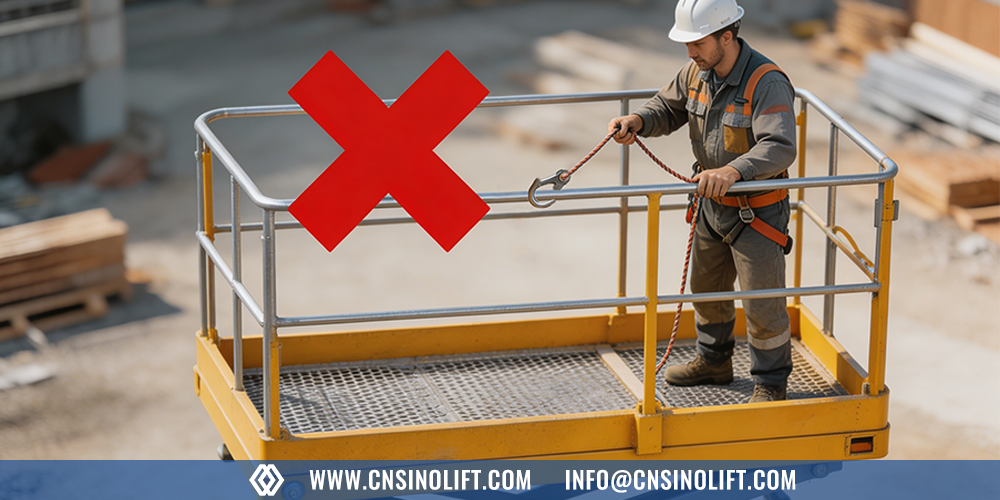
Under the current (2026) OSHA standards, if the scissor lift's guardrails are intact and operation is proper, a harness is not mandatory. However, a full‑body harness with a fall restraint system must be worn when guardrails are missing or damaged, when there are additional risks such as tip‑over or collision, or when company/regulatory requirements explicitly demand it. This is one of the most debated questions in the aerial work sector.
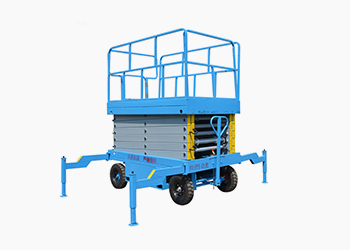
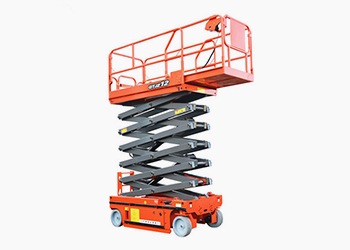
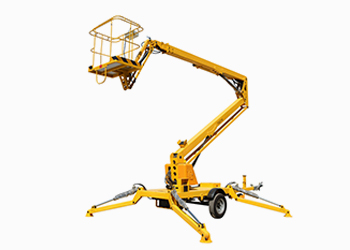
One of the most persistent sources of confusion is the classification of scissor lifts under OSHA regulations. Scissor lifts (also known as hydraulic lifting platforms) differ from boom‑type aerial work platforms in several inherent safety advantages:
Vertical movement only, no lateral sway – The platform moves straight up and down, unlike boom lifts that can swing and throw a person off.
Fully enclosed guardrail system – Standard guardrail height is no less than 1.1 m (approx. 44 inches), providing a physical barrier.
Low center of gravity design – Wide chassis, low center of gravity, relatively good resistance to overturning.
Because of these features, OSHA classifies scissor lifts as "mobile scaffolding" rather than "aerial work platforms." Under OSHA 1926.451(g)(1), when guardrails are properly designed and well maintained, they alone are considered adequate fall protection – meaning a harness is not mandatory under standard conditions.
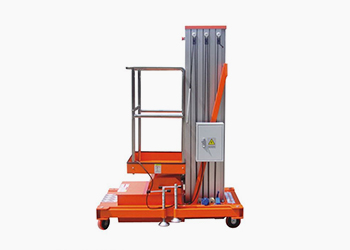
Equipment comparison note: Compared to aluminum alloy mast lifts (single‑mast or twin‑mast), scissor lifts have a larger platform area, higher load capacity, and more complete guardrails, providing a higher baseline level of protection under standard conditions. However, aluminum alloy mast lifts, being lightweight and having relatively lower guardrails, are more often recommended for full‑time harness use in most work scenarios. If you are sourcing compact indoor man lifts, you can view our mast lift product series for reference.
A harness is not required by OSHA only when all of the following conditions are met simultaneously:
Platform guardrails are complete, undamaged, properly installed, and meet OSHA strength criteria (toprail: 200 lbs minimum) – no damage, missing parts, looseness, or unauthorized modification
Work posture remains entirely within the guarded platform area – no leaning over, climbing on, or reaching beyond guardrails
Ground is flat, solid, and level – no slope, subsidence, or slipping hazard
Indoor or low‑wind environment, no risk of collision with forklifts or other vehicles
No use of ladders, boxes, or other objects to increase working height, no overload
OSHA's scaffold standard (1926.451) requires fall protection when workers are 10 feet or more above a lower level—and compliant guardrails alone satisfy that requirement.
Even when these conditions are met, OSHA still recommends using a harness as redundant protection, and most leading companies have incorporated "full‑time harness use" into their internal safety rules.
In practice, "standard conditions" are often only theoretical. A harness must be used in the following situations:
| Scenario | Risk rationale / Regulatory Basis |
|---|---|
| Guardrails missing, damaged, or temporarily removed | Primary protection is compromised; PFAS required |
| Leaning out of the guardrail to work | Worker has left the protected zone |
| Ladders, boxes, or other objects placed on the platform to increase height | Guardrail effectiveness is negated |
| Uneven, sloped, or soft ground | Equipment could tip over, throwing the occupant |
| High outdoor wind speeds | Wind load affects platform stability |
| Forklifts or vehicles moving nearby | Impact could cause loss of balance and ejection |
| Working near floor edges, openings, or other leading edges | Fall consequences are severe, requiring redundant protection |
| Company/site safety rules explicitly require a harness | Compliance takes precedence over minimum standards |
| Equipment manufacturer's manual requires a harness | Manufacturer requirements must be followed first |
Core judgment: Is there any possibility of being thrown out of the platform? If yes, a harness is mandatory.
On a scissor lift, you must use a Fall Restraint System, not a Fall Arrest System.
Fall Restraint: Uses a short lanyard (≤ 0.6 m / approx. 2 ft) that prevents you from reaching a position where you could fall. This is the preferred and safer choice for scissor lifts.
Fall Arrest: Allows some free fall distance before stopping you. But on a scissor lift, the available fall distance is too short – the energy absorber cannot deploy in time, and the shock load can be severe and cause injury.
Correct practice: Full‑body harness + short restraint lanyard + platform‑specific anchorage point.
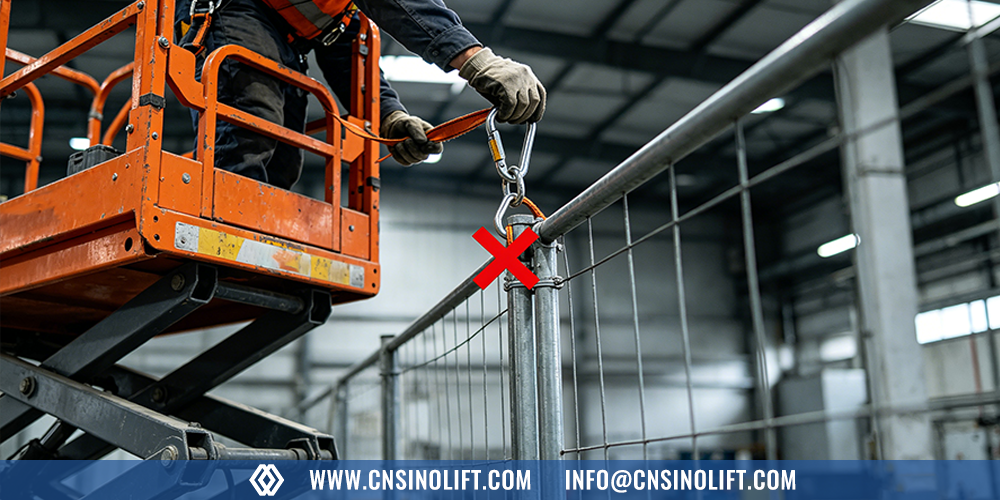
Hooking directly onto a guardrail?
Wrong – and seriously wrong. Guardrails are designed to prevent falls, not to withstand fall arrest forces. There are numerous accident cases where a guardrail bent or broke during a fall, and the person fell with the harness still attached.
Correct anchorage points (OSHA Requirements):
Manufacturer‑designated anchorage point (D‑ring) inside the platform – minimum 5,000 lbs per person
Not acceptable: guardrail horizontal members, hydraulic arms, door frames, cable trays
External building structures (building columns, pipes, etc.) – never use these, as they cause secondary injury during tip‑over or movement
Equipment selection tip: When purchasing a scissor lift or aluminum alloy mast lift, always confirm whether it is equipped with a designated anchorage point (D‑ring). Some economy‑model hydraulic lifting platforms do not come standard with anchorage points – you must verify with the supplier or request installation. This is a hard prerequisite for OSHA compliance.
| Common misconception | Fact |
|---|---|
| Wearing a harness is always safer | Incorrect use or poor anchorage can increase injury risk. Attaching to a guardrail – if the guardrail breaks, you suffer secondary impact. An improperly adjusted harness creates greater impact forces. |
| Fall arrest is better than fall restraint | On a scissor lift, fall distance is extremely short – an arrest system's energy absorber cannot deploy in time and may cause secondary impact. Fall restraint is the safer, more compliant choice. |
| Never need a harness below 6 ft | OSHA's 6‑ft rule is a general requirement. For scissor lifts, the key criteria are guardrail condition and risk level. A high proportion of fall accidents occur at 2–4 m (approx. 6.5–13 ft) – low height does NOT equal zero risk. |
| Harness inspection once a year is enough | OSHA requires inspection before each use. Any wear, tear, buckle failure, webbing aging must result in immediate replacement. |
Employer responsibilities:
Ensure operators complete OSHA‑compliant training and are certified.
Maintain equipment in safe operating condition; repair guardrail defects promptly.
Assess site risks and develop a fall protection plan.
Provide qualified personal protective equipment and train on correct use.
Keep training, inspection, and maintenance documentation for audit purposes.
Operator responsibilities:
Complete compliant training and pass competency assessment before operating independently.
Inspect guardrails, platform, controls, and harness before each use. Report any defect immediately and stop work.
Strictly follow OSHA standards, company policies, and site requirements.
Never climb guardrails, lean out, add height with objects on the platform, or overload.
Current core standards (2026):
OSHA 29 CFR 1926.451 – Scaffolding safety standard (primary for scissor lifts)
OSHA 29 CFR 1926.502 – Fall protection standard (anchor capacity, full-body harness, free fall limits)
ANSI A92.22 & A92.24‑2018 – MEWP design, training, and safety requirements (current for 2026; training must cover these)
OSHA penalties are severe. In 2026, a single serious violation can carry a maximum fine of $156,259. If a violation leads to a fatality, responsible individuals may face criminal prosecution.
Which is safer, a scissor lift or an aluminum alloy mast lift?
Are the guardrails on mobile elevating work platforms really sufficient?
Do I need to wear a harness on an indoor electric lift platform?
When can an aerial work platform be used without a lanyard?
Must a harness be worn on a scissor lift when working outdoors?
Can work continue if the platform guardrails are damaged?
Where should a harness be anchored on an aerial work platform? Can I anchor to the guardrail?
What is the difference between fall restraint and fall arrest?
How can a company develop safe operating rules for lifts? How to manage different risk levels?
Q1: At what height on a scissor lift must I wear a harness?
A: OSHA does not set a specific height threshold for scissor lifts under the scaffold standard. If guardrails are intact, a harness is not required regardless of height. If guardrails are ineffective, a personal fall protection system is required when working 10 ft (approx. 3 m) or more above a lower level.
Q2: Do I need to wear a harness on an indoor electric lift platform?
A: If indoors, on flat ground, guardrails intact, no collision risk, and proper work practices – OSHA does not require a harness. However, most large companies require full‑time use as redundant protection.
Q3: Can I anchor the harness on a self‑propelled lift to a nearby building structure?
A: Absolutely not. You must anchor to the manufacturer‑specified anchorage point on the platform itself. Anchoring to an external structure can cause a fatal secondary injury during tip‑over or movement.
Q4: Are harness requirements the same for aluminum alloy mast lifts and scissor lifts?
A: The core safety logic is the same. However, aluminum alloy mast lifts have smaller platforms, lower guardrails, and lighter construction – in practice, full‑time harness use is more strongly recommended, especially when working above 6 m (approx. 20 ft).
Q5: Must a scissor lift operator be certified?
A: Yes. OSHA requires completion of compliant training and competency assessment, with documentation retained. An online compliant course can be completed in about one hour.
Q6: Does a harness need to be worn while moving a hydraulic lift platform?
A: Yes. During movement or raising/lowering, even with intact guardrails, there is a risk of being thrown from the platform. OSHA strongly recommends – and most projects require – harness use during dynamic operations.
>What is the lifespan of a scissor lift?
>What is a disadvantage of a scissor lift?
>Do scissor lifts tip over easily?
>How many hours is a scissor lift good for?
Contact our team today for a customized quote, factory price, and fast global delivery.
We help you lift smarter — safely, efficiently, and affordably.
Email: info@cnsinolift.com
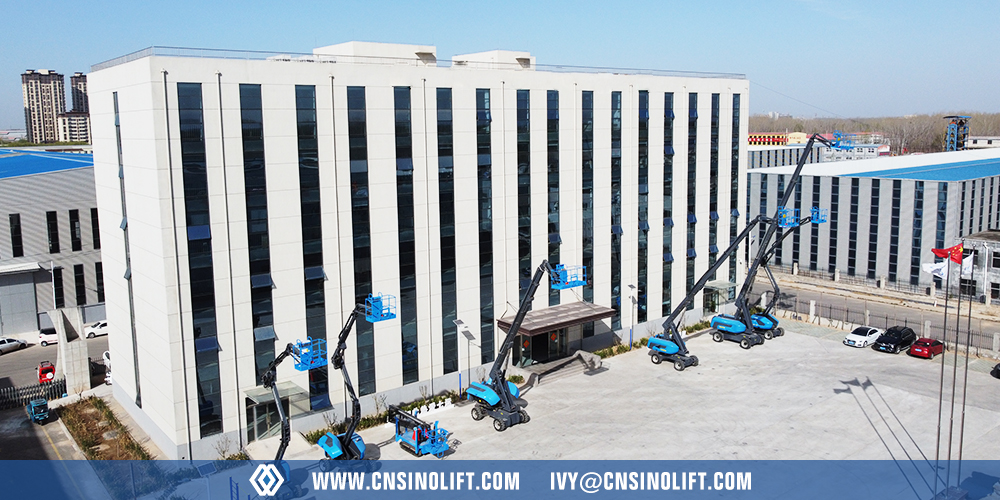
HENAN SINO LIFT is committed to providing customers with high‑quality and high‑performance industrial equipment. Over the years, we have adhered to technological innovation and product quality, earning the trust and support of our customers.
We manufacture Scissor Lift, Mast Lift,Boom Lift,Cargo Lift,Loading Ramp,Wheelchair Lift,Warehouse Handling Equipment. If you need these products, please let us specify a suitable solution for you.
We can provide detailed information on the various models and specifications and help you select the platform that best suits your specific needs.
Email: info@cnsinolift.com
Website: www.cnsinolift.com