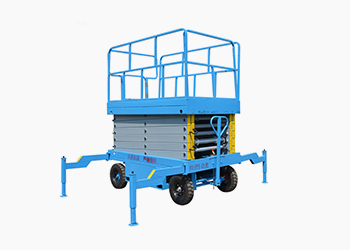
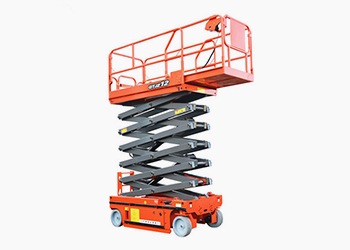
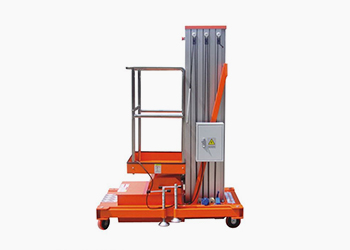
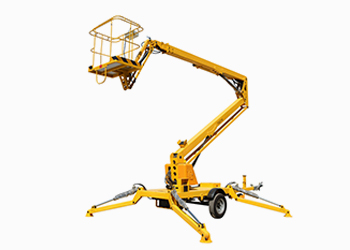
Scissor lifts (also known as scissor aerial work platforms, hydraulic lifting platforms) are widely used in building construction, plant equipment maintenance, warehouse rack access, indoor decoration, and airport/station facility repairs. As a core piece of equipment for vertical aerial work, their scissor structure stability and load capacity are highly recognized.
However, according to OSHA aerial work platform accident statistics and IPAF global safety incident reports, the accident rate involving scissor lifts remains high among various mobile elevating work platforms (MEWPs). In 2025 alone, the U.S. Occupational Safety and Health Administration recorded over 100 fatalities related to scissor lifts, with tip-over and fall-from-height accidents accounting for more than 75%.
Are scissor lifts dangerous? From a design principle perspective, scissor lifts are extremely reliable under normal working conditions. But when safety operating procedures are ignored, pre-operation inspections are inadequate, or maintenance intervals are delayed, the risk increases exponentially. So, what are the most common scissor lift accidents?
I. Four Typical Scissor Lift Accidents
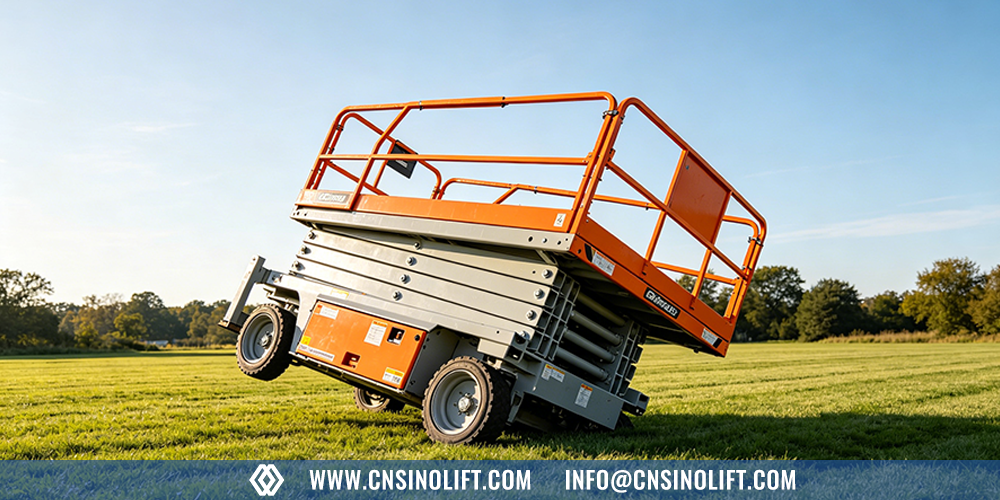
1. Scissor Lift Tip-over
Tip-over is the most severe type of safety accident involving scissor lifts, referring to the equipment overturning sideways or collapsing entirely when raised or moving, usually resulting in equipment scrappage and casualties.
Are scissor lifts prone to tipping over?
On flat, solid ground, the stability triangle design of self-propelled scissor lifts provides sufficient anti-tip-over moment. But when the platform is raised, the center of gravity shifts upward. If the ground slope exceeds the rated limit (usually 3°–5° for scissor lifts), lateral wind force, or dynamic inertia occurs, the stability threshold is breached, and the equipment may lose stability within seconds.
Main Causes
- Insufficient ground bearing capacity: Local subsidence caused by soft soil, uncompacted backfill, hidden sewer manholes, or suspended concrete floors.
- Illegal dynamic operation: Traveling, moving at height, sharp turns, or emergency braking while the platform is raised.
- Overloading and eccentric loading: Exceeding the rated load capacity or placing heavy materials concentrated on one side of the platform, causing center-of-gravity deviation.
- External environmental interference: Wind speed exceeding 12.5 m/s (approximately Beaufort scale 6) during outdoor operations, creating significant wind loads.
Related questions:
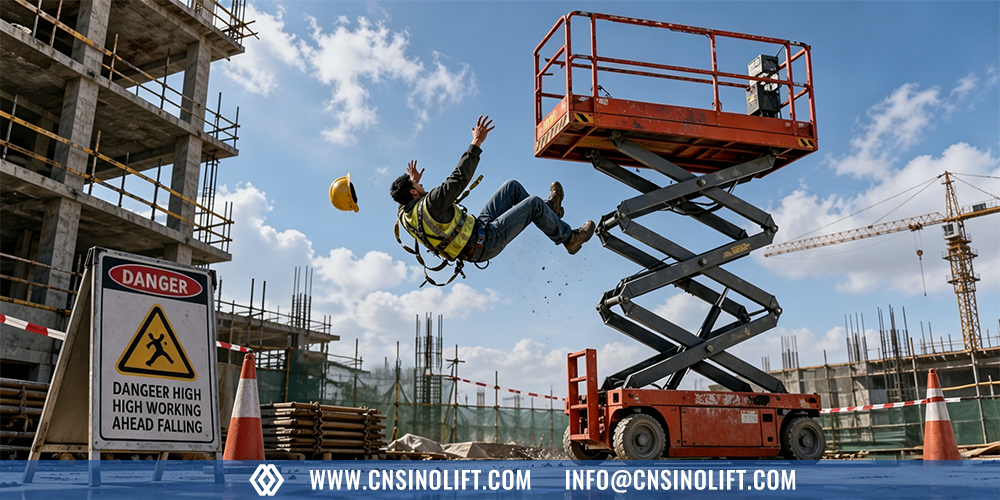
2. Fall from Scissor Lift
This type of accident involves operators falling over the guardrails of a scissor lift platform.
OSHA fall protection standards clearly state that most such incidents stem from unsafe behavior rather than guardrail structural failure.
Why do people fall from scissor lifts?
When operators stand on guardrails to gain extra height or lean excessively to expand their working radius, slight hydraulic settling of the platform or external collisions can lead to slips and falls.
Main Causes
- Illegal postures: Standing on scissor lift guardrails, leaning against guardrails while working, or using ladders or wooden boxes to gain height inside the platform.
- Failed protective devices: Unclosed platform access doors, damaged guardrail latches, or unreset extendable platforms.
- Lack of personal protective equipment (PPE): Failure to wear a full-body harness as required, or incorrect selection of harness anchor points (not fixed to manufacturer-specified anchor points).
- Sudden imbalance: Micro-movement of hydraulic cylinders, collisions with overhead obstacles, or accidental operation of the ground control box by ground personnel.
Related questions:
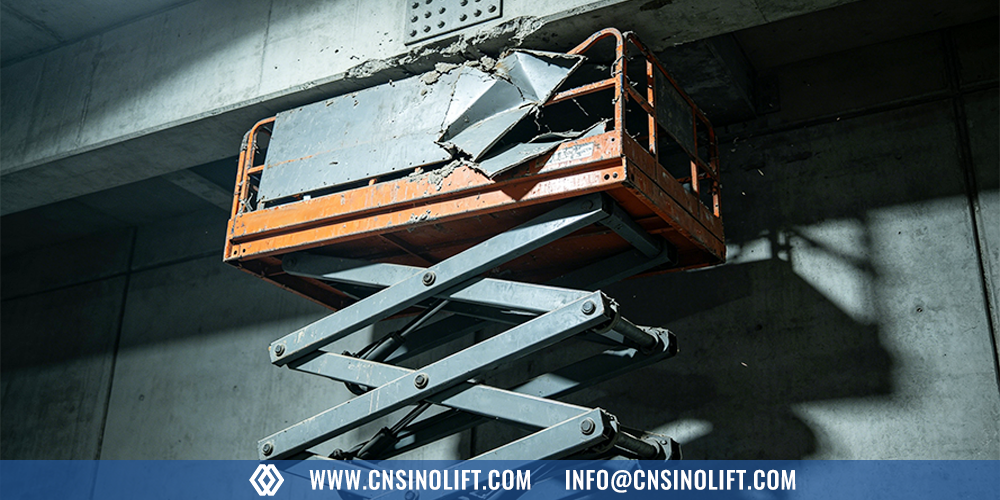
3. Crushing / Entrapment
Such accidents mostly occur in low-headroom environments such as high-altitude work in indoor warehouses, plant pipeline maintenance, and shopping mall atrium construction. Operators are trapped between the platform guardrails and overhead structures (fire sprinkler pipes, steel beams, ventilation ducts).
Main Causes
- Insufficient headroom assessment: Failure to measure the distance to overhead obstacles before operation, causing the top of the platform to hit concrete beams or pipeline supports during ascent.
- Operation in blind spots: Moving forward or reversing while raised without a ground observer or reversing camera system.
- Misjudgment of space: Failure to lower the platform height in advance when passing through low roller shutter doors or elevator lobbies.
Related questions:
4. Electrical & Mechanical Hazards
These involve electric shock, hydraulic system failure, or structural component fracture. Although accounting for a relatively low proportion, they can easily trigger catastrophic consequences such as free fall of the platform.
Main Causes
- Insufficient safe distance from high-voltage electricity: The platform fails to maintain the minimum safe approach distance from overhead high-voltage transmission lines (≥3 meters for below 10kV; greater distances required for above 35kV).
- Burst hydraulic pipelines: Aging and cracking of high-pressure oil pipes or loose joints causing oil leakage. The scissor lift’s explosion-proof valve (pipeline rupture valve) is the last line of defense to instantly lock the cylinder and prevent rapid platform descent.
- Lack of maintenance: Failure to perform daily inspections, quarterly maintenance, and annual safety testing of scissor lifts. Long-term lack of lithium-based grease lubrication leads to excessive wear of scissor arm pins, causing structural fatigue fracture.
- Water ingress into electrical systems: Short circuits and malfunctions of controllers with insufficient IP ratings when electric scissor lifts operate outdoors in rain or in humid environments.
Related questions:
II. Systematic Safety Prevention System
Accident prevention requires a closed-loop system covering intrinsic equipment safety, operator certification, on-site risk control, and full-life-cycle maintenance.
1. Equipment Selection and Core Safety Configurations
Selecting the right model according to working conditions is the first step to controlling risks at the source.
Power Type Selection
- Electric scissor lifts: Zero emissions, low noise, equipped with non-marking solid tires, suitable for epoxy floor workshops, shopping malls, and food and pharmaceutical warehouses.
- Rough-terrain scissor lifts: Four-wheel drive, high ground clearance, equipped with automatic leveling outriggers, suitable for construction sites, mine maintenance, and municipal garden pruning.
- Crawler scissor lifts: Suitable for soft terrain such as mudflats or grasslands.
Essential Safety Devices Checklist
- Tilt alarm system: Real-time monitoring via angle sensors, with audible and visual alarms and automatic cut-off of lifting actions when exceeding limits.
- Pothole protection device: Mechanical connecting rods or electronic sensors to prevent front wheels from falling into potholes and causing rear overturning during travel.
- Overload sensing system: Inoperative control handle and audible alarm when load exceeds limits.
- Emergency descent manual pump: Safe platform lowering via manual hydraulic pump in case of total power failure.
2. On-site Operation and Environmental Control
- Confirm foundation bearing capacity: Measure with a level to ensure compliance with the allowable slope of the scissor lift.
- Set up operation warning zones: No unauthorized personnel allowed within 3 meters of the platform projection radius to prevent impact from falling objects.
- Monitor weather and environment: Immediately lower the platform and move to a sheltered area in case of strong winds, rainstorms, or lightning warnings.
3. Operator Qualification and Standards
- Certification requirements: Operation of MEWP aerial work platforms requires a special equipment operator certificate or IPAF PAL card training.
- Prohibited Behaviors:
- It is strictly forbidden to relocate while raised (unless the equipment is equipped with active movement control functions).
- It is strictly forbidden to use scissor lifts as cranes (for lifting heavy objects).
- It is strictly forbidden to bypass limit switches or short-circuit safety circuits.
III. Frequently Asked Questions About Scissor Lifts
Q1: What is the most common type of scissor lift accident?
A: Statistics show tip-overs and falls from height. The former is mostly caused by poor ground conditions or illegal travel while raised; the latter mostly results from not wearing a harness or standing on guardrails.
Q2: Is slight shaking or settling of the platform normal when a scissor lift is raised?
A: Extremely slow natural settling (a few millimeters per hour) of a stationary platform is a normal pressure-retaining characteristic of the hydraulic system. If obvious shaking or accelerated settling occurs, stop the machine immediately to check the hydraulic oil level and cylinder seal, and contact a professional technician.
Q3: How to choose a scissor lift for narrow aisle operations?
A: Focus on the overall width of the equipment. For standard single doors (approx. 0.9–1 meter), narrow or mini scissor lifts should be selected. Also confirm whether the stowed platform height can pass through basement entrances or elevator cars.
Q4: Can electric scissor lifts be used outdoors?
A: Pure electric scissor lifts are only suitable for indoor flat hardened floors or outdoor plazas without standing water. For operations on grass, mud, sand, or slopes, rough-terrain scissor lifts must be used; otherwise, vehicle sinking and tipping are highly likely.
Q5: Is wearing a harness mandatory when working on a scissor lift platform?
A: Yes. OSHA 1926.453 standards require wearing a full-body harness with the lanyard secured to a dedicated platform anchor point. A harness is the last line of defense against falls caused by collisions or sudden tilting.
IV. That Harness Saved My Life
One day I was replacing overhead lights in a warehouse. I was lazy and moved the lift without lowering the platform, with one foot resting on the guardrail. When the front wheel jolted over a ground expansion joint, my whole body was thrown toward the guardrail, with my upper body fully leaning out. The harness was the only thing that held me back. If I hadn’t worn the harness that day, or had clipped it randomly to the guardrail, the consequences would have been unthinkable.
V. Conclusion: Standard Operation Is the Greatest Efficiency
Scissor lift accidents are not random events—they are the inevitable result of management loopholes and illegal operations. For equipment lessors, construction managers, and individual operators alike, zero-accident aerial work can only be achieved by integrating safety technical specifications into every lift and movement.
For equipment users, choosing a high-safety-standard scissor lift equipped with tilt protection, explosion-proof valves, and overload alarms, combined with a strict pre-operation inspection system, is a dual investment in ensuring construction schedules and personnel safety.
>What is the lifespan of a scissor lift?
>How many hours is a scissor lift good for?
Contact our team today for a customized quote, factory price, and fast global delivery.
We help you lift smarter — safely, efficiently, and affordably.
Email: info@cnsinolift.com
About HENAN SINO LIFT CO.,LTD:
HENAN SINO LIFT is committed to providing customers with high-quality and high-performance industrial equipment. Over the years, we have adhered to technological innovation and product quality, earning the trust and support of our customers.
We manufacture Scissor Lift, Mast Lift,Boom Lift,Cargo Lift,Loading Ramp,Wheelchair Lift,Warehouse Handling Euipment, If you need these products, please let me specify a suitable solution for you.
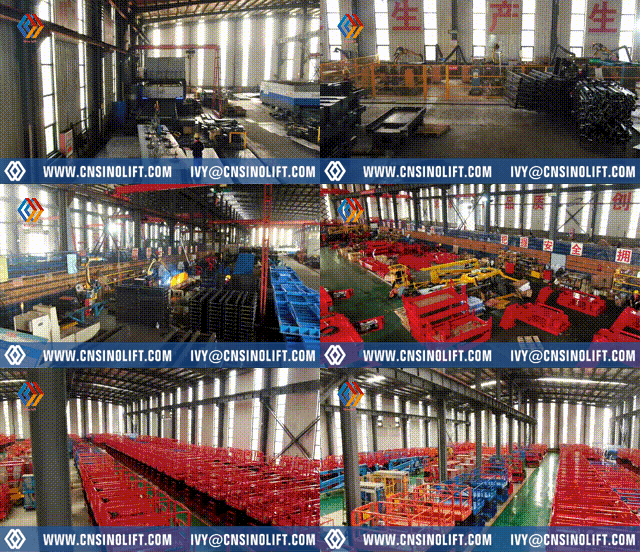 We can provide detailed information on the various models and specifications and help you select the platform that best suits your specific needs.
Email: info@cnsinolift.com
Website: www.cnsinolift.com