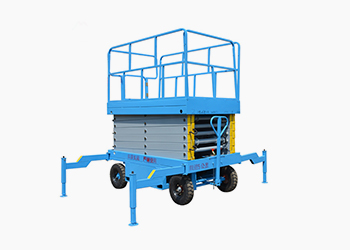
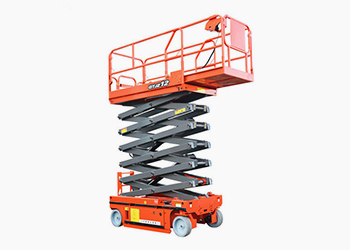
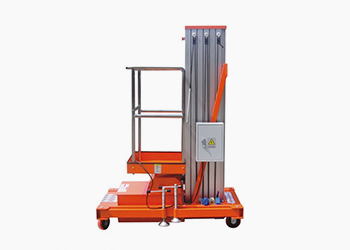
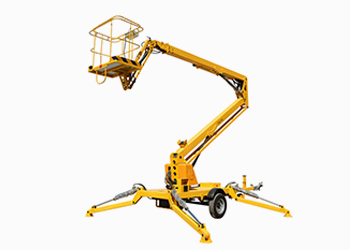
A scissor lift can be carrying less than its rated platform capacity and still be at risk of tipping over.
That statement surprises many buyers. The number on the nameplate—typically 227 kg to 550 kg across the self-propelled scissor lift configurations in SINO LIFT’s range—is often read as “the maximum safe load in all conditions.” It is not. Rated capacity defines the load limit under defined test and operating conditions. Lateral stability determines whether the machine can remain upright on a real jobsite when side forces, wind, slope, load eccentricity and dynamic movement act on an elevated platform.
The core principle is simple:
At SINO LIFT, scissor lift documentation is built around this distinction—not just the headline capacity number.
Rated capacity, also called platform capacity or nominal load, is the maximum allowable total load specified by the manufacturer under defined operating conditions. It normally includes operators on the platform, tools and equipment, materials being lifted, and any additional weight carried on the platform.
Certification testing is carried out under controlled conditions: level rigid concrete, evenly distributed static load, no wind and no dynamic movement. Standards such as ANSI/SAIA A92.20 and EN 280-1 require structural and stability verification with safety factors and overload protection.
This is primarily a vertical structural benchmark. It answers one question: under defined conditions, how much load can the structure and hydraulic system support? It does not answer the jobsite question: at this height, on this ground, in this wind, with this load arrangement, will the machine remain stable?
In some industry documents, “safe working load” is used interchangeably with rated capacity. For mobile scissor lifts, that can be misleading. The rated platform capacity is the manufacturer-specified maximum allowable load. Safe operation also depends on complying with the machine’s rated operating conditions, including load distribution, platform configuration, ground conditions, slope limits and wind restrictions.
There is no universal percentage discount that converts rated capacity into a safe load for every site. A scissor lift’s allowable load depends on the specific model, platform configuration, load position, permitted inclination, wind limits and the manufacturer’s operating instructions. Operators should not calculate a separate site-specific safe working load and treat it as a replacement for the manufacturer’s load chart and safety labels.
Rated capacity is established through the manufacturer’s design and verification process, which considers both structural strength and stability under specified conditions. However, it does not authorize operation outside the machine’s rated limits.
Two separate failure risks must be controlled:
Many scissor lift tip-over incidents involve the second risk, and they can occur before any structural part fails.
A scissor lift remains stable as long as the combined center of gravity (CoG) of the chassis, scissor stack, platform, operator and load stays inside the effective support base. When the CoG crosses a tipping axis, the machine overturns.
The governing relationship is:
For example, a horizontal force of 200 N applied at 10 m creates an overturning moment of 2,000 N·m. The same force near ground level has a much smaller effect. This is why platform height changes the safety equation even when the load weight stays the same.
Key geometric factors include:
Even with a centered load at rated weight, any lateral force—wind, operator movement, braking, potholes or slope—reduces the effective safety margin.
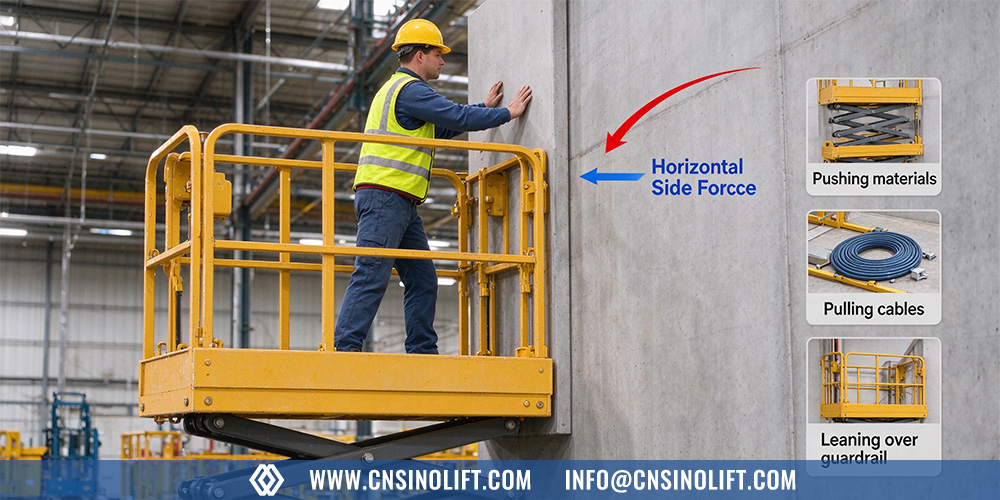
Rated capacity assumes a defined load distribution. Real loads are rarely perfectly centered. A heavy toolbox on one side, a worker leaning over the guardrail, or a long pipe cantilevered off the edge all create eccentric loads and lateral overturning moments.
Load charts often specify de-rated capacity at a given load radius. Extension decks are a common source of misunderstanding. In SINO LIFT’s self-propelled range, the main platform capacity and the extended platform capacity are listed separately. For example, the GTJZ06 lists a 380 kg platform capacity and a 113 kg extended platform capacity; the GTJZ08 lists 450 kg and 113 kg; the GTJZ12 lists 320 kg and 113 kg; the GTJZ16 lists 320 kg and 100 kg. The extension deck adds reach, but it moves the load center outward and reduces the allowable load.
Operators should use the de-rated capacity at the actual load radius and platform configuration, not the headline nameplate number.
Sloped ground tilts the entire machine and shifts the CoG toward the downhill side. Most slab scissor lifts are rated for operation on slopes of approximately 1.5° lateral and 3° longitudinal when elevated. In SINO LIFT’s self-propelled range, the maximum allowable working angle is typically 1.5°/3°, with some models such as the GTJZ08 and GTJZ16 listed at 2°/3°.
Soft or settling ground creates a more variable condition. If one wheel sinks into soil or a depression, the effective tilt is dynamic and unpredictable. Rough-terrain models improve capability with wider axles, foam-filled tires, oscillating axles and optional outriggers, but physics still applies. A rough-terrain lift does not remove lateral stability limits.
Wind is a major invisible lateral threat. Wind force increases with the square of wind speed and acts at platform height, creating a direct overturning moment. Some outdoor-rated scissor lifts are designed for operation at wind speeds up to 12.5 m/s (28 mph). The permitted wind speed varies by model and must be confirmed from the manufacturer’s rating plate and operating manual. Indoor-only models have no outdoor wind rating and must not be used outdoors at height unless specifically approved by the manufacturer.
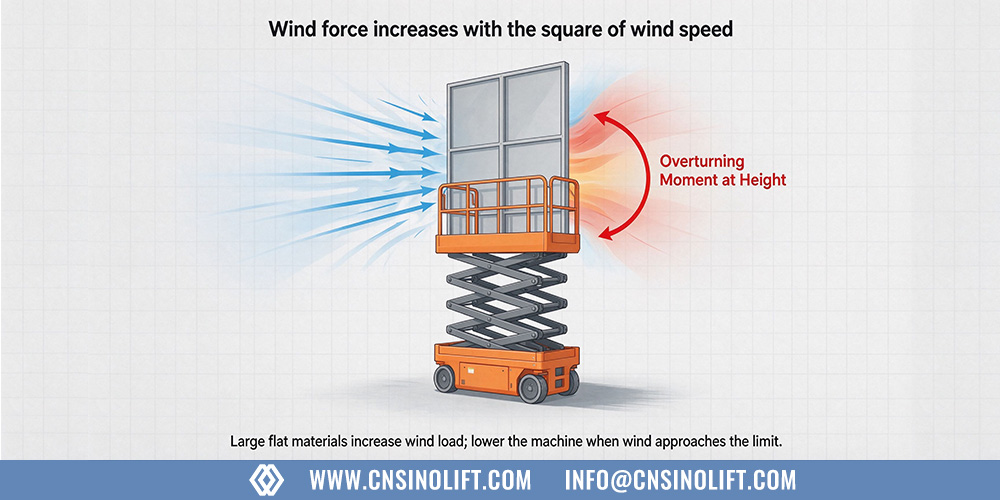
Wind risk increases when the platform is near maximum height, when large flat materials such as drywall, glass or panels are carried, when mesh panels or unauthorized attachments increase exposed area, or when gusts occur suddenly in exposed outdoor areas.
A practical rule: if the wind is strong enough to make you brace yourself on the platform, it is time to lower and secure the machine.
Stability calculations assume quasi-static conditions. Braking, acceleration, crossing expansion joints, driving over bumps or hitting a pothole with the platform raised introduce inertial side loads that reduce the safety margin. Scissor lift structures also have natural frequencies that can overlap with human walking and wind-induced oscillation, increasing sway.
This is why a raised platform should be treated as a static workstation, not a mobile maneuvering platform. In SINO LIFT’s self-propelled range, the machine speed in the lifting state is limited to 0.8 km/h, compared with 3.5 km/h in the folded state. That difference limits dynamic lateral loads at height. Driving at height should be limited to approved low-speed modes on smooth, level floors. On slopes or rough ground, lower the platform before traveling.
Operators apply horizontal forces at height: pushing or pulling objects, handling materials against a wall, pulling cables or hoses, leaning over guardrails, or contacting nearby structures. EN 280-1 and related MEWP standards include requirements for horizontal forces and stability verification. The specific values depend on the machine category, configuration and applicable standard edition.
A scissor lift should not be assumed to resist a horizontal force simply because the platform load is below rated capacity. The allowable side force must be checked in the manufacturer’s operating manual and safety labels.
The following standards and regulations are relevant to scissor lift design, stability and safe use. Specific applicable clauses and editions depend on the market and the product certification.
| Standard / Regulation | Relevance |
|---|---|
| ANSI/SAIA A92.20 | Design, calculations, safety requirements and testing for mobile elevating work platforms |
| ANSI/SAIA A92.22 | Safe use of mobile elevating work platforms |
| EN 280-1 | Design, stability, safety requirements and testing for mobile elevating work platforms |
| OSHA 29 CFR 1926.451 | Relevant scaffolding requirements where applicable |
| OSHA 29 CFR 1926.452(w) | Mobile scaffold requirements where applicable |
Engineered protections may include tilt sensors and alarms, overload sensing or load limiting, pothole protection, emergency lowering, load charts with eccentric de-rating, guardrails and fall restraint anchorage, and elevated travel controls. These systems support safe operation, but they do not replace site assessment, load planning or operator training.
Before every elevated job, verify the machine’s operating limits against the manufacturer’s instructions:
Do not substitute a field calculation for the manufacturer’s load chart. If site conditions fall outside the documented limits, stop and consult the manufacturer or a qualified person.
The following values are drawn from SINO LIFT’s self-propelled scissor lift data. They are model-specific and should be checked against the current operator manual and load chart for the exact configuration before use.
| Model | Max. Working Height | Max. Platform Height | Rated Platform Capacity | Extended Platform Capacity | Max. Allowable Working Angle (Lateral / Longitudinal) |
|---|---|---|---|---|---|
| Mini GTJZ06M | 7.8 m | 5.8 m | 230 kg | 113 kg | 1.5° / 3° |
| GTJZ06 (380 kg) | 7.8 m | 5.8 m | 380 kg | 113 kg | 1.5° / 3° |
| GTJZ06 (550 kg) | 7.8 m | 5.8 m | 550 kg | 113 kg | 1.5° / 3° |
| GTJZ08Z | 9.8 m | 7.8 m | 230 kg | 113 kg | 1.5° / 3° |
| GTJZ08 | 9.8 m | 7.8 m | 450 kg | 113 kg | 2° / 3° |
| GTJZ10 | 11.8 m | 9.8 m | 320 kg | 113 kg | 1.5° / 3° |
| GTJZ12 | 13.8 m | 11.8 m | 320 kg | 113 kg | 1.5° / 3° |
| GTJZ14 | 15.8 m | 13.8 m | 227 kg | 113 kg | 1.5° / 3° |
| GTJZ16 | 17.8 m | 15.8 m | 320 kg | 100 kg | 2° / 3° |
All listed models use a 0.9 m extension deck. Travel speed is listed as 3.5 km/h in the folded state and 0.8 km/h in the lifting state. Rated platform capacity and extended platform capacity are separate limits; the extension deck rating applies when the deck is deployed. Two GTJZ06 configurations are listed in the source data; confirm the exact model designation and capacity with SINO LIFT before ordering.
At SINO LIFT, scissor lift documentation is based on model-specific operating limits rather than a single headline capacity figure. The self-propelled range is documented with working heights, platform heights, rated platform capacities, extension deck ratings, working angles and travel speeds for each configuration.
SINO LIFT self-propelled scissor lifts are designed with model-specific operating limits and safety features to support stable operation under the conditions specified by the manufacturer. Depending on model and configuration, documented features may include tilt sensors, overload sensing, pothole protection and emergency lowering. The speed difference between folded travel and lifting-state travel limits dynamic lateral loads when the platform is raised.
SINO LIFT manufactures scissor lifts, mast lifts, boom lifts, cargo lifts, loading ramps, wheelchair lifts and warehouse handling equipment for warehouse maintenance, industrial installation, building maintenance and indoor construction. The technical team can help customers review model specifications, load charts and operating limits for their application.
Contact SINO LIFT for model selection, load chart documentation or technical support.
Q1: Can I exceed rated capacity if the load is centered and the machine is level?
No. Rated capacity is a manufacturer-specified load limit under defined conditions. It is not a target. Safe operation requires staying within the rated capacity and all other operating limits in the manual.
Q2: Can a scissor lift tip over even when it is not overloaded?
Yes. Excessive side force, uneven ground, strong wind, slope or an unfavorable load position can affect lateral stability even when platform load is below rated capacity.
Q3: What wind speed is safe for a scissor lift?
Some outdoor-rated scissor lifts are designed for operation at wind speeds up to 12.5 m/s (28 mph). The permitted wind speed varies by model and must be confirmed from the manufacturer’s rating plate and operating manual. Indoor-rated units must not be used outdoors at height unless specifically approved. Monitor wind and lower the machine when approaching the limit.
Q4: Does a rough-terrain scissor lift remove lateral stability concerns?
No. It expands the operating envelope for slope, ground condition and wind class, but eccentric loads, wind and height still affect stability. Follow the machine-specific load chart and slope rating.
Q5: What should an operator do if the tilt alarm sounds?
Stop operation. Do not bypass the alarm or make unauthorized adjustments. Follow the manufacturer’s emergency lowering procedure, lower the platform when safe, and move the machine only after the platform is lowered and movement is permitted.
Q6: Can I calculate my own safe working load for a specific site?
No. Use the manufacturer’s rated platform capacity, load chart, slope limits, wind restrictions and operating manual. If conditions are outside the documented limits, consult the manufacturer or a qualified person.
Rated capacity answers a narrow question: how much load can the lift carry under defined conditions? Safe operation depends on a broader set of limits: platform height, load position, ground condition, wind, side force and dynamic movement.
The gap between the nameplate number and real jobsite safety is filled by lateral stability—and by site assessment, load planning, operator training and the machine’s documented operating limits.
For scissor lift selection support, load chart documentation or technical information, contact the SINO LIFT team.
HENAN SINO LIFT is committed to providing customers with high-quality and high-performance industrial equipment. Over the years, we have adhered to technological innovation and product quality, earning the trust and support of our customers.
We manufacture Scissor Lift, Mast Lift, Boom Lift, Cargo Lift, Loading Ramp, Wheelchair Lift, and Warehouse Handling Equipment. If you need these products, please let us specify a suitable solution for you.
Email: info@cnsinolift.com
Website: www.cnsinolift.com