


Introduction
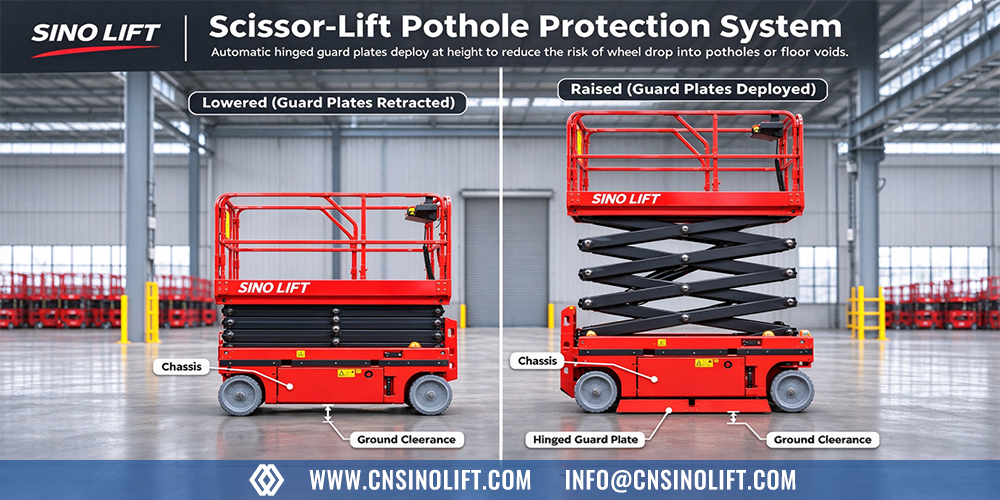
Pothole protection systems are an important safety feature on many modern self-propelled electric scissor lifts. Depending on the machine design, these systems use hinged plates, bars, or mechanical guards that deploy when the platform is raised. Their purpose is to help reduce the risk of chassis contact with the ground when a wheel encounters a small depression.
However, pothole protection has specific design limitations. It does not make an elevated scissor lift safe to operate across every type of uneven surface. Large floor openings, steep slopes, soft ground, structural weaknesses, excessive loads, and external forces can still create serious stability risks, even when the guards are fully deployed.
Understanding these limitations is essential for equipment operators, rental companies, construction contractors, and facility managers.
This guide explains how scissor lift pothole protection systems work, what conditions they are designed to address, which overlooked hazards can still cause tip-overs, and how to inspect the system before operation.
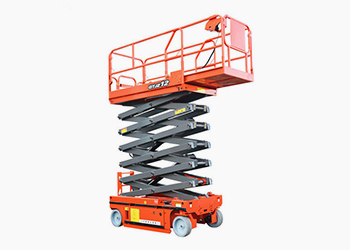
The product examples in this article are based on the SINO LIFT self-propelled scissor lift range, with maximum working heights from 7.8 m to 17.8 m. Specifications vary by model and configuration. Always refer to the machine's data plate and operating manual for the applicable limits.
What a Pothole Protection System Does
A pothole protection system typically consists of hinged plates, bars, or protective guards installed near the lower chassis of a scissor lift.
When the platform rises, the protection components deploy downward, reducing the clearance beneath the chassis. This helps limit the risk of the chassis contacting the ground if a wheel enters a small depression within the system's designed operating range.
The exact deployment mechanism varies by manufacturer and model. Some systems use mechanical linkages, while others may incorporate spring-assisted components or electrical monitoring and interlocks.
When fitted, safety interlocks may prevent the platform from rising or restrict machine movement if the protection mechanism does not deploy correctly. Operators should never assume that every scissor lift uses the same activation logic or safety configuration.
There are several important points to understand:
-
Pothole protection is designed to address specific wheel-drop situations, not every ground hazard.
-
The protective effect depends on the guard design, deployment range, machine configuration, and ground conditions.
-
The mechanism is not an outrigger, leveling device, or substitute for adequate ground bearing capacity.
-
It does not compensate for excessive slope, overloading, structural floor weakness, or external impact.
Pothole protection should therefore be treated as one layer of the machine's overall safety system, not as a guarantee against tip-over.
Key Limitations of Scissor Lift Pothole Protection
1. Designed for Small Depressions Only
Pothole protection guards have a limited deployment range and physical span.
They may help reduce risks when a wheel encounters a relatively small depression, but they are not designed to bridge large openings, deep trenches, wide drainage channels, or substantial floor gaps.
If a depression is wider than the protection mechanism can reach, the guard may remain suspended without contacting a suitable supporting surface.
In this situation, the wheel can still drop into the opening, potentially causing the chassis to tilt and the platform to become unstable.
Operators should pay particular attention to:
-
Large potholes and damaged concrete.
-
Drainage channels and floor trenches.
-
Uncovered maintenance openings.
-
Dock edges and loading areas.
-
Gaps between floor sections.
A deployed guard does not make these hazards safe to cross.
2. No Correction for Slope or Cross-Slope
Pothole protection does not correct the machine's inclination or compensate for an excessive operating slope.
Every scissor lift has a maximum allowable working angle. This is a separate safety limit from the pothole protection system.
According to the supplied SINO LIFT specifications, most models have a maximum allowable working angle of 1.5° longitudinally and 3° laterally. The GTJZ08 and GTJZ16 are specified at 2° longitudinally and 3° laterally.
These limits must be followed according to the specific model's operating manual.
A machine operating on an excessive slope may experience uneven weight distribution and a reduced stability margin. A small wheel drop, surface irregularity, or sudden movement can further increase the risk.
Operators should distinguish between two different specifications:
-
Maximum gradeability: The maximum slope the machine is designed to climb under specified travel conditions.
-
Maximum allowable working angle: The permitted inclination when operating the machine, particularly with the platform elevated, as defined by the manufacturer.
The SINO LIFT range lists a maximum gradeability of 25% across the models covered in this article. This does not mean that the platform can be elevated safely on a 25% slope.
Never use gradeability as a substitute for the rated working angle.
3. Soft or Deformable Ground
Pothole protection depends on suitable ground conditions.
On loose gravel, wet soil, sand, uncompacted backfill, cracked asphalt, or other deformable surfaces, the protection guard may sink along with the wheel.
When the supporting surface compresses under the machine's weight, the guard cannot provide the intended protection.
This is particularly important for heavy scissor lifts. Machine weight across the SINO LIFT range varies from approximately 1,350 kg to 4,590 kg, depending on the model.
The machine's operating weight, platform load, wheel contact area, and local ground conditions must all be considered.
Before operating on potentially weak surfaces:
-
Inspect the ground for soft areas and visible settlement.
-
Check for concealed voids and poorly compacted backfill.
-
Confirm that the surface can support the machine's total operating load.
-
Obtain an appropriate ground-bearing assessment where required.
Do not assume that a deployed pothole guard can compensate for inadequate ground strength.
4. Jamming, Debris, and Partial Deployment
Pothole protection components are installed close to the ground and can be exposed to dirt, moisture, and site debris.
Gravel, concrete fragments, wood scraps, dried mud, welding slag, ice, and other materials may become trapped around the guard plates, hinges, pivot points, or chassis.
This can prevent the mechanism from deploying or retracting correctly.
A partially deployed guard may be difficult to identify during a normal walkaround because much of the mechanism is located underneath the machine.
Before operation, inspect:
-
Guard plates and protective bars.
-
Hinges and pivot points.
-
Connecting arms and mounting brackets.
-
Springs and mechanical linkages, where fitted.
-
Sensors, wiring, and limit switches, where fitted.
If the mechanism does not move freely or fails to deploy correctly, stop using the machine and arrange an inspection by qualified service personnel.
Never bypass a safety interlock to continue operating the lift.
5. Wear, Bent Guards, and Damaged Linkages
Repeated operation, accidental impacts, and improper handling can damage pothole protection components.
Common problems include:
-
Bent or deformed guard plates.
-
Worn pivot pins and bushings.
-
Loose or missing retaining pins.
-
Cracked mounting brackets.
-
Damaged connecting arms.
-
Broken springs or misaligned linkages.
-
Faulty sensors and electrical connections.
Even relatively small mechanical defects can affect the deployment range or movement of the protection system.
A visual inspection from one side of the machine may not reveal every problem.
The mechanism should be checked according to the manufacturer's maintenance and functional inspection procedures.
Damaged components must be repaired or replaced using approved parts before the machine returns to service.
6. No Protection Against Dynamic Loads or Impact
Pothole protection is not designed to make sudden impacts or aggressive driving safe.
Driving into a curb, striking a raised concrete joint, crossing an obstacle, or making an abrupt steering correction while the platform is elevated can introduce unexpected forces into the chassis.
These forces may affect machine stability independently of whether the pothole guards are deployed.
Operators should:
-
Maintain a controlled travel speed.
-
Avoid sudden steering movements.
-
Keep clear of curbs, steps, and obstacles.
-
Avoid driving across uneven transitions with the platform elevated.
-
Follow the manufacturer's elevated travel restrictions.
Pothole protection should never be treated as an impact-absorbing or stability-control system.
7. Pothole Protection Does Not Replace Load and Wind Safety Controls
Pothole protection does not compensate for incorrect platform loading or excessive wind exposure.
An overloaded platform, concentrated materials on one side, or large panels exposed to wind can change the machine's center of gravity and increase lateral forces.
These conditions may create instability even when the protection guards are fully deployed.
Operators must follow the rated platform capacity, extension deck capacity, load distribution requirements, and applicable wind restrictions.
Some machines may have separate overload, tilt, or other safety monitoring functions. These functions are independent of pothole protection and must also be maintained and used correctly.
SINO LIFT Self-Propelled Scissor Lift Specifications
The following table provides reference specifications for the SINO LIFT self-propelled scissor lift range.
The two GTJZ06 entries represent different platform-width configurations with different rated capacities.
| Model | Max. Working Height | Rated Capacity | Platform Size (L × W × H) | Max. Working Angle (Longitudinal / Lateral) | Machine Weight |
|---|---|---|---|---|---|
| Mini GTJZ06M | 7.8 m | 230 kg | 1.67 × 0.74 × 1.1 m | 1.5° / 3° | 1,350 kg |
| GTJZ06 | 7.8 m | 380 kg | 2.29 × 0.81 × 1.1 m | 1.5° / 3° | 1,880 kg |
| GTJZ06 | 7.8 m | 550 kg | 2.29 × 1.13 × 1.1 m | 1.5° / 3° | 2,150 kg |
| GTJZ08Z | 9.8 m | 230 kg | 2.29 × 0.81 × 1.1 m | 1.5° / 3° | 2,030 kg |
| GTJZ08 | 9.8 m | 450 kg | 2.29 × 1.13 × 1.1 m | 2° / 3° | 2,300 kg |
| GTJZ10 | 11.8 m | 320 kg | 2.29 × 1.13 × 1.1 m | 1.5° / 3° | 2,530 kg |
| GTJZ12 | 13.8 m | 320 kg | 2.29 × 1.13 × 1.1 m | 1.5° / 3° | 2,870 kg |
| GTJZ14 | 15.8 m | 227 kg | 2.64 × 1.13 × 1.1 m | 1.5° / 3° | 3,340 kg |
| GTJZ16 | 17.8 m | 320 kg | 3.05 × 1.56 × 1.1 m | 2° / 3° | 4,590 kg |
Additional platform and operating specifications:
-
Extended platform safe working load: 113 kg for most models; 100 kg for GTJZ16.
-
Maximum deck extension: 0.9 m.
-
Maximum gradeability: 25%.
-
Maximum lifting speed: 3–5 m/min.
-
Travel speed in stowed position: 3.5 km/h.
-
Travel speed in elevated position: 0.8 km/h.
-
Charger specification: 24 V / 30 A.
These figures are based on the supplied SINO LIFT product specifications. Always verify the exact configuration, rated capacity, working angle, machine weight, and operating restrictions using the machine's data plate and official operating manual.
Overlooked Triggers of Scissor Lift Tip-Overs
Pothole protection addresses only one category of ground-related risk. Other site conditions can compromise scissor lift stability independently of the protection mechanism.
Understanding these overlooked hazards is essential when planning elevated work.
1. Hidden Floor Voids and Covered Openings
Floor openings are not always visible.
Plywood, temporary boards, or other coverings may conceal maintenance pits, utility trenches, removed manhole covers, and underground service openings.
A scissor lift wheel can place a substantial concentrated load on a relatively small area. If a temporary cover cannot support that load, it may collapse.
Pothole protection cannot compensate for a surface that fails structurally.
All concealed openings should be identified, properly secured, and assessed before equipment enters the area.
2. Weak Floor Structures and Mezzanines
A concrete floor may appear solid while having insufficient load-bearing capacity for a particular scissor lift.
This is especially important in older industrial buildings, mezzanines, warehouse platforms, and areas containing backfilled sections.
Different models have significantly different operating weights.
For example, the supplied SINO LIFT specifications list machine weights ranging from 1,350 kg for the Mini GTJZ06M to 4,590 kg for the GTJZ16.
The total load also increases when operators, tools, and materials are on the platform.
Before operation, verify that the floor structure can support the machine under the intended working conditions.
Where necessary, obtain approval from a qualified structural professional.
3. Slopes, Cross-Slopes, and Uneven Settlement
Warehouse floors, outdoor yards, loading ramps, dock transitions, and patched concrete can contain subtle changes in elevation.
A surface that looks level may still exceed the machine's permitted working angle.
Do not rely on visual judgment alone.
Measure the slope where required and compare the result with the specific machine's rated working angle.
Remember that gradeability and allowable working angle are different specifications.
4. Curbs, Steps, and Dock Transition Zones
Small obstacles can create significant stability risks when a scissor lift is elevated.
Curbs, floor joints, raised edges, temporary ramps, loading dock transitions, and trailer access areas may cause sudden changes in wheel height.
If one wheel moves over an obstacle while the others remain on a lower surface, the machine may experience diagonal inclination.
Avoid elevated travel across curbs, steps, and uneven transition zones unless the machine manufacturer specifically permits the operation under defined conditions.
5. Overloading and Unbalanced Platform Loads
Exceeding the rated platform capacity can reduce the machine's stability margin and compromise safe operation.
Even when the total load is within the rated capacity, placing heavy materials on one side of the platform can create an unfavorable load distribution.
Long materials and equipment should also be secured to prevent unexpected movement.
Operators must observe:
-
Maximum rated platform capacity.
-
Maximum extension deck capacity.
-
Permitted load distribution.
-
Platform extension restrictions.
-
Material handling and securing requirements.
Never use the platform as a substitute for a crane or material lifting device unless the machine is specifically approved for that application.
6. Wind Loading and Unusual Airflow
Wind is an important consideration for elevated scissor lifts, particularly when working outdoors.
Large panels, sheets, doors, and other materials can act as wind-catching surfaces, increasing lateral forces on the platform.
Indoor operation does not automatically eliminate wind-related risks. Strong ventilation systems, industrial fans, and other unusual airflow conditions may also affect large materials.
Always follow the manufacturer's wind restrictions and any limitations on material handling at height.
Do not assume that a pothole protection system provides additional resistance to wind-induced instability.
7. Horizontal Forces and External Impact
A stationary scissor lift can also become unstable when subjected to sufficient external horizontal forces.
Potential sources include:
-
Being struck by forklifts or other industrial vehicles.
-
Materials being pushed against the guardrails.
-
Pulling or pushing against nearby structures.
-
Sudden movement of unsecured loads.
-
Unexpected external contact with the elevated platform.
Maintain an appropriate safety perimeter and coordinate nearby equipment movements.
8. Bypassed Interlocks and Incorrect Equipment Selection
Safety interlocks and monitoring systems are designed to help prevent operation outside permitted conditions.
Bypassing these systems can remove important layers of protection.
Using an indoor-only model on unsuitable outdoor terrain or selecting a machine without sufficient working height or capacity can also create unnecessary risks.
Rental companies and fleet operators should ensure that users understand the operating characteristics and safety restrictions of the specific model supplied.
Practical Scissor Lift Inspection Checklist
A consistent pre-use inspection helps identify potential problems before the platform is elevated.
The following checklist can be incorporated into daily equipment inspection procedures.
Pothole Protection System Inspection
Before operating the machine:
-
Check that all pothole protection guards are present and correctly installed.
-
Inspect guard plates for bending, cracking, corrosion, or visible damage.
-
Check hinges, pivot pins, connecting arms, and mounting brackets.
-
Confirm that there are no stones, mud, ice, or other obstructions around the mechanism.
-
Verify that the guards deploy and retract correctly according to the manufacturer's inspection procedure.
-
Check applicable sensors, wiring, and safety interlocks.
-
Confirm that warning indicators and relevant safety functions operate correctly.
-
Report any abnormal movement, unusual noise, or incomplete deployment.
Never place hands or tools beneath an elevated platform to adjust the mechanism.
If the guards are damaged, jammed, or fail a required functional test, stop operation and arrange qualified maintenance.
Ground and Site Inspection
Before moving the lift into position:
-
Inspect the complete travel path.
-
Identify potholes, trenches, floor openings, and drop-offs.
-
Check for loose gravel, soft soil, and uncompacted backfill.
-
Look for cracks, settlement, and damaged concrete.
-
Verify floor load-bearing capacity where required.
-
Check slopes and cross-slopes against the machine's rated working angle.
-
Identify curbs, ramps, dock edges, and other transition hazards.
-
Confirm that temporary floor covers are adequately rated.
Load and Operating Condition Inspection
Before raising the platform:
-
Confirm the machine's rated platform capacity.
-
Check the extension deck capacity.
-
Distribute materials evenly.
-
Secure tools and equipment.
-
Check applicable wind restrictions.
-
Confirm that the machine is configured for the intended working environment.
-
Ensure that all operators are familiar with the machine's controls and safety instructions.
Common Site Hazards and Recommended Actions
| Inspection Area | Potential Hazard | Recommended Action |
|---|---|---|
| Potholes and floor openings | Wheel drop or chassis instability | Avoid the area and ensure openings are properly secured |
| Soft ground and backfill | Ground settlement or sinking | Verify ground-bearing capacity |
| Slopes and cross-slopes | Excessive machine inclination | Measure and compare with rated working angle |
| Concrete slabs and mezzanines | Structural weakness | Confirm floor strength and condition |
| Utility and trench covers | Cover collapse | Verify load rating before access |
| Debris, ice, and mud | Guard obstruction | Remove obstructions before operation |
| Wind and large panels | Increased lateral forces | Follow wind and load restrictions |
| Damaged protection guards | Incomplete deployment | Stop operation and arrange qualified repair |
Operating Rules for Safer Scissor Lift Use
To reduce the risk of tip-over incidents, operators and site managers should follow these basic rules:
-
Treat pothole protection as a supplementary safety feature, not a substitute for ground inspection.
-
Never assume that deployed guards make every uneven surface safe.
-
Do not operate beyond the machine's rated working angle.
-
Avoid elevated travel over wide openings, trenches, soft ground, and unsuitable surfaces.
-
Keep platform loads centered, secured, and within the rated capacity.
-
Avoid sudden movements, impacts, and contact with obstacles.
-
Remove debris that may interfere with pothole guard movement.
-
Never bypass safety interlocks or ignore warning indicators.
-
Stop using the machine if the protection mechanism is damaged or fails inspection.
-
Follow the manufacturer's operating instructions, maintenance intervals, and applicable regional safety regulations.
Elevated travel on loose or uncompacted ground should not be undertaken unless the manufacturer explicitly permits the operation and the site conditions have been assessed as suitable.
Frequently Asked Questions
Does pothole protection prevent all scissor lift tip-overs?
No. Pothole protection helps reduce specific wheel-drop risks, but it cannot prevent every cause of instability.
Excessive slopes, soft ground, large floor openings, structural weakness, overloading, wind, collisions, and external forces can still create tip-over risks.
When does the pothole protection system activate?
Activation and deployment behavior vary by manufacturer and model.
Some systems deploy automatically as the platform rises, while others use different mechanical or monitored arrangements.
Always consult the specific machine's operating manual.
Can debris stop a pothole protection system from working?
Yes. Gravel, mud, ice, concrete fragments, and other debris can obstruct the hinges, connecting arms, or guard plates.
Operators should inspect the mechanism before use and ensure that all components move correctly.
Can I drive a scissor lift over gravel if pothole protection is installed?
Not automatically.
Loose gravel and uncompacted ground may shift or compress under the machine's weight. The protection guards cannot reinforce weak ground or guarantee stability.
Check the manufacturer's ground-condition restrictions before operation.
What should I do if a pothole protection guard is jammed?
Stop operating the machine.
If it is safe to do so, lower the platform and take the machine out of service. Arrange an inspection and repair by qualified personnel.
Do not attempt to bend, force, or manually adjust the guard while the platform is elevated.
Can a stationary scissor lift tip over?
Yes.
A stationary machine can become unstable if the ground settles, the platform is overloaded, the load shifts, wind forces become excessive, or sufficient external horizontal forces are applied.
Safe operation requires continuous attention to ground conditions, load distribution, and environmental factors.
Is maximum gradeability the same as maximum working angle?
No.
Maximum gradeability describes the machine's climbing capability under specified travel conditions.
Maximum allowable working angle defines the permitted operating inclination.
These are different specifications and must never be used interchangeably.
Conclusion
Pothole protection systems play an important role in scissor lift safety, but their capabilities have clear limits.
They are designed to help address specific wheel-drop situations. They do not eliminate the risks associated with large floor openings, excessive slopes, soft ground, structural weakness, damaged components, impact, overloading, or wind.
Safe scissor lift operation requires more than relying on a single protective mechanism.
Operators and site managers should combine proper ground assessment, pre-use inspection, load control, functional safety checks, operator training, and compliance with the machine's rated operating limits.
For every SINO LIFT model, the machine's specific data plate and official operating manual remain the primary references for rated capacity, working height, working angle, and operating restrictions.
About HENAN SINO LIFT CO., LTD
HENAN SINO LIFT CO., LTD is a professional manufacturer of aerial work platforms and industrial lifting equipment.
Our product range includes self-propelled scissor lifts, mast lifts, boom lifts, cargo lifts, loading ramps, wheelchair lifts, and warehouse handling equipment.
With a focus on product quality, engineering innovation, and practical application requirements, SINO LIFT is committed to providing reliable lifting solutions for customers across different industries and markets.
Whether you need an electric scissor lift for warehouse operations, an aerial work platform for construction projects, or customized material handling equipment, our team can help you identify a suitable solution.
Email: info@cnsinolift.com
Website: https://www.cnsinolift.com/