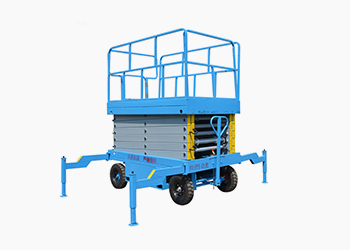
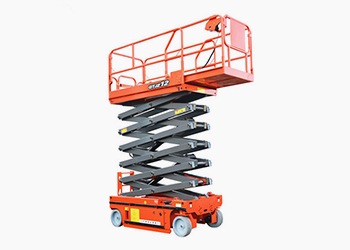
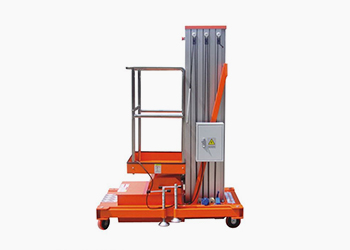
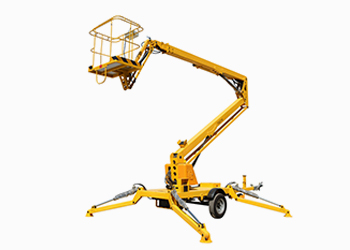
A self-propelled scissor lift relies on hydraulic, electrical, mechanical, and structural components that can develop faults between shifts. A unit that passed inspection yesterday may develop a slow leak, a worn pin, or a control fault overnight. A short daily pre-use inspection catches these issues before they turn into an accident, an injury, or unplanned downtime. Understanding what are common scissor lift accidents helps reinforce why this daily check matters.
Quick answer: A complete pre-use check covers the work area, machine structure, hydraulic and electrical systems, controls, safety devices, and required documentation. A routine pre-use inspection can often be completed in a few minutes, but the time required depends on the machine and the inspection procedure, and should be repeated at the frequency required by the manufacturer, site procedures, and applicable local regulations. A new operator should review the machine's current inspection status before taking over. (Can you operate a scissor lift by yourself? Yes, with proper training and certification.)
A note on specifications: The model numbers and figures in this checklist are drawn from HENAN SINO LIFT CO., LTD's self-propelled electric scissor lift range (GTJZ series). Figures vary by model and configuration, so always confirm the exact values on your machine's rating plate and operator's manual before beginning any inspection.
Begin with the environment before touching the machine. Park the lift on firm, level ground and make sure the surface can support its weight. Avoid soft soil, uncompacted fill, holes, floor openings, drop-offs, ramps, debris, uneven surfaces, and slopes beyond the manufacturer's limit. For operations on grass or other soft surfaces, refer to our guide on how to use a scissor lift on a lawn.
Important distinction: Two different slope ratings apply to scissor lifts—and they are not interchangeable.
Gradeability is the machine's driving capability—the steepest slope it can climb while stowed (platform fully lowered). Gradeability varies by model and configuration; check the machine's data plate or operator's manual for the exact value for your unit.
Tilt limit or working surface tilt is the safety limit for operation—the maximum side-to-side or front-to-back tilt of the ground surface while the platform is elevated. The tilt alarm threshold varies by model and configuration; check the machine's data plate or operator's manual for the exact limit for your machine.
These are different parameters for different situations. Gradeability tells you what the machine can drive up; tilt limit tells you what surface it can safely work on once elevated.
Walk the area and look up. Confirm there are no power lines, beams, pipes, or low clearances within the platform's reach, and leave enough room to manoeuvre both at ground level and at height. For models approved for outdoor use, check the maximum permitted wind speed on the machine's data plate or in the operator's manual. Some models are rated for wind speeds up to 12.5 m/s (about 28 mph or 45 km/h). Also stop work in heavy rain or lightning. (Can electric scissor lifts get rained on? Learn what conditions are safe and which are not.) Indoors, check that there is adequate clearance and ventilation for the planned work.
Before starting, the operator should wear the required personal protective equipment and hold the training or operator certification required by local regulations. Apply the parking brake, switch the power off, and make sure people are clear of the machine and its travel path.

With the power still off, walk completely around the unit and check each of the following.
Structure and chassis. Look for dents, cracks, bends, corrosion, and cracked welds on the base frame and scissor arms, paying close attention to hinge points and the chassis bearing structure. Confirm that pins, bolts, and retaining fasteners are in place, that cotter pins are seated, and that there is no excessive play at the pivot points. Check the slide blocks, wear pads, and rollers for condition.
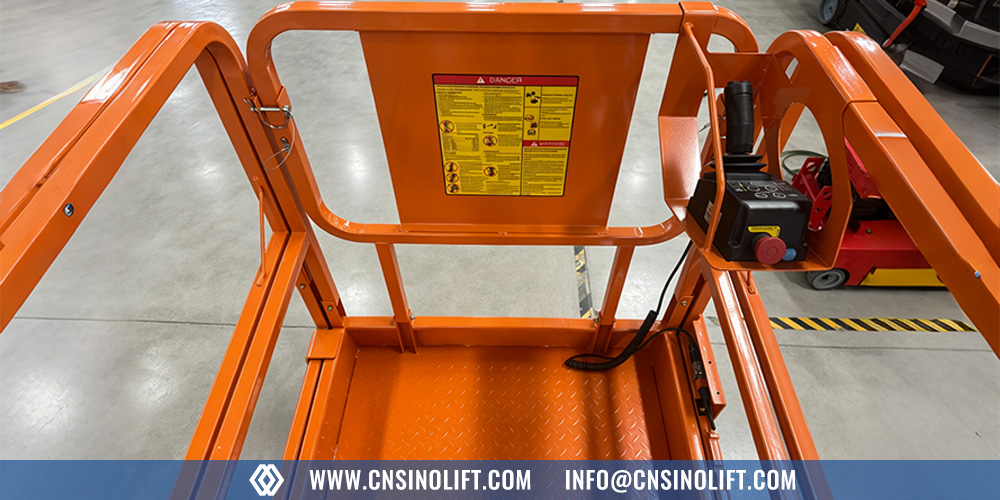
Platform assembly. Verify that guardrails are intact, secure, and meet the height and configuration specified for the machine. Toe boards should be undamaged and the anti-slip platform floor clean and complete. Close and latch the entry gate to confirm it locks. Do not operate the lift if any guardrail, gate, or toe board is missing, damaged, or loose. Where the machine is equipped with designated fall-protection or restraint anchorage points, inspect them for damage and confirm that they are clearly identified and used according to the manufacturer's instructions and local requirements. (Do I need to wear a safety harness in a scissor lift? OSHA requirements and best practices explained.) Make sure the capacity plate is legible.
Tires and wheels. Check for cuts, cracks, bulges, and heavy wear. For pneumatic tires, confirm air pressure is within the specified range and that all lug nuts are present and tight.
Decals and manuals. All warning labels, capacity plates, and operating instructions should be present, clean, and legible. The operator's manual belongs in its designated storage location.
Leaks and fluids. Look underneath for hydraulic or battery fluid pooling. Inspect hoses and fittings for chafing, cracks, and seepage, and check the cylinder rods for scoring or seal leakage.
Hydraulic system. Check the hydraulic oil level and condition according to the manufacturer's specification. Cloudy, milky, or visibly contaminated oil should be investigated before operation. Inspect hoses, fittings, cylinders, and the reservoir for leaks.
Note on hydraulic creep testing: Some manufacturers recommend holding the platform at mid-height for a few minutes to check for excessive sinking (which would indicate internal leakage). This is not always a standard daily pre-use check requirement. Confirm your specific machine's operator manual for the official procedure before performing this test. If your manual does not explicitly require it, treat it as a periodic maintenance check rather than a daily inspection item.
Battery (electric models). The battery fitted to SINO LIFT electric models is a maintenance-free lead-acid type. Before use, confirm that the battery has sufficient charge for the planned work. Check the terminals for tightness and corrosion, and look for cracks or leaks in the casing. Inspect the wiring harness for chafing and loose connections.

Turn the power on and test the ground controls first, so the machine is under control from outside before anyone enters the platform.
Move the key switch to the ground-control position.
Press the emergency stop button—all functions should stop—then pull it out to reset.
Raise and lower the platform through a suitable operating range. Movement should be smooth, with no jerking, binding, unusual noise, or abnormal vibration. If the manufacturer's inspection procedure requires a full-height or limit-switch test, follow that procedure separately.
Test the manual emergency descent (lowering valve): it should let the platform come down smoothly under loss of power.
Confirm every button and switch returns to neutral when released.
Enter the platform, close the gate, and test from the operating position.
Move the key switch to the platform-control position.
Press the emergency stop button and reset it.
Test the foot switch or enable device if fitted.
Raise and lower from the platform; the motion should be smooth.
Drive forward and reverse, then steer in both directions. Confirm the reduced drive speed cuts in automatically once the platform is elevated—on these models the machine travels at about 3.5–3.8 km/h (2.2 mph) when stowed and roughly 0.8 km/h (0.5 mph) when raised, with a lifting speed of 3–5 m/min.
Test the horn and the braking, and confirm all controls return to neutral when released.
Safety devices must be functional, but the daily pre-use inspection is not a full functional safety test. The operator should check for obvious damage, missing components, or visible faults that would prevent the device from operating. The following functional checks are limited to what can be safely performed during a routine pre-use inspection:
Emergency stops. Both the ground and platform emergency stop buttons should stop the machine's powered functions when activated.
Height limit. Check the height limit switch indicator, if provided, and confirm the device operates according to the manufacturer's procedure. Full-height limit-switch tests should be performed as specified in the service or maintenance schedule.
Tilt alarm. Check the alarm indicator and related function according to the manufacturer's procedure. Do not deliberately place the machine on an unsafe slope or tilt it beyond the rated limit to test the alarm.
Pothole protection. Confirm the pothole guards deploy automatically as the platform rises.
Overload protection. Check the overload indicator or diagnostic function, if provided, according to the manufacturer's inspection procedure. Do not deliberately overload the machine to test the protection system.
Fall protection anchorage. Where the machine is equipped with designated fall-protection or restraint anchorage points, inspect them for damage and confirm that they are clearly identified and used according to the manufacturer's instructions and local requirements.
Record every result on the daily inspection report or digital checklist: date, time, shift, machine model, serial number, and hour-meter reading. Note any defect, tag the machine out, and report it to the supervisor. Do not operate until the issue has been corrected and the machine has been inspected and released for service by an authorized person.
Use this summary as a field reference. Complete every item before operating.
| Check Item | What to Look For | Pass | Fail |
|---|---|---|---|
| Work area | Firm, level ground; no overhead hazards; wind within limit | ☐ | ☐ |
| Structure and chassis | Cracks, bends, corrosion, loose pins or fasteners | ☐ | ☐ |
| Platform and guardrails | Guardrails secure, gate latches, floor intact | ☐ | ☐ |
| Tires | Damage, wear, proper pressure, lug nuts tight | ☐ | ☐ |
| Decals and manual | Legible, present, manual in place | ☐ | ☐ |
| Leaks | No hydraulic or battery fluid pooling underneath | ☐ | ☐ |
| Hydraulic oil | Level and condition per manufacturer specification | ☐ | ☐ |
| Battery (electric) | Charge adequate, terminals tight, no casing cracks | ☐ | ☐ |
| Emergency stops | Ground and platform—both stop all functions | ☐ | ☐ |
| Lift and lower function | Smooth operation, no unusual noise or jerking | ☐ | ☐ |
| Drive and steer | Moves and steers in both directions | ☐ | ☐ |
| Reduced drive speed | Slows automatically when platform elevated | ☐ | ☐ |
| Tilt alarm | Indicator functional—do not tilt machine to test | ☐ | ☐ |
| Pothole protection | Deploys as platform rises | ☐ | ☐ |
| Overload protection | Indicator or diagnostic functional—do not overload | ☐ | ☐ |
| Finding | Action |
|---|---|
| Dirty decal | Clean before use |
| Low battery charge | Recharge before use |
| Low hydraulic oil | Correct according to manual before use |
| Low tire pressure | Inflate to specified pressure before use |
| Hydraulic leak | Remove from service |
| Damaged guardrail | Remove from service |
| Failed emergency stop | Remove from service |
| Structural crack or bend | Remove from service |
| Broken or missing pins or fasteners | Remove from service |
| Overload or tilt alarm not functioning | Remove from service |
For reference while inspecting, the SINO LIFT self-propelled electric scissor lift range covers platform heights from 6 to 16 m, with rated capacities varying by model and configuration. For a complete overview of available models, see our scissor lift purchasing guide and scissor lift price guide.
| Model | Platform Height | Working Height | Rated Capacity |
|---|---|---|---|
| GTJZ06 / 06S | 6 m | approx. 8 m | 230–500 kg |
| GTJZ08 | 8 m | approx. 10 m | 320–450 kg |
| GTJZ10 | 10 m | approx. 12 m | 320 kg |
| GTJZ12 | 12 m | approx. 14 m | 320 kg |
| GTJZ14 | 14 m | approx. 16 m | 227 kg |
| GTJZ16 | 16 m | approx. 18 m | 227 kg |
Overall machine dimensions stay compact for indoor work: the GTJZ06 measures about 2.47 × 1.18 × 2.24 m, the GTJZ08 about 2.47 × 1.18 × 2.36 m, and the GTJZ10 about 2.47 × 1.18 × 2.48 m. At 1.18 m wide, these models can fit through many standard industrial doorways, subject to the actual clear opening and site conditions.
A daily pre-use inspection takes only a few minutes but can identify problems before the lift enters service. If any safety-critical component fails the inspection, do not operate the machine until the issue has been corrected. For guidance on when a machine has reached the end of its serviceable life, read our article on when an electric scissor lift is no longer worth fixing.
HENAN SINO LIFT manufactures self-propelled scissor lifts and other access and material-handling equipment for industrial, warehouse, construction, and commercial applications.
Our product range includes scissor lifts, mast lifts, boom lifts, cargo lifts, loading ramps, wheelchair lifts, and warehouse handling equipment. Contact SINO LIFT if you need help selecting the right equipment for your application.
Email: info@cnsinolift.com
Website: www.cnsinolift.com