Data centers rely on thousands of servers, network systems, cooling equipment, cable trays, lighting, and other critical infrastructure. Many of these systems are installed above or around server racks, making aerial work platforms (AWPs) an essential part of routine maintenance.
However, selecting a scissor lift for a data center is different from choosing one for a warehouse or construction site. The lift must be capable of working safely around sensitive equipment, navigating restricted access points, meeting the facility’s floor loading requirements, and providing sufficient space and capacity for maintenance tasks.
The right choice depends on more than just lift height. You also need to consider working height, machine dimensions, floor loading, platform capacity, maneuverability, power source, safety features, and battery requirements. For a detailed breakdown of costs, refer to our Scissor Lift Price Guide.
This guide explains how to evaluate these factors and select a scissor lift for data center maintenance.
Note: All GTJZ series models mentioned in this guide are products of SINO LIFT. For exact specifications (working height, rated load, dimensions, etc.), always refer to the official product data sheets.
1. Start with the Maintenance Tasks and Required Working Height
Before comparing scissor lift models, first define the specific application for the equipment.
Typical data center maintenance tasks include:
Inspecting and laying overhead cable trays
Installing or replacing lighting fixtures and sensors
Servicing cooling pipes and CRAC units
Checking fire protection and security systems
Working near the tops of server racks
Installing power distribution or communications infrastructure
Once you have determined the highest point that technicians need to reach, you can establish the required working height.
Platform Height vs. Working Height
These two specifications should not be confused.
Platform height is the maximum height of the platform above ground.
Working height typically includes the operator's normal reach range from the platform, as defined by the manufacturer's specifications.
As a planning reference:
Working height ≈ Platform height + Operator's reach range (2.0 m for SINO LIFT's GTJZ scissor lifts)
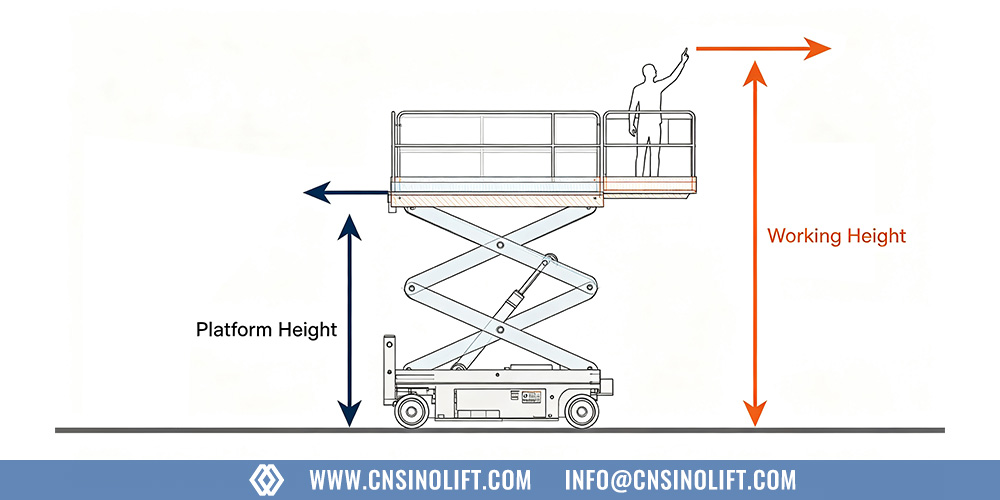
For example, if a technician needs to reach a cable tray at 10 meters, choosing a lift with a platform height of exactly 10 meters may provide more reach than actually required. The required platform height should be determined based on the actual work location and the working height as defined by the manufacturer.
It is better to choose a machine that provides adequate operating margin rather than one that only just reaches the target at its maximum rated height.
Match the Lift to the Highest Task
For example:
Low-level lighting, sensors, or cable work may only require a mini scissor lift or a mast lift.
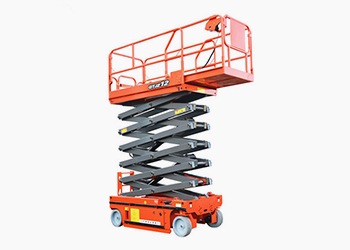
General server room maintenance may require a medium working height range (e.g., 7.8–9.8 m, covered by the GTJZ06 and GTJZ08).
Higher cable trays, cooling infrastructure, or overhead installations may require a greater working height (e.g., 11.8–15.8 m, covered by the GTJZ10, GTJZ12, and GTJZ14).
The key is to select the smallest machine that can safely cover the required working height and workload, rather than automatically purchasing the largest lift.
2. Choose Electric Power for Indoor Data Center Operations
For active data halls, battery-powered electric scissor lifts are generally the most practical configuration.
Electric lifts produce no local exhaust emissions during operation, making them suitable for enclosed indoor environments with controlled air quality and ventilation. They also typically operate more quietly than internal combustion engine equipment. Learn more about the advantages and disadvantages of scissor lifts to determine if they fit your operational needs.
When evaluating electric scissor lifts for a data center, consider:
Zero local exhaust emissions
Operating noise levels suitable for the facility
Battery capacity and charging time
Charging location and electrical requirements
Electrical system compatibility
Electromagnetic compatibility (EMC), if required by the facility
Do not assume that every electric lift is automatically suitable for every data center. Check the facility's specific requirements before bringing equipment into an active data hall.
3. Check Machine Width, Length, and Access Clearances
A scissor lift with sufficient lifting capacity but incapable of moving within the server room is not a practical solution.
Measure the complete route the machine must traverse, including:
Server aisles
Doorways
Access control doors
Corridors
Passenger or service elevators
Turns and intersections
Enclosed passage systems
Clearances around racks and other fixed equipment
Machine Width
Compare the machine's overall width with the narrowest point along the planned route, not just the nominal aisle width.
Compact and narrow-body scissor lifts are particularly useful in data centers where server racks are densely packed. For example, the GTJZ08Z narrow-body model has an overall width of 0.84 m, compared with 1.19 m for the standard GTJZ08, allowing it to operate in aisles where a conventional machine cannot pass. For the tightest spaces, the Mini GTJZ06M has overall dimensions of 1.85 × 0.84 × 1.85 m. You can explore our range of self-propelled electric scissor lifts for options that suit narrow aisles.
Stowed Height
Check the lift's height in transport or stowed condition.
A machine may fit easily between server racks but may not pass through a doorway due to its stowed height. Measure the actual clear opening height of doorways, including door closers, thresholds, overhead structures, and other potential obstructions.
If the machine has collapsible guardrails, check both the operating and stowed dimensions.
Turning Radius
A smaller turning radius makes it easier to reposition the machine between rack rows and around fixed equipment.
If the facility has particularly tight corners, compare the manufacturer's turning specifications with the actual route. Do not assume that a narrow-body machine automatically has sufficient maneuverability.
4. Verify Raised Floor Loadings and Wheel Loads
Floor compatibility is one of the most important considerations when selecting a scissor lift for a data center.
Many data centers use raised access floors with electrical, network, and cooling infrastructure beneath. The relevant constraints go beyond the machine's total weight.
You should verify:
Machine total weight
Facility floor loading requirements
Maximum allowable wheel load
Load distribution between wheels
Tire type and contact area
Whether the machine is approved for use on the facility's flooring system
A lightweight machine is not automatically suitable for all raised floors, and a heavy machine is not automatically unsuitable.
Before operation, compare the machine's actual wheel loads with the requirements of the floor manufacturer or facility engineer.
This is particularly important when the lift is being moved across raised access flooring, as the machine's weight distribution and wheel loads may be just as critical as the total weight.
5. Choose Non-Marking Tires for Indoor Finished Floors
Data centers may use raised floor panels, epoxy coatings, polished concrete, or other finished surfaces. Tire selection is therefore important.
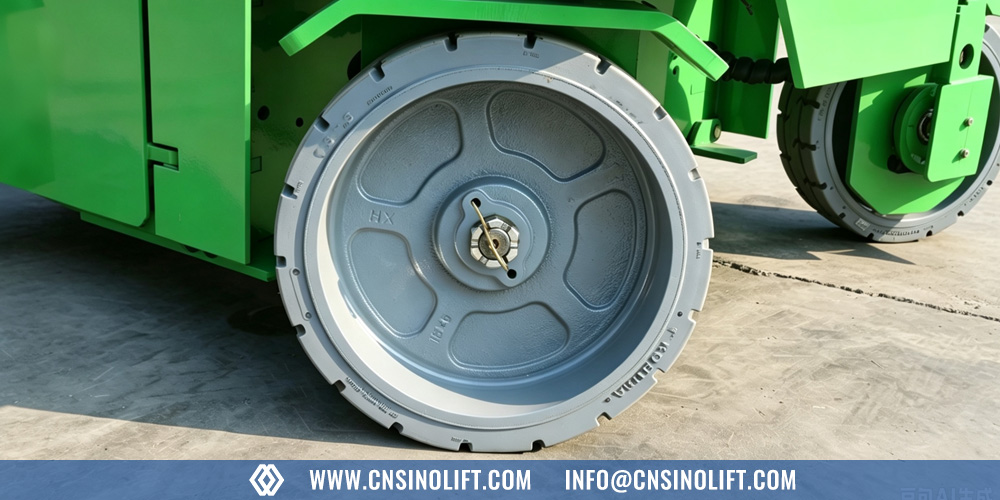
For indoor data center applications, look for non-marking tires suitable for finished floors.
They help reduce:
Black tire marks
Surface wear
Damage to finished flooring
Visible contamination during maintenance
However, non-marking tires do not eliminate floor loading concerns. You must still verify wheel loads and floor compatibility. For more insight on protecting delicate surfaces, read our article: Can you use an electric scissor lift on tile without causing damage?
Rough-terrain scissor lifts primarily designed for outdoor construction should generally not be used for indoor server room operations unless specifically permitted by the facility.
6. Match Platform Capacity to Technicians, Tools, and Materials
Platform capacity is not just the operator's body weight.
Total platform load may include:
One or more technicians
Hand tools
Test equipment
Cable management components
Replacement parts
Small installation materials
Before selecting a lift, calculate the expected workload.
Required platform capacity = Personnel + Tools + Materials + Other allowable platform loads
The selected machine should provide adequate capacity for the actual tasks while remaining within the manufacturer's rated limits.
Platform size is equally important.
A larger platform can make cable laying, HVAC maintenance, or equipment installation easier, but it may also increase the machine's overall dimensions. The goal is to balance workspace, capacity, and maneuverability.
7. Consider Whether Travel with Platform Raised Is Needed
For maintenance along long rows of equipment, a self-propelled scissor lift can improve efficiency.
Rather than repeatedly:
Lowering the platform
Driving to another location
Raising the platform again
Approved self-propelled models may allow the operator to reposition the machine with the platform elevated, subject to the manufacturer's operating restrictions.
This is useful for:
Long-run cable tray installation
Repeated lighting inspections
Security camera installation
Continuous work along server rows
Large data halls with multiple maintenance points
However, travel with platform raised is not merely a convenience feature. Operators must comply with the manufacturer's requirements for travel with platform raised, including restrictions related to ground conditions, slope, platform load, and other operating conditions.
8. Review Safety Features Before Purchase
Data centers combine overhead work risks with high-value electrical and IT infrastructure. Safety features should therefore be evaluated as part of the equipment specification.
Depending on the machine configuration and applicable requirements, important features may include:
Tip-over protection – Helps reduce the risk when the platform is elevated and the machine encounters floor gaps or uneven conditions. This is particularly relevant when operating around raised access floors.
Tilt and level monitoring – Tilt sensors or level monitoring systems can provide warnings or restrict operation if the machine exceeds its specified operating limits.
Overload protection – The lift should be equipped with appropriate overload protection to prevent operation beyond its rated platform capacity.
Emergency stop and emergency lowering – Emergency stop controls should be accessible at both the platform and ground controls, depending on the machine design. Emergency lowering systems provide a controlled means of lowering the platform when normal power operation is unavailable.
Guardrails and access gates – The platform should have guardrails, toe boards, and entry gates that comply with applicable machine configurations and safety requirements.
Hydraulic and electrical protection – For machines using hydraulic lifting systems, check how hydraulic components and potential leaks are managed, especially when operating above sensitive finished floors.
Always verify the actual safety features fitted to the specific model. Safety equipment and configurations may vary by model and market.
9. Consider Battery Runtime and Charging Arrangements
Data centers typically operate continuously, and maintenance may be restricted to specific service windows. Battery management therefore affects equipment availability.
When evaluating battery-powered scissor lifts, consider:
Battery capacity
Expected duty cycle
Charging time
Charger compatibility
Battery replacement requirements
Availability of spare batteries
Planned maintenance windows
Do not select a battery based solely on the manufacturer's maximum runtime data. Actual runtime depends on factors such as travel frequency, number of lift cycles, platform load, temperature, and operating conditions.
For facilities with frequent maintenance work, having a clear charging schedule or backup machines can help prevent equipment unavailability during critical maintenance windows.
It is also worth considering whether lithium batteries are suitable for the application, based on their charging characteristics, maintenance requirements, and total cost of ownership.
10. Determine Whether a Scissor Lift Is Indeed the Best Machine
Not every data center maintenance task requires a scissor lift.
Scissor lifts are particularly useful when technicians need a stable, spacious platform and may need to carry tools or work with multiple people.
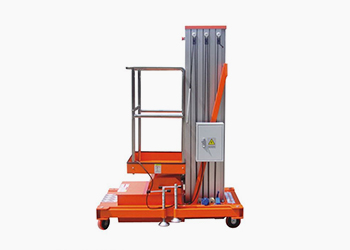
For very light-duty single-person tasks in extremely confined areas, an aluminum mast lift may be more appropriate. Explore our mast lift product range for compact alternatives.
Scissor Lift vs. Mast Lift
| Requirement | Electric Scissor Lift | Mast Lift |
|---|---|---|
| Platform workspace | Larger | More compact |
| Typical applications | General maintenance and multi-person tasks | Light-duty precision work |
| Maneuverability | Good | Excellent in confined spaces |
| Machine weight | Generally higher | Generally lower |
| Floor load sensitivity | Must be verified | Often advantageous where low weight is critical |
| Multiple technicians | Depends on capacity; generally more suitable | More limited, depending on model |
| Narrow doorways | Depends on model | Typically easier to pass through |
The point is not that one type is universally better. The task and site constraints determine the appropriate equipment.
11. Use a Simple Selection Process
A practical scissor lift selection process for data centers can be simplified into seven steps. For a comprehensive overview, refer to our Scissor Lift Purchasing Guide.
Step 1: Determine the highest work point – Measure the actual height of cable trays, cooling equipment, lighting, racks, or other maintenance targets.
Step 2: Determine the workload – Calculate the total of all technicians, tools, equipment, and materials that must be on the platform.
Step 3: Measure the access route – Record the narrowest aisle, smallest doorway, lowest headroom, elevator dimensions, and tightest turning points.
Step 4: Check the floor – Verify machine total weight and wheel loads against the facility's raised floor specifications.
Step 5: Select the machine type – Choose a self-propelled electric scissor lift when you need a stable work platform and repeated movement between maintenance points. Consider a mast lift when weight, doorway, or access restrictions make a scissor lift impractical.
Step 6: Verify safety and operational requirements – Check the machine's safety systems, applicable local requirements, operator requirements, and facility-specific rules.
Step 7: Check battery and service support – Ensure that charging, spare parts, maintenance, and technical support are available for the intended service life of the equipment.
12. Reference Examples for Scissor Lift Selection in Data Centers
The following examples illustrate how to apply the selection logic to specific product families (using a manufacturer's product line as an example), but all specific values should be based on official publications.
| Data Center Requirement Description | Equipment Type to Consider |
|---|---|
| General maintenance, working height approximately in the medium range (e.g., 8–10 m class) | GTJZ06 or GTJZ08 self-propelled electric scissor lift (working height 7.8 m / 9.8 m) |
| Narrow aisles requiring minimal machine width | GTJZ08Z narrow-body scissor lift (0.84 m width) or GTJZ06M mini scissor lift |
| Higher overhead work (e.g., top cables or cooling pipes) | GTJZ10 or GTJZ12 self-propelled electric scissor lift (working height 11.8 m / 13.8 m) |
| Maintenance of higher overhead infrastructure (e.g., 14 m class) | GTJZ14 self-propelled electric scissor lift (working height 15.8 m) |
| Very light-duty single-person tasks | Mast lift |
| Large data halls with multiple repeated maintenance points | Self-propelled electric scissor lift (with travel-with-platform-raised capability) |
Different manufacturers' product lines typically cover multiple working heights and load capacities. For example, the GTJZ08Z has an overall width of 0.84 m for narrow aisles, while the GTJZ16 offers a working height of 17.8 m with a safe working load of 320 kg. It is recommended to start from the actual measured highest work point, total load, access dimensions, and floor loading capacity, and then filter models from the product catalog that meet all conditions. Specific performance parameters (such as working height, rated load, external dimensions, etc.) should be based on the manufacturer's officially published data sheets.
Data Center Scissor Lift Selection Checklist
Before purchasing or renting a scissor lift, confirm the following:
□ Working height matches the highest maintenance point
□ Platform capacity covers technicians, tools, and materials
□ Platform size provides adequate working space
□ Machine width fits the narrowest aisles and doorways
□ Stowed height can pass through all entrances
□ Turning radius suits the planned route
□ Machine total weight is within facility limits
□ Wheel loads meet raised floor requirements
□ Tires are suitable for indoor finished floors
□ Electric drive is suitable for the environment
□ Battery capacity matches the maintenance schedule
□ Required safety systems are installed
□ Operators have received appropriate training
□ Machine complies with applicable local requirements and the manufacturer's operating instructions
Conclusion
Selecting a scissor lift for data center maintenance is not just about choosing the highest lift height or the largest platform.
The right machine should provide adequate reach for the job, fit through the facility's access routes, be compatible with the flooring system, carry the required personnel and tools, and operate safely in an indoor technical environment.
For many general indoor maintenance applications, a battery-powered electric scissor lift is a practical starting point. Where access is extremely constrained or floor loading is a primary concern, a compact scissor lift or mast lift may offer a better solution.
The best approach is to work backwards from the actual maintenance task:
What needs to be reached → How much must be carried → Where must the lift fit → What can the floor support → Which machine configuration satisfies all these conditions?
Once these requirements are defined, selecting the right scissor lift becomes a straightforward engineering decision rather than a guess based solely on lift height.
Always comply with the manufacturer's operation manual, applicable local regulations, site-specific safety procedures, and facility requirements. Equipment should only be operated by properly trained and authorized personnel. All specific technical parameters (such as working height, rated load, external dimensions, etc.) should be based on the manufacturer's officially published product data sheets.
About HENAN SINO LIFT
HENAN SINO LIFT is committed to providing customers with high-quality, high-performance industrial equipment. Over the years, we have adhered to technological innovation and product quality, earning the trust and support of our customers.
We manufacture scissor lifts, mast lifts, boom lifts, cargo lifts, loading ramps, wheelchair lifts, and warehouse handling equipment. If you need these products, please let us provide you with the right solution.
For more information or to consult on specific selection, please contact us.
Email: info@cnsinolift.com
Website: www.cnsinolift.com
.png)