


The key difference is simple: a scissor lift moves straight up, while a boom lift can reach up and over obstacles. This guide explains the differences between the two designs, walks through the specifications that matter most, and gives you a straightforward way to match the machine to your actual site conditions.
What Is a Scissor Lift?
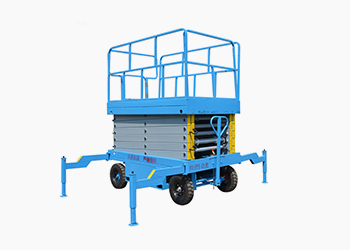
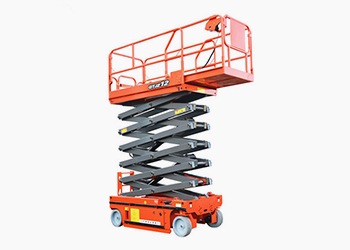
A scissor lift raises a large platform straight up and down on a set of linked, crisscrossing supports. The main platform remains directly above the machine's footprint. That simple motion brings a practical reward: a big, stable deck that carries several workers, tools, and materials at once. For a comprehensive overview of scissor lift types, selection criteria, and procurement strategies, see our Scissor Lift Purchasing Guide.
HENAN SINO LIFT builds electric scissor lifts in its GTJZ line, spanning a working-height range of roughly 7.8 m to 17.8 m. A few models show how the line scales:
| Model | Platform height | Working height | Rated load | Machine weight |
|---|---|---|---|---|
| GTJZ08 | 7.8 m | 9.8 m | 450 kg | 2,300 kg |
| GTJZ10 | 9.8 m | 11.8 m | 320 kg | 2,530 kg |
| GTJZ12 | 11.8 m | 13.8 m | 320 kg | 2,870 kg |
| GTJZ14 | 13.8 m | 15.8 m | 227 kg | 3,340 kg |
| GTJZ16 | 15.8 m | 17.8 m | 320 kg | 4,590 kg |
Two pairs of numbers in this table are easy to mix up, and both matter when you choose a machine. Platform height is where the deck itself stops; working height is the platform height plus roughly 2 m, which is the reach a person gets standing on the deck with arms raised. Always select by working height, not platform height.
The second mix-up is rated load versus machine weight. The 320 kg on a GTJZ10 is the load the platform can carry — operators, tools, and material combined. The 2,530 kg is the machine's own weight, which is what the floor or slab actually has to support. A scissor lift does not weigh its rated load.

To better understand the trade-offs between different scissor lift configurations, read our detailed analysis of the advantages and disadvantages of scissor lifts.
What Is a Boom Lift?
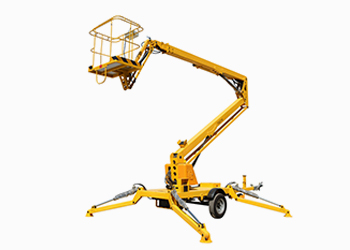
A boom lift, also called a cherry picker, carries a smaller basket on the end of a hydraulic arm that extends outward as well as upward. Because the arm can swing past the machine's footprint, a boom lift reaches points a vertical-only lift cannot — over a wall, under a roofline, or around stored racking.
SINO LIFT's TGZ articulating booms cover working heights from 12 m to 22 m:
| Model | Platform height | Working height | Rated load | Machine weight | Working radius |
|---|---|---|---|---|---|
| TGZ10 | 10 m | 12 m | 200 kg | 2,000 kg | 5.5 m |
| TGZ14 | 14 m | 16 m | 200 kg | 2,300 kg | 8.5 m |
| TGZ16 | 16 m | 18 m | 200 kg | 2,500 kg | 10.5 m |
| TGZ20 | 20 m | 22 m | 200 kg | 3,200 kg | 11 m |
These are articulating machines: the arm bends at a hinge so the basket can be placed up and over an obstruction. They rotate nearly a full circle — 359° — which lets one machine serve several work points without repositioning. TGZ models are equipped with hydraulic outriggers that are set before lifting, keeping the machine stable even when the basket sits well beyond the chassis. SINO LIFT also offers diesel-powered boom lift options for outdoor applications.
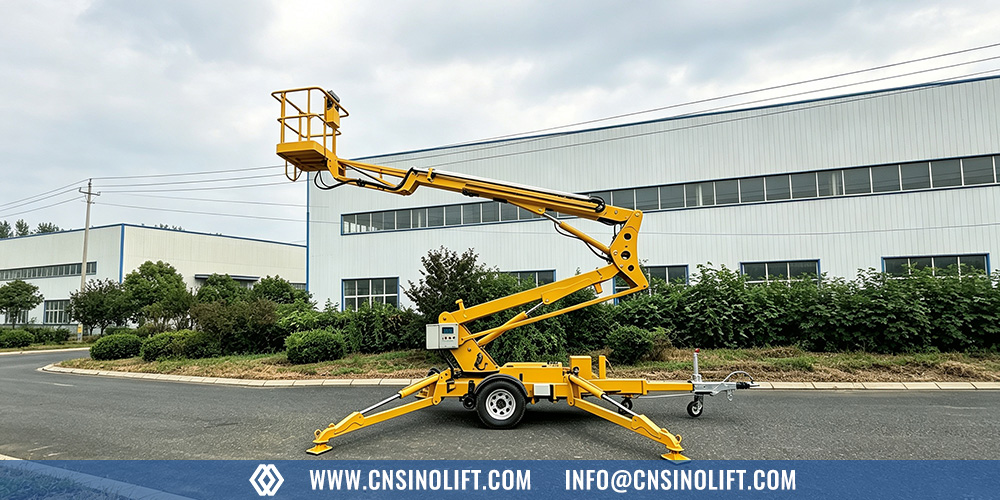
For a deeper dive into towable boom lift applications, height ranges, and towing requirements, explore our comprehensive Towable Boom Lift Guide.
Scissor Lift vs. Boom Lift at a Glance
| Factor | Scissor lift | Boom lift |
|---|---|---|
| Movement | Vertical only | Vertical plus horizontal outreach and rotation |
| Working height | About 7.8–17.8 m (GTJZ) | 12–22 m (TGZ) |
| Horizontal reach | None | 5.5–11 m working radius |
| Rated load | 227–450 kg | 200 kg |
| Platform | Large platform for multiple workers, tools, and materials | Compact basket for 1–2 workers |
| Typical site | Flat indoor slab | Outdoor or obstacle-heavy sites |
| Power | Electric | Electric / hydraulic |
When to Choose a Scissor Lift
A scissor lift is the right tool when the work point is directly overhead and you need room to work. That describes most indoor maintenance and construction:
- Warehouse racking, inventory, and order picking
- Ceiling, lighting, HVAC, and electrical work in open halls
- Drywall, painting, and finishing
- Schools, hospitals, retail fit-outs, and other finished-floor buildings
The strengths are the large deck, high rated load, simple controls, and quiet electric drive with no exhaust — a real advantage on enclosed, occupied floors. Because the deck is wide and flat, it doubles as a mobile workbench: two or three workers can stand at the work point with tools and material within reach, which keeps a team moving instead of making repeated trips up and down.
The trade-off is geometry. A scissor lift cannot move sideways or go around anything, so the base must sit directly under the work area, and standard GTJZ models require a level slab. Height also has a ceiling — the GTJZ line tops out around a 17.8 m working height — so high facade work is out of scope.
For rough or outdoor ground, SINO LIFT offers the GTJZ RE rough-terrain line, available with electric or diesel drive options. The GTJZ12RE, for example, reaches a 14 m working height with a 320 kg rated load on 33×12-20 solid tires and a 30% climbing ability — the same reach class as an indoor GTJZ12, but built for uneven sites rather than finished floors.
For detailed specifications and customization options for self-propelled electric scissor lifts, visit our Self-Propelled Electric Scissor Lift product page.
When to Choose a Boom Lift
Choose a boom lift when the work point is not directly above the machine, or when the height exceeds what a scissor lift reaches. Common jobs include:
- Exterior facade, curtain-wall, and window work
- Roof-edge, gutter, and signage work
- Bridge, highway, and streetlight maintenance
- Tree trimming and utility work
- Reaching over machinery, racking, or production lines
The trade-off is platform size and capacity: boom lift baskets are smaller and typically carry less than scissor lift platforms. The basket holds one or two people and about 200 kg, and the machine needs clearance for the arm to swing and rotate. That makes it a poorer fit for team tasks with heavy materials, and the more complex arm means more training and a higher price than a comparable scissor lift. Even so, when the work point sits past a wall, roofline, or rack of shelving, none of those drawbacks matter — the boom lift is the only machine that reaches it.
Explore the full range of towable hydraulic articulated boom lifts for various working heights and configurations.
How to Choose Between a Scissor Lift and a Boom Lift
Ask these five questions before making a decision:
1. What working height do you need?
Up to about 17.8 m, a scissor lift may work. Above that, or for facade work at height, a boom lift is the answer.
2. Is the work directly above the machine?
If a dock, overhang, wall, or stacked goods sits between the base and the work point, you need a boom lift.
3. How many people and how much material?
Team tasks with tools and materials favor a scissor lift's big deck and higher rated load.
4. What is the ground like?
A flat concrete slab suits an electric scissor lift. Uneven or sloped outdoor ground calls for a rough-terrain scissor lift or a boom lift with outriggers.
5. What does the budget allow?
For applications that do not require outreach, scissor lifts are generally the more economical choice because their design is simpler and they do not need a multi-section boom system. Reserve the boom lift for jobs where the reach is non-negotiable. For current pricing and cost comparisons across different scissor lift types, refer to our Scissor Lift Price Guide.
A simple shortcut: flat ground, direct overhead access, and a crew on the platform points to a scissor lift; an obstacle in the way, high reach, or a single operator points to a boom lift.
Quick Selection Checklist
Run down this list when the choice is not obvious:
- Work point directly above the machine, flat floor, and several workers → scissor lift
- Obstacle between the base and the work point → boom lift
- Enclosed space where noise or exhaust is a problem → electric scissor lift
- Uneven or sloped outdoor ground → rough-terrain scissor lift or boom lift
- Budget is tight and the reach is modest → scissor lift
- Height beyond about 18 m, or work over a parapet → boom lift
Summary
| Choose a scissor lift if… | Choose a boom lift if… |
|---|---|
| The work is directly overhead | You need horizontal reach |
| The required working height is within the scissor lift's available range | The working height exceeds 18 m |
| You need a large platform for a crew | One or two workers is enough |
| You are carrying heavy tools and material | You only need a basket of about 200 kg |
| The ground is a flat, level slab | The ground is uneven or sloped |
| You are working indoors | You are working over or around obstacles |
| Budget is often a deciding factor | Reach is non-negotiable |
Safety Considerations
For U.S. worksites, OSHA applies different regulatory requirements to scissor lifts and boom lifts.
Scissor lifts are generally treated as mobile scaffolds under OSHA's scaffold requirements, including 29 CFR 1926.452(w). When a scissor lift has a properly designed and maintained guardrail system that meets applicable OSHA requirements, the guardrails provide the required fall protection for workers on the platform. Additional personal fall protection may be required in situations where the guardrail system does not provide adequate protection or when workers are exposed to fall hazards outside the protected platform area.
Boom lifts are covered by OSHA's aerial lift requirements under 29 CFR 1926.453. Section 1926.453(b)(2)(v) requires workers in aerial lifts and boom-type platforms to be tied off while elevated. This generally means using a full-body harness with a lanyard or self-retracting lifeline (SRL) connected to a manufacturer-approved anchorage point inside the platform.
Both types of equipment require proper pre-operation inspections, trained and authorized operators, and operation within the manufacturer's rated limits. Operators should also check site conditions, including the machine's allowable slope, wind limits, ground conditions, and rated platform capacity before starting work.
In the United States, applicable OSHA requirements should be considered together with relevant industry standards, including ANSI A92.22 for the safe use of mobile elevating work platforms (MEWPs) and ANSI A92.24 for training requirements.
Note: This information is provided for general educational purposes and does not constitute legal or compliance advice. Employers and equipment users should consult the current OSHA and ANSI standards and determine the requirements applicable to their specific equipment, worksite, and operations.
Frequently Asked Questions
What is the main difference between a scissor lift and a boom lift?
Movement. A scissor lift goes straight up with a large platform; a boom lift adds horizontal outreach and rotation so it can reach over obstacles.
Which is safer?
Both are safe when used within rated limits. A scissor lift is simpler and more stable for straight vertical work; a boom lift requires more training because stability drops as the arm extends.
Can a boom lift be used indoors?
Yes, for spacious high-reach work, though its swinging arm needs clearance. For most indoor tasks an electric scissor lift is quieter, cleaner, and easier to maneuver on finished floors.
Do I need different training for each?
Both require operator training, but boom lift operation involves more advanced instruction because of its movement and stability limits.
Which costs less?
A scissor lift is generally less expensive when the application does not require horizontal reach. A boom lift costs more because its articulated boom, hydraulic system, and additional reach capability add complexity.
How is a lift different from a ladder?
A ladder gives one person a small, temporary platform, while a scissor or boom lift provides a stable, guarded deck that carries tools and material and can be repositioned at height. For sustained work, a lift is both safer and faster.
About HENAN SINO LIFT CO., LTD
HENAN SINO LIFT manufactures electric and hydraulic aerial work platforms, including scissor lifts and boom lifts, with different working heights, load capacities, and configurations for indoor and outdoor applications.
Our product range includes Scissor Lifts, Mast Lifts, Boom Lifts, Cargo Lifts, Loading Ramps, Wheelchair Lifts, and Warehouse Handling Equipment.
Email: info@cnsinolift.com
Website: www.cnsinolift.com
If you are deciding between a scissor lift and a boom lift, send us your required working height, working radius, platform load, ground conditions, and application environment (indoor or outdoor). Our engineering team can recommend a suitable model for your needs. Contact us for expert guidance and a tailored quote.