


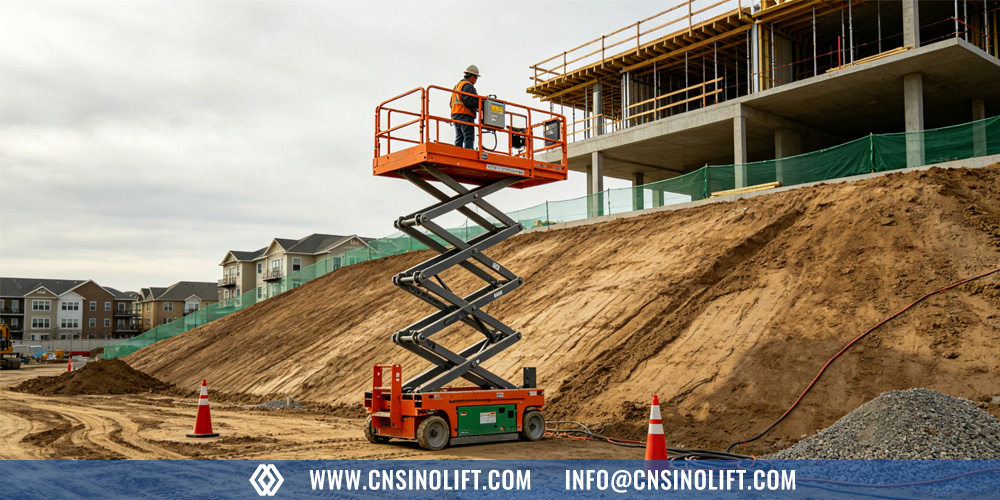
The question comes up on almost every outdoor job: can you operate a scissor lift on a slope?
Some scissor lifts can be driven on slopes within their rated limits, but elevated operation on a slope is subject to much stricter limits. Scissor lifts are designed for stable ground conditions, and the machine's own operating limits matter more than how steep a slope looks to the operator. This guide explains gradeability, working slope limits, the relevant safety requirements, and how to choose the right machine for sloped work. For a broader overview of scissor lift selection across different applications, see our Scissor Lift Purchasing Guide.
Driving and Elevating Are Two Different Limits
Scissor lift specifications commonly include two different slope-related ratings: gradeability for driving and a maximum allowable tilt (or working slope) for elevated operation. Mixing them up is one of the most common mistakes when evaluating a scissor lift for sloped ground.
Gradeability – the steepest grade the machine can climb when the platform is fully lowered.
Allowable working slope (or tilt angle) – the maximum slope on which the platform may be safely raised, according to the manufacturer's specifications.
The allowable slope for elevated operation is typically much lower than the machine's driving gradeability.
A standard self-propelled electric scissor lift in the GTJZ range has a gradeability of 25%, roughly a 14-degree incline. That means it can drive up a reasonably steep ramp or driveway with the platform stowed. But the allowable working angle is only 1.5° side-to-side and 3° front-to-back (about a 2.6% and 5.2% grade). On anything steeper than the specified working limit, the platform must remain lowered.
Grade and Angle, Explained
Slope is commonly quoted either as a percentage grade or as an angle in degrees. The two measurements describe the same surface, but they are not interchangeable numbers.
Grade percentage and degrees are not interchangeable values; the angle is calculated as arctan(grade ÷ 100).
| Grade | Angle | What it looks like |
|---|---|---|
| 5% (1:20) | ~3° | Gentle ramp or driveway pitch |
| 25% (1:4) | ~14° | Steep driveway; maximum drive grade for standard electric scissors |
| 30% (1:3.3) | ~17° | Rough, uneven ground; maximum drive grade for rough terrain scissors |
| 40% | ~22° | Off-road grade; the largest model in the range only |
A 25% grade means the surface rises 25 units for every 100 units of horizontal distance. It is a much steeper surface than most people picture when they hear "25 percent."
How Do You Measure a Slope for a Scissor Lift?
Before you rely on any slope rating, you need to know the actual angle or grade of the site. Measuring the ground where the machine will actually operate is much more reliable than estimating the slope by eye.
There are two practical methods.
1. Use a digital inclinometer
A digital inclinometer is the quickest method for measuring slope angle. Place it on a representative section of the ground where the machine will be positioned and read the angle directly. Make sure the measurement reflects the actual operating area rather than a nearby section of the site.
2. Use a level and tape measure
You can also calculate the grade by measuring the vertical rise over a known horizontal distance.
For example, if the ground rises 25 cm over a horizontal distance of 100 cm, the grade is 25%.
Then convert the grade to degrees:
angle = arctan(grade ÷ 100) → 25% ≈ 14°
This method is useful when a digital inclinometer is not available, but the measurement needs to be taken carefully. Small changes in ground conditions can affect the machine's stability, especially on uneven or soft surfaces.
Always measure the slope where the machine will actually be positioned—not just at the edge of the site.
What the Standards Require
Slope use is covered by regulations and standards that all point in the same direction: safe setup comes first, and the manufacturer's instructions are critical.
OSHA requires employers to follow safe operating practices and applicable manufacturer instructions for mobile scaffolds and aerial equipment (see 29 CFR 1926 subpart L for general scaffold requirements, but always prioritize the specific machine manual). For scissor lifts, the data plate and operating manual are the primary references for allowable slope, setup, travel, and elevated operation.
ANSI/ITSDF B354.4 addresses stability, safety controls, and operating requirements for self-propelled elevating work platforms. The actual allowable slope or tilt limit must always be taken from the specific machine's documentation.
EN 280 includes requirements related to stability, safety devices, and platform-levelling or inclination monitoring for applicable mobile elevating work platforms.
Never assume that a machine's ability to drive up a slope means it is safe to elevate the platform on that same slope. If the data plate or manual lists a lower limit than any general guideline, that lower number is the rule.
Slope Ratings by Machine Type
All models and specifications mentioned in this section (including GTJZ, GTJZ RE, and tracked series) are SINO LIFT products. The performance data and slope ratings provided below reflect our own factory testing and product documentation.
Not all scissor lifts are created equal on a slope. Three families cover different applications, and their ratings differ in useful ways.
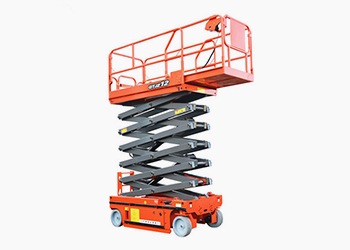
Standard electric scissors (GTJZ series) – These are designed for indoor and finished-surface applications. Across the range, working heights run from 7.8 m to 17.8 m with safe working loads from 227 kg to 550 kg. Gradeability is 25%, and the allowable working angle is 1.5° laterally and 3° longitudinally. They are generally suited to warehouses, workshops, and level paved areas rather than angled ground.
Rough terrain scissors (GTJZ RE series) – These are built for outdoor and uneven sites. Gradeability rises to 30%, and the working angle stays at 1.5° × 3°. The machines also feature solid tyres, higher ground clearance, and a levelling system designed to help maintain stability within its specified operating range. The levelling system does not eliminate the manufacturer's slope or stability limits. SINO LIFT's GTJZ RE series is available with both electric and diesel power options, allowing operators to choose the right power source for their site conditions and duty cycle requirements. Learn more about rough terrain scissor lift specifications and configurations.
The GTJZ12RE provides a 12 m platform height and 14 m working height with a 320 kg load, while the largest model (GTJZ20RE) reaches a 22 m working height, 500 kg load, and 40% gradeability.
Tracked scissors – These are useful for soft or finished ground where conventional wheels may sink or leave marks. Tracked models carry a 30% gradeability and a working angle around 1.5° side-to-side and 2.5° front-to-back. The track footprint distributes the machine's weight over a larger area and can provide better traction on loose surfaces. See the full crawler scissor lift product range for detailed specifications.
The table below summarizes the practical difference.
| Machine type | Drive gradeability | Allowable working angle |
|---|---|---|
| Standard electric scissor (GTJZ) | 25% (~14°) | 1.5° side / 3° front-back |
| Rough terrain scissor (GTJZ RE) | 30% (~17°) | 1.5° side / 3° front-back |
| Tracked scissor | 30% (~17°) | 1.5° side / 2.5° front-back |
Why Slopes Cause Tip-Overs
A scissor lift's centre of gravity rises as the platform goes up. On level ground, the machine's weight remains within the base of support. On a slope, the ground angle changes the relationship between the machine's centre of gravity and its support area. Elevating the platform can reduce the available stability margin. For a deeper look at this topic, read our article: Do Electric Scissor Lifts Tip Over Easily?
Several factors can increase tip-over risk on a grade:
- Soft or uneven ground – a wheel sinking into a depression, wet grass, or loose fill can change the machine's position even when the overall slope is mild.
- Side slopes – lateral tilt can present a particularly serious rollover risk because instability can develop quickly, especially when the machine is elevated.
- Overload – extra weight on the platform changes the machine's load distribution and reduces the available safety margin.
- Driving while raised – moving the machine with the platform up changes its stability characteristics and may be prohibited or severely restricted by the manufacturer.
Modern scissor lifts may use tilt sensors and interlocks to warn the operator or restrict certain functions when the machine exceeds its permitted inclination. The alarm is not a nuisance—it is the machine indicating that the operating condition may be outside its permitted range.
Real Incidents
Tip-overs are a serious hazard in aerial lift operations, and accident investigations repeatedly point to factors such as unstable ground, improper setup, overloading, inadequate training, and operation outside the equipment's limits. For more documented cases and analysis, see What Are Common Scissor Lift Accidents?
Two cases show how quickly a seemingly manageable slope can become dangerous.
In one OSHA-recorded incident, two electricians set a scissor lift on a sloped wheelchair ramp and attempted to level it with an unsecured wooden assembly. The platform was raised to full height, the wood shifted, and the lift tipped down the ramp, ejecting both workers; one suffered a fractured back.
In a NIOSH FACE investigation, a painter was working from a platform raised to about 17 feet on a sloping asphalt lot. The lift was positioned sideways on the slope, the operator had not been trained on the model, and damaged outriggers were left unused. The machine tipped and the operator died.
The lesson in both cases is straightforward: a slope does not need to look extreme to create a serious hazard. The combination of slope, ground condition, machine setup, equipment condition, and operator practices determines the actual risk.
How to Work Safely on a Slope
When a slope cannot be avoided, follow the machine manufacturer's operating instructions and assess the site before starting work.
Before you start
- Measure the slope with a digital inclinometer or level, not by eye.
- Check the data plate and manual for the gradeability and allowable working slope limits.
- Inspect the surface for soft ground, holes, debris, and wet spots.
- Position the machine according to the manufacturer's instructions and the site's slope conditions. Where applicable, avoid positioning the machine sideways across a slope because lateral instability can be a greater concern.
During the job
- Keep the platform fully lowered whenever the machine is moving—unless the manufacturer's instructions specifically allow elevated travel under defined conditions.
- Raise the platform only after the machine is in its final position and within the specified working slope limit.
- If the machine has outriggers or a levelling system, deploy and use them according to the manufacturer's instructions, on suitable supporting ground or pads where required.
- Travel slowly and avoid sharp turns or sudden stops on a grade.
If the tilt alarm sounds
- Stop lifting and stop driving.
- Lower the platform if it is raised.
- Move the machine back onto level, firm ground and recheck the slope.
Do not block up one side of the machine with timber or plates to silence the alarm. That defeats a safety system designed to warn the operator about an unstable operating condition.
Common Mistakes
| Mistake | Correct practice |
|---|---|
| Judging a slope by eye | Measure it with an inclinometer |
| Raising the platform while driving on a grade | Drive low, elevate only when stationary and within the manufacturer's limits |
| Setting up sideways on a slope | Follow the manufacturer's positioning requirements and avoid unnecessary lateral exposure |
| Ignoring the tilt alarm | Stop, lower, and reposition on suitable ground |
| Using a standard electric scissor on grass or gravel | Use a rough terrain or tracked model when the application requires it. For specific guidance on operating on grass, read How to Use a Scissor Lift on a Lawn. |
| Assuming gradeability equals working angle | Check the working slope limit separately |
Frequently Asked Questions
What is the maximum slope for a scissor lift?
There is no single maximum slope for every scissor lift. The allowable limit depends on the machine's design and manufacturer specifications. Some models specify separate limits for side-to-side and front-to-back tilt, while others may require level ground for elevated operation. Always check the data plate and manual for your specific machine.
Can I raise the platform while on a slope?
Only if the slope is within the allowable working angle and the manual permits it. Some models restrict or prohibit elevation on a slope, while others specify a limited allowable tilt. The manufacturer's working slope or tilt specification is the number to check.
What is the difference between gradeability and working angle?
Gradeability is how steep a grade the machine can drive up with the platform stowed. Working angle is the amount of slope or tilt allowed while the platform is raised. The allowable working slope is typically the stricter limit.
Do outriggers or a levelling system help on a slope?
They can, when the machine has them and the slope is within the levelling system's rated range. They are designed to help maintain stability within specified operating conditions. They do not turn a steep, unapproved slope into level ground.
My scissor lift alarm went off on a slope. What should I do?
Lower the platform, move the machine off the slope onto suitable level ground, and investigate the cause. Never bypass or disable the tilt sensor or other safety devices.
Should I use a rough terrain or tracked model instead?
If the site is unpaved, soft, uneven, or moderately sloped, a rough terrain or tracked scissor may be a better match than a standard electric scissor. The final choice should still be based on the machine's rated capabilities and the actual site conditions.
Choosing the Right Machine
Before you rent or buy, write down four things: the measured slope in percentage or degrees, the ground surface, the working height you need, and whether the work is indoor or outdoor.
For level, paved indoor or finished-surface work, a standard electric scissor is often the most practical choice. For uneven or sloped outdoor ground, a rough-terrain or tracked model may be more appropriate—and steeper sites may require a different type of access equipment altogether. For a detailed cost breakdown across different types and heights, refer to our Scissor Lift Price Guide.
The key is to match the machine's rated capabilities to the actual site conditions—not simply choose the machine with the highest gradeability.
About HENAN SINO LIFT CO., LTD
HENAN SINO LIFT is a manufacturer of electric and hydraulic scissor lifts for indoor, warehouse, construction, and light industrial applications. We provide different platform heights, capacities, dimensions, and configurations for specific site requirements.
Our product range includes Scissor Lifts, Mast Lifts, Boom Lifts, Cargo Lifts, Loading Ramps, Wheelchair Lifts, and Warehouse Handling Equipment.
Email: info@cnsinolift.com
Website: www.cnsinolift.com
Send us your required working height, the measured site slope, ground surface, and whether the application is indoor or outdoor. Our team can recommend a suitable model for your condition. Contact us for more information or to request a quote.