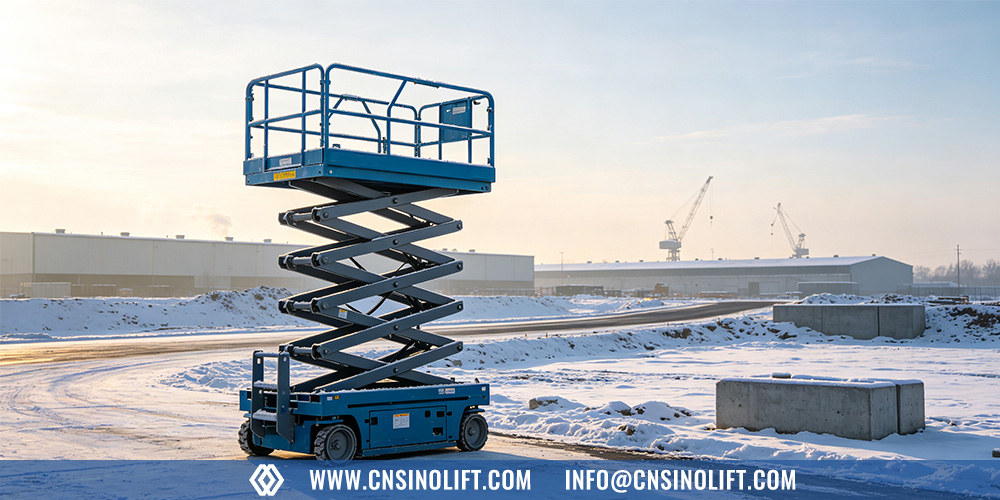
Yes, scissor lifts can be used in winter. Cold weather itself is not necessarily a reason to stop work, but freezing temperatures, snow, ice and strong winds can affect the battery, hydraulic system, traction and overall operating safety. This guide explains when a scissor lift can be used in freezing weather, how cold conditions change machine behaviour, how to prepare and operate the lift, and when to stop work.
Yes, but suitability depends on the model, the work environment and the ground conditions. Always check the operator manual and the nameplate before working in freezing conditions.
Indoor winter work. Electric scissor lifts are commonly used indoors in winter. Stable indoor temperatures reduce cold-start concerns, but cold air entering through open doors can still affect battery performance and hydraulic response.
Covered outdoor work. Work under a roof or in a covered bay may be possible, but the machine still needs to operate within its specified temperature range and should be protected from prolonged exposure to snow, ice and moisture. For more on moisture exposure, see can electric scissor lifts get rained on?
Outdoor work in snow or ice. This requires a machine rated for the intended outdoor conditions, with suitable tyres, hydraulic fluid and ground clearance. Snow and ice must be assessed and cleared as necessary, and the surface must meet the operator manual requirements.
Sub-zero conditions. Operation below freezing depends on the specific model, battery type, hydraulic-fluid grade and manufacturer specifications. Never assume a standard indoor model is rated for sustained sub-zero outdoor work.
Cold weather does not necessarily stop a scissor lift from working. It changes how the machine behaves.
Battery performance. Lead-acid traction batteries deliver less usable capacity as temperatures fall. A battery that provides a full shift in mild conditions may provide significantly shorter operating time in cold weather, especially when temperatures remain well below freezing.
Hydraulic system. Hydraulic oil becomes more viscous at low temperatures, which can slow cylinder response and affect pump flow. The hydraulic-fluid grade should match the expected operating temperature and the manufacturer’s recommendations.
Tyres and traction. Cold temperatures can reduce tyre pressure. Check pneumatic tyres before operation and inflate them to the manufacturer’s specified pressure. Solid tyres do not require air-pressure adjustment, but traction can still be reduced on snow, ice or wet surfaces.
Snow and ice. Snow and ice on the platform add extra weight and must be removed before raising. Ground conditions must meet the operator manual. Untreated glare ice is not a safe working surface.
Visibility and wind. Frost and short daylight hours can reduce visibility around the platform and base. Strong winds, snowfall and poor visibility can make elevated work unsafe even when the air temperature is within the machine’s operating range.
Battery. Park the lift in a suitable protected area when possible. If the machine or battery is stored in cold conditions, follow the battery and charger manufacturer’s storage and charging requirements. Check battery condition, terminal tightness and visible signs of corrosion before use.
Hydraulic fluid. Confirm the hydraulic fluid grade matches the expected climate. Use only the fluid grade specified in the operator manual for the expected operating temperature.
Tyres. Check tyre pressure and condition. Inflate pneumatic tyres to the manufacturer’s specified pressure and replace any tyre with sidewall cracking or other visible damage.
Platform and controls. Clear snow, ice and frost from the platform, guardrails, tyres and accessible sensors before operation. Test limit switches, emergency stop buttons, tilt sensors and pothole protection according to the operator manual.
Snow and ice removal. Remove snow and ice from the platform deck and around the base before raising. Continue checking the work area if snow or ice accumulates during the shift.
Warm up according to the operator manual. Some machines require a warm-up period in low temperatures. Follow the procedure specified for the particular model rather than using a fixed warm-up time.
Start slowly. Avoid rapid lifting, sudden stopping and full-load operation until the machine reaches normal operating conditions.
Reduce travel speed. Keep travel speed low on wet, frosted or polished surfaces, and on any surface where traction may be reduced.
Avoid icy surfaces. Do not operate on untreated glare ice. If ice cannot be cleared or the ground does not meet the manufacturer’s requirements, stop work and change the method or machine.
Monitor battery performance. Cold weather can reduce available battery capacity. If runtime drops sharply, recharge the battery according to the manufacturer’s charging requirements and check the battery condition before returning the lift to service.
Watch ground conditions. Ensure the surface meets the operator manual. Clear snow and ice as needed, and identify uneven, soft or slippery areas before moving the lift. Stability on uneven ground is critical; see do electric scissor lifts tip over easily?
Stop if abnormal. Stop work if the lift behaves unusually, such as jerky elevation, steering problems, warning lights or a sudden drop in drive performance. Reviewing common scissor lift accidents can help operators recognize early warning signs.
| Component | What To Check |
|---|---|
| Battery | Charge, terminals, capacity, charger profile |
| Hydraulic System | Fluid grade, leaks, filters, response |
| Tyres | Pressure, wear, traction, sidewall cracks |
| Platform | Snow, ice, drainage, guardrails |
| Electrical System | Moisture, connectors, harness chafing |
| Safety Devices | Emergency stop, sensors, tilt, pothole protection |
Have the battery inspected before winter and check the condition of the terminals, cables and charger. For lead-acid batteries, follow the manufacturer’s charging and equalisation requirements.
Replace hydraulic return filters and confirm the suction strainer is clean according to the maintenance schedule.
Inspect hoses and fittings along the scissor stack, especially around bend points. Torque wheel nuts and check tyre condition. Replace any tyre with sidewall cracking or other visible damage.
Confirm the hydraulic fluid grade matches the climate and the operator manual. Do not mix viscosity grades unless approved by the manufacturer.
Lubricate pivot points according to the maintenance schedule. In cold conditions, use the lubricant specified for the machine and operating temperature.
Check hydraulic level with the lift fully lowered and on level ground. Top up with the same approved fluid grade; do not mix viscosity grades unless specifically approved by the manufacturer.
Keep battery tops and terminals clean, check cable connections, and verify that the charger profile matches the battery type. Test safety devices according to the operator manual.
For machines that remain idle for extended periods, follow the manufacturer’s recommended storage and periodic inspection procedure.
Wash the chassis to remove salt and de-icing chemicals that can damage paint and electrical connectors.
Inspect the harness for chafing under the scissor arms. Salt and de-icing chemicals can accelerate corrosion of electrical connectors and wiring.
Recheck wheel bearings and the steer linkage after a winter of compacted snow and grit.
Severe icing. The only available surface is untreated glare ice, or ground conditions do not meet the operator manual.
Poor visibility. Heavy or persistent snowfall reduces visibility for the platform operator and ground spotter.
Unsafe wind. Strong winds or gusts make elevated work unsafe, even if the air temperature is within the machine’s operating range. Always follow the wind-speed limit specified for the machine.
Ground cannot support the machine. Snow accumulation is deeper than the chassis ground clearance, or the ground is uneven, soft or unstable.
Machine shows abnormal movement. Jerky elevation, steering problems, warning lights, or a sudden drop in drive performance.
Temperature outside manufacturer specifications. The ambient temperature is below the rated operating range shown in the operator manual or on the nameplate.
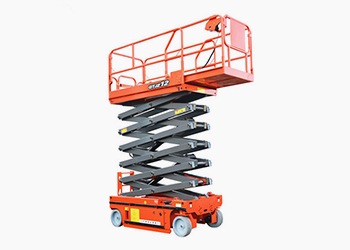
For indoor and mild outdoor winter work, the SINO LIFT GTJZ series of self-propelled electric scissor lifts is the practical choice. A 12 m platform model such as the GTJZ12 runs on 4×6V/200Ah lead-acid traction batteries, weighs roughly 2,870 kg (6,327 lb), and reaches about 25% gradeability — well suited to warehouses and loading docks but not heavy winter conditions.
For sustained outdoor work on rough, wet, snowy or icy ground, the SINO LIFT GTJZ RE series is designed for more demanding outdoor conditions. The GTJZ12RE uses 33×12-20 solid tyres, 8×6V/260Ah batteries, weighs about 3,810 kg (8,400 lb), and reaches about 30% gradeability, with a hydraulic system designed for outdoor use and solid tyres suited to wet, snowy and icy ground. As with any scissor lift, the actual work surface must still meet the operator manual requirements. For a broader comparison of models and configurations, see our scissor lift purchasing guide.
Send us your working height, doorway and corridor widths, ground conditions, and whether the lift operates indoors or outdoors. Our team can recommend a suitable GTJZ or GTJZ RE configuration. For budget planning, see our scissor lift price guide.
Can a scissor lift be used below freezing?
It depends on the model, battery type, hydraulic-fluid grade and manufacturer specifications. Always check the operator manual and nameplate. Some models are suitable for indoor and mild outdoor use; others are designed for sustained cold-weather outdoor work.
Can electric scissor lifts work in snow?
Only when the machine is suitable for outdoor winter conditions and the ground meets the operator manual requirements. Snow and ice must be cleared from the platform and base. Travel speed must be reduced, and untreated glare ice is not a safe surface.
Does cold weather affect scissor lift batteries?
Yes. Lead-acid batteries lose usable capacity in cold conditions. Repeated deep cycles in freezing temperatures can reduce battery life more quickly than the same cycles under moderate conditions. Follow the battery manufacturer’s charging, storage and maintenance requirements during winter.
Should I warm up a scissor lift before use?
Follow the operator manual. Some machines require a warm-up procedure in cold conditions, while others specify different operating limits or procedures. Avoid rapid lifting, sudden stopping and full-load operation until the machine reaches normal operating conditions.
Can a scissor lift be stored outside in winter?
Indoor storage is preferred. If outdoor storage is necessary, follow the manufacturer’s storage requirements and protect the machine from rain, snow, ice and corrosive materials. Keep the platform fully lowered and park the machine on stable, level ground.
What temperature is too cold for a scissor lift?
It depends on the model. Always check the operator manual and nameplate for the specific machine. The rated operating range takes into account the battery, hydraulic system and other cold-sensitive components.
HENAN SINO LIFT is a manufacturer of electric and hydraulic scissor lifts for indoor, warehouse, construction, and light industrial applications. We provide different platform heights, capacities, dimensions, and configurations for specific site requirements.
Our product range includes Scissor Lifts, Mast Lifts, Boom Lifts, Cargo Lifts, Loading Ramps, Wheelchair Lifts, and Warehouse Handling Equipment.
Email: info@cnsinolift.com
Website: www.cnsinolift.com