When your scissor lift stays firmly on the ground instead of rising, work on-site stops immediately. Whether you are working in warehouse aisles, retail fit-outs, factory maintenance, or construction projects, a scissor lift that refuses to lift wastes labour hours and delays project timelines.
Many operators jump straight to conclusions about major component failure. In reality, the no-lift fault often stems from simple operator error, a triggered safety interlock, low battery power, minor hydraulic problems, or an active fault code. This article walks you through step-by-step troubleshooting for electric scissor lifts, outlines typical root causes, and clarifies when you should arrange professional service — or even consider replacement instead of repeated repairs. If you are evaluating a new machine rather than repairing an existing one, our scissor lift purchasing guide covers types, parameters, and selection criteria in detail.
Important safety note: Never bypass safety sensors, short-circuit limit switches, or attempt advanced disassembly without qualified technicians trained to service the specific equipment. Improper repair or bypassing safety devices can create serious tipping, crushing, and fall hazards. Before inspecting any component, lower the platform fully whenever possible, switch off the machine, and follow the manufacturer's lockout, isolation, and service procedures. Never work beneath a raised platform unless it has been properly secured according to the manufacturer's instructions.
Common causes include:
Safety interlocks, emergency stops, or fault conditions
Low or weak battery power
Low hydraulic fluid or hydraulic problems
Overload on the platform
Electrical faults — fuse, relay, wiring, or control
Solenoid valve or lift cylinder problems
Hydraulic pump or motor problems
Joystick or platform control box problems
An active fault code or alarm that has not been diagnosed
Start with the basic checks below before moving to component-level diagnosis. This helps rule out simple causes before major components are replaced. For readers comparing new machines, our scissor lift price guide covers typical cost ranges by type and height.
| What You See | Most Likely Areas to Check |
|---|---|
| No response when pressing UP | E-stop, key switch, safety interlock, battery, control circuit |
| Lift drives but won't raise | Battery under load, hydraulic system, lift circuit, fault code |
| Motor runs but platform stays down | Hydraulic oil level, suction filter, pump, valve, relief circuit |
| Lift rises slowly | Battery, oil level, restricted filter, pump condition, cold oil |
| Lift raises then stops | Battery voltage drop, overload, thermal protection, fault code |
| Alarm or fault code appears | Safety sensor, tilt, pothole guard, overload, control system |
| Platform drifts down after raising | Cylinder internal leakage or hydraulic holding circuit |
| Controls work from ground but not platform | Platform control box, cable, joystick, key switch position |
Work through these checks in order before contacting a technician:
Is the emergency stop released at both ground and platform stations?
Is the machine on a firm surface within the manufacturer's permitted operating slope?
Is the key/control selector in the correct position — ground or platform?
Is the platform gate fully closed and latched, if equipped?
Is the platform overloaded?
Is the battery adequately charged, and are terminals clean and tight?
Is the charger disconnected?
Is the hydraulic oil level correct with the platform fully lowered?
Is there a visible hydraulic leak?
Is a fault code displayed? Write it down.
Does the pump motor run when UP is commanded?
Is the pothole protection mechanism, if equipped, free of debris and able to move as designed?
Modern scissor lifts are built with protective interlock systems that intentionally block lifting functions whenever unsafe operating conditions are detected. You may hear beeping alarms or see warning codes on the display panel. Even if the machine powers on and drives normally, lifting may be disabled until the hazard is removed.
Scissor lifts are designed to operate only within the maximum slope specified by the manufacturer. If the machine detects excessive tilt, the lift function may be disabled to reduce tip-over risk.
Symptom: Beeping alarm, drive function still works, lift button gives zero response.
Solution: Fully lower the platform, reposition the scissor lift onto a firm surface within the manufacturer's permitted operating slope, and retry. For models equipped with outriggers, confirm they are fully extended and stable according to the manufacturer's procedure.
Exceeding the safe working load, or placing heavy materials unevenly on the platform, may trigger the overload sensor if the model uses a load-sensing or overload protection system. Operators, tools, and materials all count toward total load capacity.
Symptom: Warning light flashes when pressing the lift control.
Solution: Remove excess weight and avoid eccentric loading. Retry after load reduction. If overload protection keeps triggering at a legal load, have the system checked by a qualified technician.
On models equipped with automatic pothole protection, the guards must deploy correctly before or during elevation. Mud, rocks, or construction debris can interfere with the mechanism or its limit switch.
Solution: Lower the platform completely, power off, clear debris underneath the chassis, and check for physical obstruction. If the pothole protection system or limit switch is not functioning correctly, do not bypass or force the mechanism. Follow the manufacturer's inspection procedure.
If platform access gates are not fully latched, related safety switches will inhibit lift movement. Inspect gate latches for bending or wear.
Many self-propelled scissor lifts have E-stop buttons at both the ground and platform control stations. If either is pushed in, the machine will not function. On many models, the selector switch provides Off, Ground Control, and Platform Control positions. If the key is left in “Ground” while you are trying to operate from the basket, the platform controls will be dead. Conversely, if you are testing from the ground but the key is set to “Platform,” the machine won't respond.
Modern scissor lifts do not just fail silently — they log faults and flash codes. Reading those codes is the fastest way to move from “it won't go up” to a targeted repair.
Fault codes vary by manufacturer and model. The examples below are based on the SINO LIFT GTJZ series service manual and are for general troubleshooting reference only. Always use the fault-code table provided for your specific machine.
| Code | Description | Machine Status | First Checks |
|---|---|---|---|
| 01 / 10 | System initialization error (PCU may display 10) | Stop all actions | ECU may be faulty. Check ECU and replace if needed. |
| 18 | Pothole protection error | Stop lifting and travelling | Check if pothole protection is extended; check pothole protection limit switch and wiring; check lower stop limit switch and wiring. |
| 23 | Level 2 fault: Lithium battery total voltage too low | Stop lifting and travelling | Check battery voltage and charge if necessary; check battery and switch connections. |
| 25 | Level 2 fault: Lithium battery cell voltage too low | Stop all actions | Check battery cell voltage; charge or service battery as needed. |
| 31 | Pressure sensor error | Stop all actions | Check sensor wiring and sensor; confirm correct weight sensor option is selected. |
| 54 | Lift up coil error | Stop lifting and travelling | Check coil connections; check whether coil is short-circuited or open-circuited. |
| 68 | Low voltage alarm | Stop all actions | Check battery voltage and charge if necessary; check battery and switch connections; check supply voltage to ECU and PCU. |
| OL | Platform overload error | Stop all actions | Remove excess load immediately. |
| LL | Machine tilt exceeds safety limit | Stop lifting and travelling | If the machine is tilted, level it up. If the machine is level, check tilt sensor wiring and the sensor itself. |
Each code points to a circuit, not necessarily a failed part. A safety-loop code can be caused by a bumped E-stop, a stuck foot switch, or a broken wire. A hydraulic code may trace back to a solenoid coil, a pressure sensor, or the ECU output. Always consult the model-specific code table, repair the root cause before clearing the code, and never bypass a safety-related alarm to keep production moving.
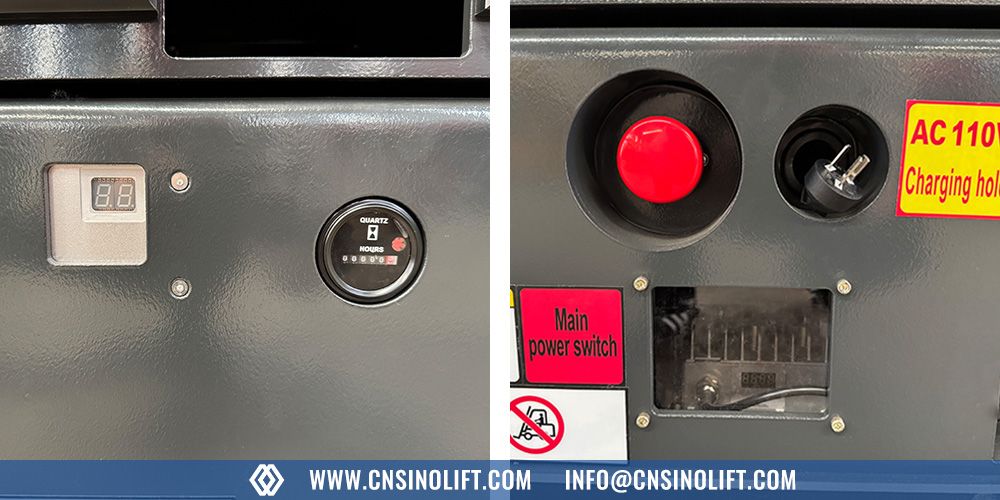
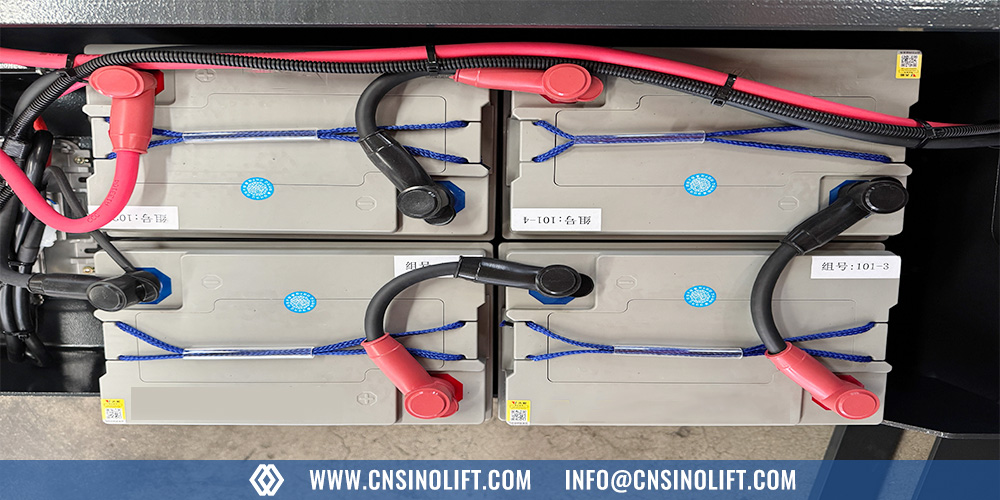
For electric scissor lifts, battery and connection faults rank high on no-lift diagnostics. A confusing detail: the machine may still turn on lights and drive short distances, yet lack sufficient voltage under heavy load to run the hydraulic pump for lifting. Battery lifespan and runtime depend on type, duty cycle, and charging habits — our guide to scissor lift battery lifespan and runtime covers this in detail.
Symptom: Lifting starts and immediately stalls; dim dashboard indicators; pump clicks without lifting action.
How to check: Read the battery level on the control panel, then verify against the manufacturer's specifications. Check for corroded terminals, loose connections, or damaged cables. A battery may show an acceptable resting voltage but still drop significantly under the high current demand of the hydraulic pump. If the lift drives normally but stops when you press UP, have the battery tested under load rather than relying only on resting voltage.
The fix: Fully recharge battery packs according to the charger and manufacturer instructions. Clean and tighten terminals. If the battery is old, swollen, or will not hold charge after repeated full cycles, plan battery replacement. Also check the charger itself — a faulty charger is often mistaken for a battery problem.
Most modern lifts have a safety feature that prevents operation while the machine is plugged into a wall outlet. If your lift is fully charged but the controls are dead, the control system may still detect the charger as connected. Ensure the charger cord is unplugged and stowed, and check whether the charge port microswitch is stuck.
Water ingress, vibration from site travel, or cable wear at scissor-arm pivot points can damage wiring harnesses.
Symptom: No pump noise when activating the lift command; error codes appear.
Solution: Visually inspect exposed cables. Fuse replacement can resolve simple blown circuits. If wires are frayed or the controller shows persistent faults, stop operation and contact a qualified technician. Do not tape over damaged wiring for temporary work-arounds.
Joystick trigger: On some models, the enable trigger or foot switch must be activated before the joystick will respond. Follow the operating sequence specified for your machine.
If you hear the hydraulic pump motor running but the platform remains grounded, focus your inspection on the hydraulic circuit. Aging seals, oil shortage, contamination, and trapped air can reduce or eliminate lifting pressure.
Common possibilities include low hydraulic fluid, a restricted suction filter, a worn pump, a stuck valve, a relief valve issue, or internal cylinder leakage.
Insufficient hydraulic fluid prevents pressure build-up. Hydraulic oil levels can fall because of leaks, incorrect servicing, or component problems. A leaking hose, fitting, or cylinder seal accelerates the problem.
How to check: Check the hydraulic oil level with the platform fully lowered — the correct level is usually read at rest, never raised. Inspect hoses, fittings, the cylinder, and the reservoir for wet spots or drips. Look at the ground where the machine is parked.
The fix: Top up only with the hydraulic fluid specified in your operator's manual. Do not mix hydraulic fluids unless the manufacturer specifically permits it. If you find a leak, replace the hose or seal before operating again. Continuing to run the pump with insufficient fluid can cause expensive pump damage.
Dirty oil damages pumps and valves. A restricted suction filter can starve the pump, causing abnormal pump noise, slow lifting, or failure to build sufficient pressure. Air trapped inside the system can create spongy, jerky lifting or complete failure to rise, often after hose replacement or oil refills.
Solution: Replace contaminated hydraulic fluid and filters according to the manufacturer's schedule. Follow the manufacturer's procedure for bleeding air from the hydraulic circuit. Do not improvise a bleeding procedure on a personnel-lifting machine.
A fault in the lowering solenoid valve or lift circuit can prevent the hydraulic system from directing oil correctly for lifting. Worn pump internals cannot generate working pressure. Internal cylinder seal failure causes pressure loss.
Symptom: Motor runs at normal noise level but zero upward movement.
How to check: A qualified technician can test the solenoid coil and control voltage against the manufacturer's specifications. Check for a stuck spool and test the cylinder for internal leakage using the manufacturer's procedure.
The fix: Replace a failed coil, clean or replace a sticking valve, and flush contaminated oil as directed. Cylinder seal kits are a standard repair — a leaking cylinder does not always mean a full replacement. These tasks require professional disassembly, cleaning, or component replacement. On-site operators should not disassemble hydraulic valve assemblies without training.

Pressure-relief valve testing and adjustment should be performed only by a qualified technician using the manufacturer's specified pressure and test procedure. Incorrect adjustment can affect lifting performance and damage hydraulic components.
If the platform drifts down after being raised, internal leakage in the cylinder or hydraulic holding circuit may be responsible. A qualified technician should perform the pressure and leakage tests specified by the manufacturer.
Hydraulic oil that is too hot or too cold can affect lifting performance. Excessive heat can reduce oil viscosity and accelerate wear, while very cold oil can become too viscous and increase resistance. Always use the oil grade and operating temperature range specified by the manufacturer. In cold weather, follow the manufacturer's cold-weather operating procedure.
Every scissor lift has a rated load capacity. Rated capacity varies widely by model. Always check the capacity plate or operator's manual — not the previous job's configuration.
The fix: Remove weight until you are within the rated capacity. If overload protection keeps triggering at a legal load, the pressure sensor or load-sensing system may need recalibration by a qualified technician.
Lack of required lubrication at serviceable pivot points or other manufacturer-specified lubrication points can contribute to binding. Foreign objects in the guide rails are another common cause of jamming. Inspect the scissor stack for debris and lubricate only the manufacturer-specified lubrication points according to the maintenance schedule. Check for cracked or broken welds, bent or warped surfaces, and excessive wear on pins and bushings.
Many modern lifts are equipped with pothole guard switches or limit switches that prevent operation when the machine is not on level ground. If a switch is stuck or a guard is deployed incorrectly, the control system may lock out the lift function. If the system is not functioning correctly, do not bypass or force the mechanism. Follow the manufacturer's inspection procedure.
If the motor overheats during operation, check for inadequate ventilation, restricted airflow, low or contaminated hydraulic fluid, or a binding pump. Restore unobstructed airflow paths, check fluid condition, and verify that the load is within rated capacity. If overheating persists, have a qualified technician verify the electrical supply and motor condition.
DIY diagnosis is fine for the checklist above. Stop and contact a qualified technician trained to service the specific equipment when:
The platform is stuck in the raised position — use the manual emergency descent procedure in the operator's manual; never improvise.
You are dealing with pressurized hydraulic lines or heavy electrical components.
The same fault keeps returning after “fixes.”
The machine shows repeated fault codes you cannot clear.
Structural damage is found: cracks in the scissor arms, chassis welds, or frame components.
Persistent control faults occur: if the machine throws codes or operates intermittently after power cycling, the control system or ECU may require further diagnostic testing with manufacturer-specific tools.
Internal cylinder leakage is confirmed: if the platform drifts down after being raised, worn piston seals are likely. This requires cylinder disassembly and seal replacement.
Repeated battery system failures occur: if the battery triggers unexpected shutdowns multiple times after full charging, the battery pack may have reached end-of-life and requires load testing under actual operating conditions.
Do not return a lift to service if a lifting problem remains unresolved or a safety-related fault is present. Learn more about common scissor lift accident risks in our related guide: What Are Common Scissor Lift Accidents?
If the problem is caused by a battery, switch, fuse, hose, or minor hydraulic issue, repair may be the most economical option.
If the machine has recurring electrical, hydraulic, or structural failures, compare the total repair cost, downtime, remaining service life, parts availability, and warranty coverage against the cost of a replacement. On an older lift, major component failures are often the point where repair stops making financial sense and replacement becomes the smarter investment.
If structural damage exists or safety systems keep failing even after component replacement, replacement is often the safer and more cost-effective choice for your worksite.
If you are not troubleshooting an existing machine but choosing a new lift for warehouse maintenance, see our guide to How to Choose a Scissor Lift for Warehouse Maintenance.
Most no-lift failures can be reduced by following routine maintenance schedules. Maintenance intervals vary by manufacturer and model. Follow the model-specific service manual and applicable workplace regulations. For capacity limits and how operator weight affects platform loading, see our guide to electric scissor lift capacity vs. operator weight.
Daily pre-operation inspection:
Fluid levels — hydraulic oil
Battery charge and terminal condition
Emergency stop function from both ground and platform stations
Visible leaks, damaged hoses, or loose fittings
Tyre condition and pressure
Control function from both ground and platform stations
Pothole guard and limit switch operation
Scissor arms for visible damage or cracked welds
All pins installed and locked
Decals and placards clean and legible
Scheduled maintenance:
Keep battery packs properly charged and avoid repeated deep discharge.
Change hydraulic oil and filters according to the manufacturer's service-hour intervals.
Inspect and lubricate manufacturer-specified lubrication points according to the maintenance schedule.
Inspect electrical enclosures for moisture ingress and ensure covers, seals, and cable glands remain intact.
Document all service and repair records. A complete maintenance log helps technicians diagnose intermittent faults quickly and supports future repair-or-replace decisions.
Q: My scissor lift beeps but will not lift. Is it broken?
A: Not necessarily. Beeping warnings are often related to safety interlocks, such as slope, overload, or pothole protection conditions. Resolve the site condition first before concluding hardware damage.
Q: Why does my scissor lift go up slowly but not to full height?
A: This usually points to low hydraulic oil, a restricted suction filter, weak batteries under load, or a worn pump that cannot build full pressure. Start by checking the battery condition and hydraulic oil level before moving to component-level diagnosis.
Q: Why does my scissor lift go up but not down?
A: On many electric scissor lifts, downward movement is controlled by a solenoid-operated valve that allows hydraulic oil to return to the reservoir. A failed descent valve, stuck valve spool, or faulty down circuit is typically the cause — check fuses and the valve coil with a qualified technician.
Q: Why won't my electric scissor lift go up but it will drive?
A: This can be a sign of a battery that performs adequately during travel but drops too far under the higher demand of the hydraulic pump. It can also point to a hydraulic fault, a lift circuit fault, or a control system issue. Test the battery under load first.
Q: Why does my scissor lift have power but won't lift?
A: Power at the panel does not guarantee power at the lift circuit. Check the emergency stop, key switch position, platform gate, fault codes, battery voltage under load, fuses, relays, and the lift solenoid. If those check out, move to hydraulic diagnosis.
Q: Can cold weather stop a scissor lift from lifting?
A: Yes. Hydraulic oil thickens in cold conditions, increasing resistance and slowing or preventing movement. Follow the manufacturer's cold-weather operating procedure and use the recommended hydraulic fluid for the operating temperature.
Q: How long should scissor lift batteries last?
A: Battery life varies widely with battery type, duty cycle, charging practices, maintenance, and storage. Three to five years is a common service-life range for some lead-acid applications, but actual life can be shorter or longer.
Q: Can I manually override safety sensors to get work finished quickly?
A: Absolutely not. Bypassing safety interlocks can create serious tipping, crushing, and fall hazards. Never return the machine to service until the cause of the safety lockout has been identified and corrected.
Q: Should I repair an old scissor lift that keeps failing to lift?
A: If repairs repeat frequently or quotes exceed a substantial portion of a new unit's value, replacement generally delivers better long-term safety and uptime performance.
If an aging lift requires frequent repairs, replacement may offer better long-term value than continuing to repair it. HENAN SINO LIFT manufactures self-propelled electric scissor lifts covering working heights from 7.8 m to 17.8 m.
| Model | Max Working Height | Safe Working Load | Weight |
|---|---|---|---|
| GTJZ06 | 7.8 m | 380-550 kg | 1,880–2,150 kg |
| GTJZ08 | 9.8 m | 450 kg | 2,300 kg |
| GTJZ10 | 11.8 m | 320 kg | 2,530 kg |
| GTJZ12 | 13.8 m | 320 kg | 2,870 kg |
| GTJZ14 | 15.8 m | 227 kg | 3,340 kg |
| GTJZ16 | 17.8 m | 320 kg | 4,590 kg |
Typical features across the range include:
24V electric drive and lift system
Lifting speed of 3–5 m/min
Up to 25% gradeability
Battery-powered, zero-emission operation
Proportional joystick controls
Suitable for indoor and light outdoor applications
For detailed dimensions, battery configurations, turning radius, ground clearance, and performance data, contact our team for the model-specific datasheet. Send us your required platform height, load capacity, working environment, and application, and our team can recommend a suitable model.
HENAN SINO LIFT manufactures lifting and access equipment for warehouses, factories, construction sites, and other industrial applications. Our product range includes self-propelled scissor lifts, mast lifts, boom lifts, cargo lifts, loading ramps, wheelchair lifts, and warehouse handling equipment. Contact us with your requirements, and our team can recommend a suitable solution.
Email: info@cnsinolift.com
Website: www.cnsinolift.com