Quick answer: Choose a self-propelled scissor lift for concrete floors, warehouses, factories, and jobs that need fast relocation. Choose a crawler (tracked) scissor lift for lawns, wetlands, orchards, muddy ground, and any project where low ground pressure is critical. One rule covers 80% of cases: the ground decides the machine — not the working height.
Both types share the same scissor mechanism, but on real job sites the ground decides whether your project runs smoothly or strands equipment on soft terrain. This guide backs every point with our own field-test data, real project cases, and ANSI/OSHA/IPAF references.
KEY TAKEAWAYS
SELF-PROPELLED excels on hardened flat surfaces — warehouses, factories, supermarkets, convention centers. Fast, low-noise, indoor-friendly.
CRAWLER protects soft outdoor terrain — lawns, wetlands, orchards, golf courses, sloped ground. Ultra-low ground pressure, 30% slope stability.
• In our field test, crawler ground pressure measured ~7× lower than the wheeled model (0.11 vs 0.75 kg/cm²).
• Self-propelled covered a 10 m travel test in 12 s; crawler took 34 s — speed vs ground protection is the core trade-off.
• Crawler models are typically slightly more expensive than self-propelled of comparable height.
• Choice depends on primary terrain — not price or lift height alone.
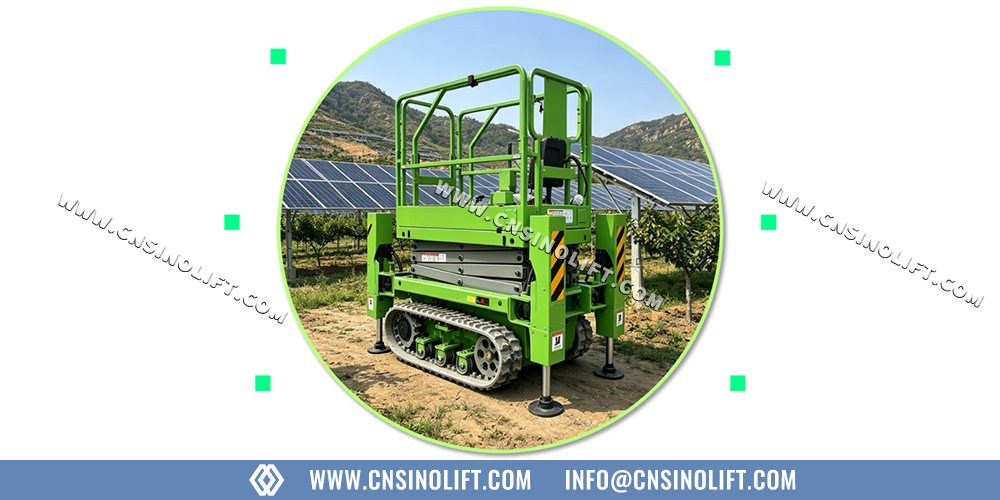
Below is the technical comparison based on standard product ranges. Use it as your reference sheet. Learn more
| Specification | Self-Propelled | Crawler (Tracked) |
|---|---|---|
| Working Height | 4–16 m | 4–12 m |
| Load Capacity | 227–550 kg | 200–450 kg |
| Gradeability (max slope) | 25% | 30% |
| Ground Pressure | 0.75 kg/cm² | 0.11 kg/cm² |
| Travel Speed | Faster (10 m in 12 s, test) | Slower (10 m in 34 s, test) |
| Primary Terrain | Concrete, asphalt, tile (indoor) | Lawn, wetland, orchard, mud (outdoor) |
| Comparison Dimension | Self-Propelled | Crawler (Tracked) |
|---|---|---|
| Core Logic | Achieve efficient movement on hardened ground | Disperse pressure through rubber tracks to protect and adapt to soft ground |
| Ground Pressure | Relatively high — requires solid ground bearing capacity | Extremely low — no obvious marks on lawns, tiles, or wetlands |
| Travel Mechanism | Rubber/polyurethane wheels — flat hardened roads | Rubber tracks — large contact area, strong grip |
| Climbing Capacity | About 25% slope | About 30% slope — better slope stability |
| Ground Adaptability | Standard hardened ground — concrete, asphalt, flat tiles | Soft soil, lawn, orchard, wetland, slightly muddy ground |
| Indoor Friendliness | Low noise, no track debris — ideal for indoor use | May carry mud, but low ground-damage risk — usable indoors when tracks cleaned |
| Relocation Method | Self-propelled — drives itself between positions | Self-propelled short moves; flatbed transport for long distance |
| Speed & Efficiency | Fast wheel movement — high workstation switching efficiency | Stable crawler speed — prioritizes ground protection over speed |
* Specifications based on typical product ranges. Actual performance varies by model and working conditions.
Buyers often ask for real numbers rather than general claims. To show the actual difference, we ran representative field measurements on comparable Sino Lift models — a 10 m self-propelled scissor lift and a 10 m crawler scissor lift with similar platform load. We measured two factors: ground pressure and horizontal travel speed (how fast each machine drives itself 10 m across flat ground).
Both are scissor lifts — the real difference is the ground each is built for.
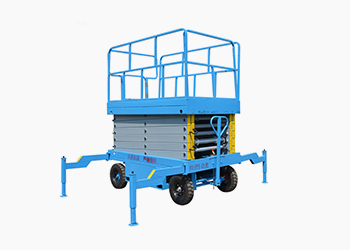
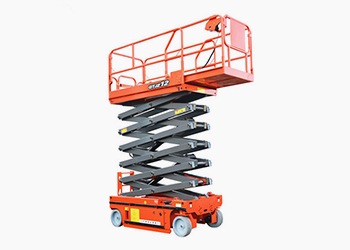
Self-propelled scissor lift is built for hardened flat surfaces — warehouses, factories, supermarkets, convention centers. Fast relocation, low noise, indoor-friendly.
Best for: operators who move between work positions many times per shift on concrete, asphalt, or tile.
Crawler scissor lift (tracked) is built for soft outdoor terrain — lawns, wetlands, orchards, golf courses. Its tracked chassis spreads weight, protecting ground that wheeled scissor lifts would damage.
Best for: a scissor lift for soft ground where ground protection is required. Standard rubber-tracked crawler scissor lifts (this guide) protect soft ground; steel-tracked crawler scissor lifts serve harsh, high-abrasion terrain where durability and traction outweigh ground protection.
Track material — rubber vs steel: The crawler scissor lifts in this guide use rubber tracks, which keep ground pressure ultra-low and protect lawns, turf, and wetlands. A steel-tracked crawler scissor lift variant exists for harsher conditions — rocky terrain, demolition, or high-abrasion outdoor sites where maximum traction and track durability matter more than protecting soft ground. For the applications covered here (orchards, golf courses, wetlands, landscaping), rubber tracks remain the right choice.
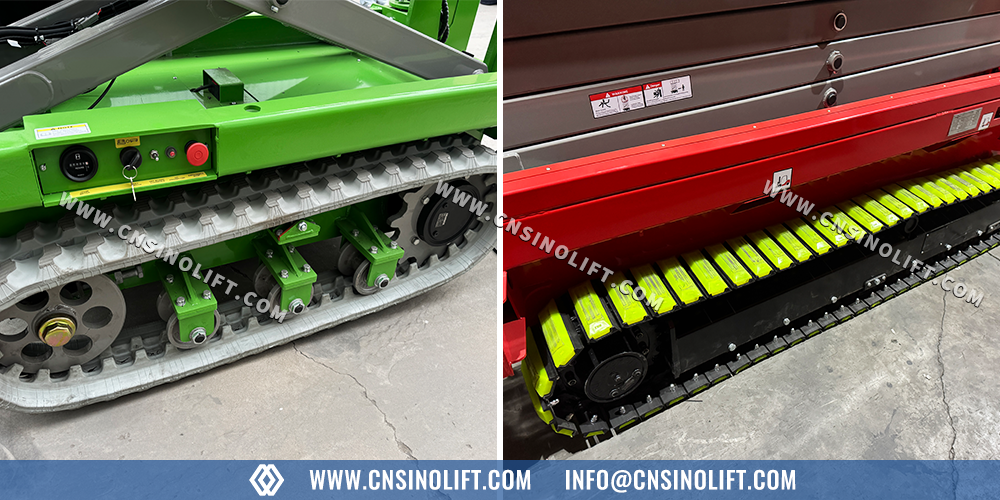
Representative deployments from Sino Lift customer projects. Each example shows how the primary terrain dictated the choice between self-propelled and crawler scissor lifts.
A logistics center with smooth concrete floors needed fast, frequent repositioning between storage aisles. The hard, flat surface made a self-propelled scissor lift the obvious terrain match. The wheeled GTJZ10 moves quickly between workstations without damaging the floor, keeping picking and maintenance operations efficient throughout the shift.
An orchard required aerial work between tree rows on soft, irrigated soil. A wheeled lift would have rutted the ground and risked getting stuck. The crew chose a rubber-track crawler scissor lift because its ultra-low ground pressure (tested ~0.11 kg/cm²) protected root systems and allowed safe movement on gentle slopes after watering, preventing both crop damage and machine downtime.
During a course upgrade, tree trimming and lighting installation had to be performed on delicate turf and uneven fairways. The project team selected a crawler scissor lift specifically to avoid turf scars and compaction. The tracked undercarriage distributed the lift’s weight so well that no post-work ground repair was needed, and the machine handled undulating terrain that wheeled units could not safely cross.
Not sure which fits your project? This logic takes under a minute.
| Maintenance Item | Self-Propelled | Crawler |
|---|---|---|
| Battery / Drive | Charge after each shift; replace every 3–5 yrs | Same — battery is primary power |
| Wheel / Track | Check wheel wear; replace tires as needed | Inspect track tension; check support rollers |
| Chassis Cleaning | Standard rinse; minimal debris | Regular mud removal keeps tracks in good condition |
| Hydraulic System | Fluid checks; filter per schedule | Same — identical scissor mechanism |
| Parts Availability | Standardized components | Crawler-specific track components |
Both types require a comparable level of upkeep. The main difference is focus: self-propelled care centers on wheels and batteries, while crawler care adds routine track inspection and cleaning.
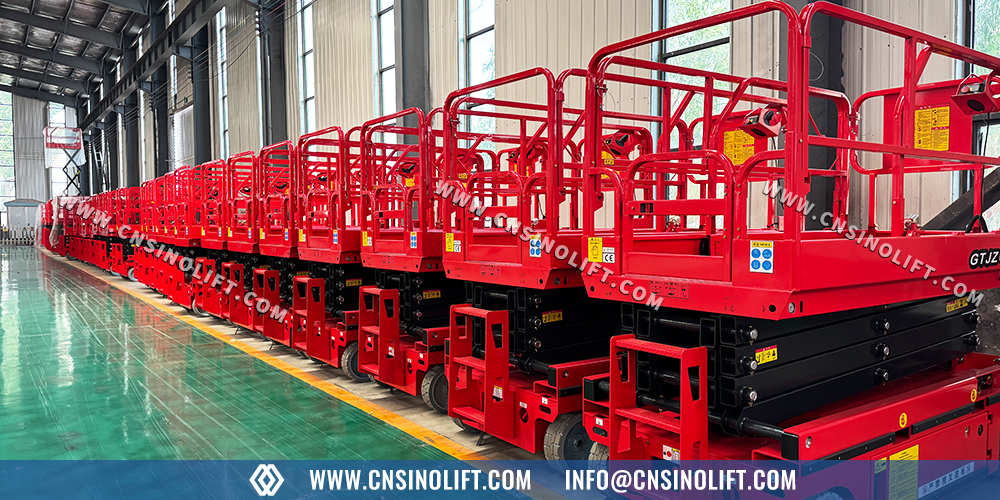
Crawler scissor lifts cost more than self-propelled models of the same working height, reflecting the tracked chassis and low-ground-pressure design. Within each type, price is driven mainly by working height, load, battery, and options.
| Type | Working Height | Load Capacity | Reference Price (USD) |
|---|---|---|---|
| Self-Propelled Scissor Lift | 4–16 m | 227–550 kg | $5,000 – $10,000+ |
| Crawler Scissor Lift | 4–12 m | 200–450 kg | $10,000 – $18,000+ |
* Reference prices are FOB estimates and vary with working height, load capacity, battery configuration, and custom options. Contact us for an exact quotation.
A self propelled scissor lift price typically runs $5,000–$10,000+, depending on height, load, and battery — the more budget-friendly option for indoor and hardened-ground work.
A crawler scissor lift price (also called tracked scissor lift cost) typically runs $10,000–$18,000+. Looking for a crawler lift for sale? Request a quote for your exact spec.
Choose by terrain first — the wrong machine on the wrong ground costs more in damage and downtime than any price gap. Sino Lift offers both types, CE/ISO certified and fully customizable.
Authoritative sources referenced in this guide:
Our core recommendation, backed by field testing: ground conditions matter far more than working height when selecting a scissor lift.
In our experience, more than 80% of customers choose the wrong machine because they start from the height they need and ignore the ground they work on. Our own measurements show why it matters — a crawler spreads load to just 0.11 kg/cm² versus 0.75 kg/cm² for a wheeled unit (about 7× lower). Get the ground right, and the height takes care of itself. — More selection guide
We do not start with a product. We start with four questions:
Answer those four, and the right machine becomes clear. If your project is a genuine 50/50 terrain split, contact us — our team will provide a tailored recommendation.
→ Browse self-propelled scissor lifts (4–16 m)