


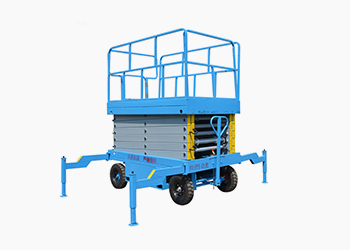
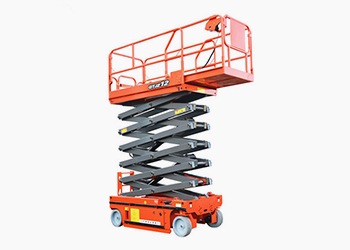
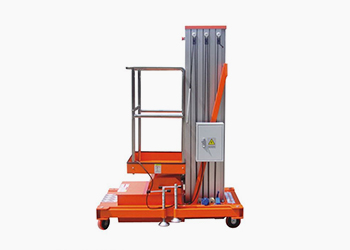
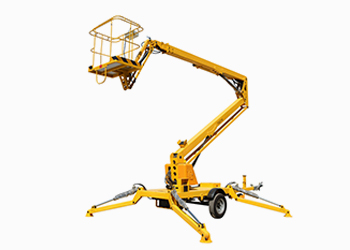
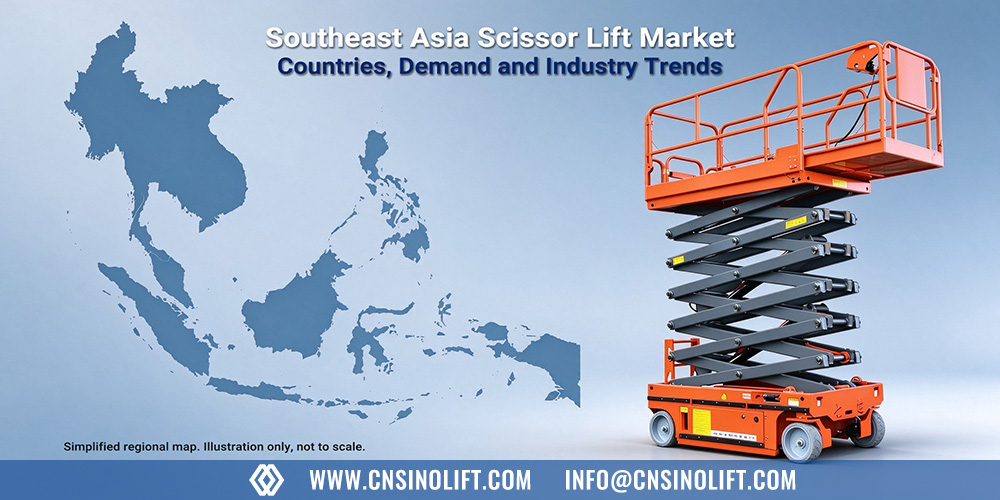
Southeast Asia's scissor lift market is connected to the region's construction, logistics, and manufacturing activity. Urbanization, industrial park development, e-commerce warehousing, and tighter work-at-height rules have made scissor lifts a common choice for indoor maintenance, building finishing, rack installation, and factory service.
The region is not one single market. Indonesia, Vietnam, Thailand, Malaysia, the Philippines, and Singapore differ in infrastructure activity, certification rules, buyer preferences, and rental maturity. This article is intended as procurement guidance. Market data and regulatory references cited below are sourced from publicly available publications and are accurate as of the date of writing. Readers should verify specific figures with primary sources before making investment decisions.
Indonesia: Construction and Industrial Applications
Indonesia is an important market to assess for scissor lift suppliers, supported by infrastructure development, industrial activity, and demand for building maintenance equipment. The Indonesia construction equipment market was sized at 21,694 units in 2025 and is projected to reach 31,920 units by 2031, rising at a CAGR of 6.65% (Source: ResearchAndMarkets, Indonesia Construction Equipment Market Research Report 2026-2031). This figure covers construction equipment broadly, not scissor lifts alone, but it indicates the scale of construction activity that supports aerial access equipment demand.
Projects driving this activity include the new capital city development, toll roads, airports, commercial buildings, mining support facilities, and palm oil processing sites. For indoor factory and warehouse work, electric scissor lifts are commonly used. For unfinished construction sites, buyers need to confirm whether the machine is suitable for ground conditions, slope, and outdoor use.
Indonesia's Ministry of Manpower (Kemnaker) operates a certification program for scissor lift operators, recognized nationally. Imported units need to meet the applicable certification requirements. For Indonesia, the practical procurement question is not only working height, but also service access, spare parts availability, and machine durability outside major cities.
Vietnam: Manufacturing and Warehousing
Vietnam's manufacturing and warehousing activity creates demand for self-propelled electric scissor lifts. Electronics factories, industrial parks, and logistics centers need equipment for racking installation, ceiling work, lighting maintenance, and production line service. The e-commerce sector is also supporting warehouse construction and upgrading. The required working height should be selected according to the actual task, building clearance, floor capacity, and site conditions.
Clean factories and indoor warehouses often prefer battery-powered scissor lifts because they produce no exhaust emissions during operation and run relatively quietly. For suppliers, Vietnam is a market where product documentation, operator training, and local service response are important for repeat business.
Thailand: Automotive and Industrial Maintenance
Thailand's demand is concentrated around Bangkok, Chonburi, and Rayong, where automotive assembly, industrial estates, logistics hubs, shopping malls, and airport facilities require regular maintenance access. Electric scissor lifts are used for factory maintenance, warehouse racking, and commercial building service. Warehouse operators tend to prefer compact narrow-width electric scissor lifts for racking installation and inventory maintenance.
Thailand has an active equipment rental sector. Ban Ngai, one of Southeast Asia's leading rental companies, operates across Thailand as well as Malaysia, Indonesia, and the Philippines (Source: Noblelift, 2026). For equipment suppliers, Thailand is a market where dealer support, clear certification, and reliable spare parts matter to rental companies and industrial end users.
Malaysia: Data Centers and Rental Market Momentum
Malaysia's market is supported by manufacturing, commercial property, data centers, and renewable energy projects. Penang and Selangor industrial hubs need scissor lifts for electronics factory maintenance. Data center development in Johor, Cyberjaya, and the Klang Valley has added demand for electric, compact, low-noise machines for indoor installation and M&E work. For a detailed breakdown of machine requirements and selection criteria, refer to this guide on how to choose a scissor lift for data center maintenance.
The rental market in Malaysia has expanded significantly. Ban Ngai, headquartered in Klang, Malaysia, currently manages a fleet of more than 3,300 aerial machines and over 400 forklifts and reach trucks across Southeast Asia. The company aims to grow its regional fleet to more than 8,500 units by 2030 (Source: Noblelift, 2026). In January 2026, Ban Ngai signed a strategic order agreement for 2,500 new scissor lifts with a total order value estimated at USD 25 million (Source: Noblelift, 2026).
Malaysia's regulatory framework has changed in recent years. Under the Occupational Safety and Health (Plant Requiring Certificate of Fitness) Regulations 2024, all power-driven lifting machinery must obtain design verification and a valid certificate of fitness from the Department of Occupational Safety and Health (DOSH) prior to construction, installation, or use (Source: Malaysia DOSH, 2024). These regulations do not apply to manually operated lifting machinery. Before importing or operating a scissor lift in Malaysia, buyers should verify current DOSH requirements for the specific equipment type and application.
Philippines: Infrastructure and Rental Access
The Philippines market is growing with government infrastructure programs, ecozone industrial parks, and logistics warehouse development in Luzon and Calabarzon. The Philippines construction equipment market was sized at 5,413 units in 2024 and is projected to reach 6,948 units by 2030, rising at a CAGR of 4.25% (Source: ResearchAndMarkets, Philippines Construction Equipment Market Research Report 2025-2030).
Rough terrain scissor lifts are used for exterior building cladding and construction sites with uneven ground. Import costs and operator availability can affect purchase decisions. For some small and mid-sized contractors, rental may be more practical than direct purchase. Ban Ngai's regional expansion plans include the Philippines alongside Malaysia, Thailand, and Indonesia (Source: Noblelift, 2026). For the Philippines, buyers should evaluate whether the project needs indoor electric equipment or outdoor-capable machines. Site access, ground conditions, and operator certification are practical issues that affect machine selection and project scheduling.
Singapore: Safety and Specification Requirements
Singapore is a market with strict safety and quality expectations. Demand is mostly for low-emission, low-noise electric scissor lifts for high-rise maintenance, retail mall upkeep, data center, and cleanroom operations.
Singapore's safety framework for MEWPs is well established. The SS 616:2016 Code of Practice for Safe Use of Mobile Elevating Work Platforms specifies safety requirements for the protection of persons working with MEWPs, covering basic safety principles, operation, maintenance, and inspection (Source: Singapore Standards Council, 2016). MEWP operators must attend and pass a MEWP training course for the specific machine type before operating the equipment.
Buyers should check compliance with applicable design standards, required safety devices, and project-specific documentation. Non-marking tires may also be necessary for indoor facilities with finished floors. Certification requirements should be confirmed before procurement rather than assumed. Suppliers entering Singapore need to meet documentation, traceability, and after-sales expectations.
Demand Drivers Across the Region
Construction and building renovation remain a major demand sector. Scissor lifts replace traditional scaffolding for ceiling work, electrical installation, painting, HVAC, and curtain wall fitting. As workplace safety rules tighten across ASEAN, contractors are moving away from ladders and improvised scaffolding toward certified mobile elevating work platforms.
Logistics, warehousing, and e-commerce are a growing application area. Distribution centers need scissor lifts for rack installation, high-level inventory checks, and routine rack maintenance. Electric models with non-marking tires are often chosen for indoor warehouse environments. For a step-by-step framework on selecting the right machine for warehouse tasks, see this guide on how to choose a scissor lift for warehouse maintenance.
Manufacturing and industrial parks also use scissor lifts for production line maintenance, overhead pipe and lighting repairs. Cleanroom factories require battery-powered electric models without exhaust fumes.
Facility maintenance in airports, hotels, malls, and solar farms forms another steady demand source. These applications usually need compact machines that can move through finished spaces without damaging floors.
Industry Trends
Electrification is a clear direction for indoor applications. Battery-powered electric scissor lifts are well suited to warehouses, factories, and commercial buildings. Their lack of exhaust emissions during operation and relatively quiet performance make them a practical choice for enclosed or occupied spaces. For a detailed comparison of power source options, read this article on electric and diesel scissor lifts. For outdoor projects, buyers should confirm whether the machine is designed for the ground conditions and outdoor environment.
Rental is a practical option for contractors with short-term projects or irregular equipment needs. Purchasing may make more sense for companies with frequent, predictable use, provided they can manage maintenance, storage, and operator training. The decision depends on project duration, utilization rate, cash flow, and local service support. Regional rental companies are expanding fleets across borders. Ban Ngai's planned expansion from 3,300 to 8,500 units by 2030 is one example of this trend (Source: Noblelift, 2026).
Safety compliance is an important part of scissor lift procurement. Requirements vary by country, equipment type, and intended application. Malaysia's DOSH enforces design verification and certificate of fitness requirements under the Occupational Safety and Health (Plant Requiring Certificate of Fitness) Regulations 2024 (Source: Malaysia DOSH, 2024). Singapore requires MEWPs to conform to SS 616:2016 (Source: Singapore Standards Council, 2016). Before placing an order, buyers should confirm the applicable standards, required technical documents, inspection procedures, and any local approval requirements. Suppliers should prepare the relevant product documentation before shipment to help avoid preventable delays.
Several practical bottlenecks remain in the region: import cost for some branded machines, limited certified operators and service technicians in certain areas, continued preference for cheaper scaffolding among some small contractors, uneven spare parts supply outside major cities, and different certification rules between ASEAN countries. These factors affect market entry and fleet planning.
SINO LIFT Scissor Lift Range for Southeast Asian Applications
HENAN SINO LIFT manufactures scissor lifts, mast lifts, boom lifts, cargo lifts, loading ramps, wheelchair lifts, and warehouse handling equipment. The model numbers and specifications referenced below are based on SINO LIFT's own scissor lift product data. They are provided as reference for application matching, not as a market-wide specification standard.
The self-propelled electric scissor lift range includes compact models such as the Mini GTJZ06M and GTJZ06, mid-height models such as the GTJZ08 and GTJZ12, and larger models up to the GTJZ16. Working heights range from 7.8 m to 17.8 m. Platform heights range from 5.8 m to 15.8 m. Safe working loads range from 227 kg to 550 kg depending on the model. Platform sizes and overall dimensions vary to suit narrow aisles, indoor fit-out, warehouse racking, and higher ceiling work. The machines use battery power and electric drive, which fits indoor factories, warehouses, and commercial buildings where exhaust and noise are concerns.
For example, the Mini GTJZ06M has a working height of 7.8 m and a platform size of 1.67 × 0.74 m, making it suitable for narrow spaces and indoor maintenance tasks. The GTJZ08 offers a working height of 9.8 m with a safe working load of 450 kg, suited to warehouse racking and factory service work. The GTJZ16 provides a working height of 17.8 m and a platform size of 3.05 × 1.56 m, appropriate for higher ceiling applications such as large industrial facilities.
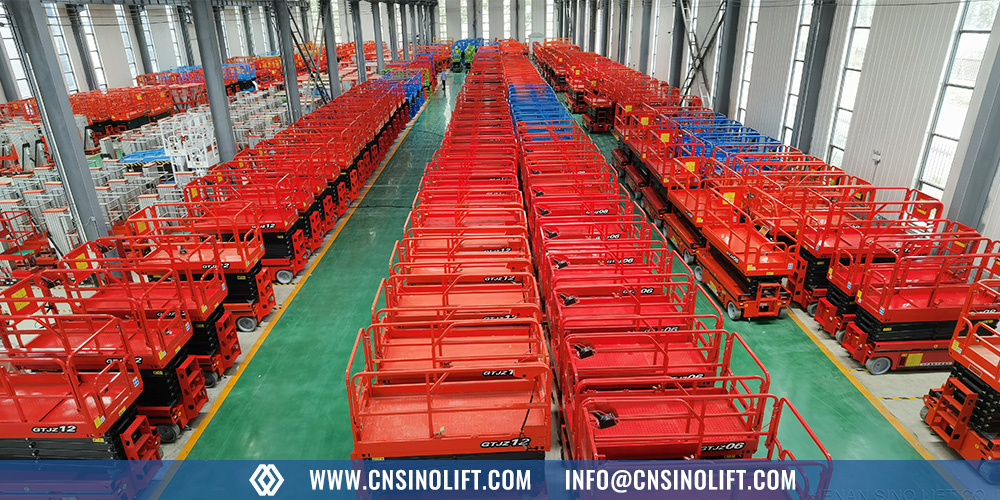
Buyers can share their required working height, platform capacity, and site conditions with SINO LIFT to identify suitable models and review the relevant specifications before placing an order.
| Procurement Scenario | Key Equipment Features to Consider |
|---|---|
| Warehouse Racking | Working height, overall width, turning space |
| Factory Maintenance | Indoor electric drive, platform load, access dimensions |
| Commercial Building Maintenance | Floor protection, machine size, safety devices |
| Rental Fleet | Maintenance access, spare parts supply, fleet utilization |
| Outdoor Construction | Ground conditions, climb capacity, outdoor suitability |
The table above is a selection guide. It does not mean every SINO LIFT model is suitable for every scenario. Outdoor construction applications in particular require checking whether the specific model is appropriate for the ground and environment. For a complete overview of machine types, selection criteria, and market price ranges, refer to the scissor lift selection and procurement guide.
What Buyers Should Consider
For contractors, rental companies, and distributors entering Southeast Asia, equipment selection should match the job site. Electric compact lifts suit indoor warehousing and factory work. Outdoor projects may require machines designed for rough terrain. After-sales support, spare parts availability, and local service matter as much as the initial price. Certification and safety compliance should be checked before shipment to avoid import and site-access problems. Total cost of ownership over the expected service life is also a practical comparison point. For indicative pricing across different scissor lift types and heights, see the scissor lift price guide. For buyers evaluating whether a Chinese battery self-propelled model suits their long-term needs, this analysis of whether a Chinese battery self-propelled scissor lift is worth buying in 2026 provides a detailed cost, quality, and durability assessment.
Conclusion
Southeast Asia offers a range of potential applications for scissor lifts across construction, warehousing, manufacturing, and facility maintenance. However, equipment demand, purchasing practices, and compliance requirements vary by country and project type.
For buyers and distributors, the key is to evaluate the intended application, required working height, platform capacity, site conditions, local safety requirements, and after-sales support before selecting equipment. Electric scissor lifts are a practical option for many indoor applications, while outdoor projects may require models specifically designed for rough terrain.
For companies evaluating equipment for Southeast Asian projects, SINO LIFT can help review application requirements and identify suitable scissor lift models based on the relevant technical specifications.
Data Sources
- Noblelift. "Noblelift - Ban Ngai Alliance Strengthens with 2,500-Unit Scissor Lift Order." 2026.
- Malaysia Department of Occupational Safety and Health (DOSH). "Design of Lifting Machinery Other Than Lift, Escalator and Walkalator Under the Occupational Safety and Health (Plant Requiring Certificate of Fitness) Regulations 2024." 2024.
- ResearchAndMarkets. "Indonesia Construction Equipment Market Research Report 2026-2031." March 2026.
- ResearchAndMarkets. "Philippines Construction Equipment Market Research Report 2025-2030." August 2025.
- Singapore Standards Council. "SS 616:2016 Code of Practice for Safe Use of Mobile Elevating Work Platforms." 2016.
About HENAN SINO LIFT CO., LTD
HENAN SINO LIFT manufactures Scissor Lift, Mast Lift, Boom Lift, Cargo Lift, Loading Ramp, Wheelchair Lift, and Warehouse Handling Equipment. We work with customers to identify suitable equipment based on their lifting requirements, working environment, and application needs. For product specifications, model recommendations, or project inquiries, contact our team.
Email: info@cnsinolift.com
Website: www.cnsinolift.com