Choosing the right scissor lift for your project or fleet is one of the most consequential decisions you will make. Both electric and diesel scissor lifts serve the same fundamental purpose -- raising personnel and equipment safely to height -- but their power sources and chassis designs dictate everything else: where they can go, how much they can carry, and how they impact your bottom line. For a broader overview, read our Scissor Lift Purchasing Guide.
This guide breaks down the real differences between electric and diesel scissor lifts, compares their costs and capabilities, and gives you a clear framework for making the right choice.
| If you need... | Consider |
|---|---|
| Indoor operation | Self-propelled electric models are generally the better choice |
| Low noise operation | Electric |
| Zero tailpipe emissions | Electric |
| Finished floor protection | Electric + non-marking tires |
| Soft or uneven ground | Rough-terrain models |
| High working height or heavy capacity | Select by model specifications, not by power source alone |
| No on-site charging infrastructure | Diesel or a suitable hybrid option |
| Mixed indoor/outdoor work | Hybrid or electric rough-terrain models |
A common mistake when discussing lift selection is conflating "power type" with "terrain capability." In reality, these are two independent dimensions:
| Power Type | Self-Propelled | Rough Terrain |
|---|---|---|
| Electric | Common in warehouses, retail centers, data centers | Electric rough-terrain models are available |
| Diesel | Less common | Common in outdoor heavy-duty applications |
| Hybrid | Less common | Primarily used in complex outdoor/mixed-use conditions |
Key takeaways:
Power type (electric/diesel/hybrid) primarily affects: noise levels, tailpipe emissions, energy replenishment method, and operating costs.
Chassis type (self-propelled/rough-terrain) primarily affects: suitable ground conditions, gradeability, tire type, and maneuverability.
Power type and chassis design can be combined in different product configurations. Therefore, the simple equation of "electric = indoor" and "diesel = outdoor" is no longer accurate.
The key takeaway: power source and terrain capability are not the same thing. This is the single most important principle to understand when selecting a lift.
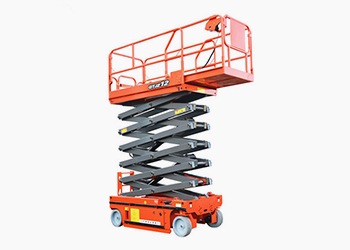
Self-propelled scissor lifts are primarily designed for hard, level surfaces such as concrete floors, warehouse flooring, or paved surfaces. They are generally more compact and lighter, making them suitable for confined spaces. Before choosing a self-propelled model, check whether the lift will fit through your doorways and maneuver in your workspace.
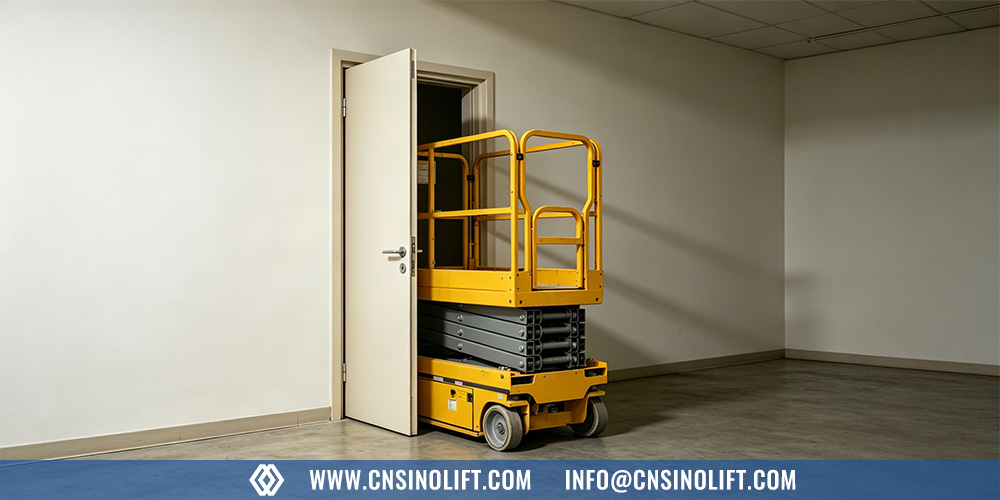
Self-propelled electric scissor lifts are among the most common choices for indoor maintenance, installation, and finishing work, powered by rechargeable battery packs. Explore our full range of self-propelled electric scissor lifts to find the right model for your application.
Advantages:
Quiet operation: Electric motors run quietly, making them ideal for noise-sensitive environments such as hospitals, offices, schools, and residential areas.
Zero tailpipe emissions: No exhaust fumes, allowing operation inside occupied buildings without ventilation concerns.
Generally lower operating costs: Electricity is typically more economical than diesel fuel, and there are fewer mechanical moving parts, simplifying maintenance. Purchase prices vary significantly by model, configuration, brand, and market. (Based on SINO LIFT's recent export quotations, standard 10 m electric models have typically been quoted at approximately $6,000–$12,800 FOB, depending on configuration and market. Data as of August 2026.) For a more detailed cost breakdown, see our Scissor Lift Price Guide.
Compact and agile: Designed to pass through standard doorways and maneuver in narrow aisles. Non-marking tires come as standard, helping to reduce the risk of tire marks on finished floors. Learn more about using electric scissor lifts on tile and other finished surfaces.
Precise control: Provides accurate control over lift and lower speeds for precise load positioning.
Considerations:
Charging must be planned: Runtime per charge varies depending on battery type, load, and operating conditions (lead-acid vs. lithium-ion batteries differ significantly). Multi-shift operations may require overnight charging or spare battery packs. Battery life depends on battery chemistry, charging practices, duty cycle, ambient temperature, and maintenance. Refer to our guide on how long scissor lift batteries last for more detailed information. Follow the manufacturer's battery replacement and service recommendations.
Terrain limitations: Primarily designed for hard, level surfaces; not suitable for muddy, soft, or significantly uneven ground.
Best Applications:
Warehouses and distribution centers · Retail centers and shopping malls · Office ceiling and lighting work · Hospitals and schools · Data center cabling and rack work · Indoor electrical and HVAC installations · Facility maintenance and fit-outs
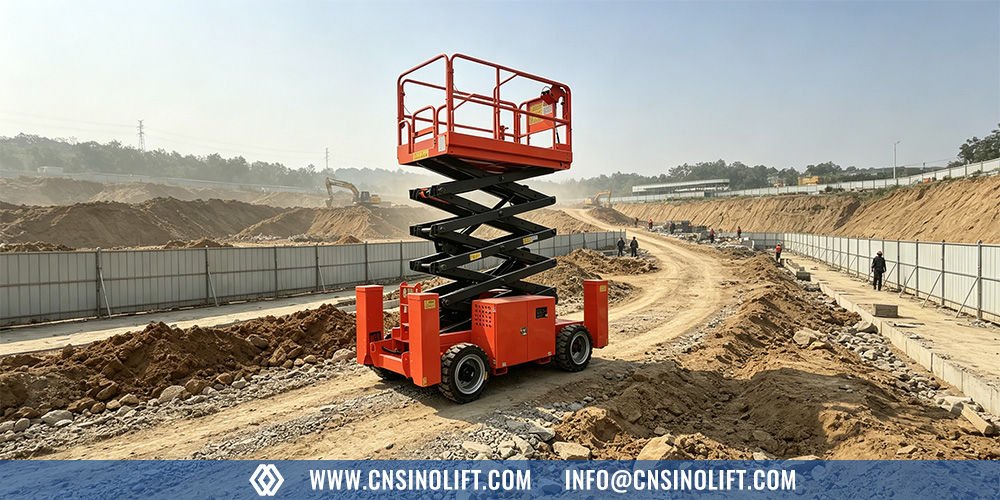
Rough-terrain scissor lifts are designed to handle gravel, mud, sand, slopes, and uneven outdoor ground. Rough-terrain models typically feature rugged tires, greater ground clearance, and depending on the specific model, four-wheel drive, oscillating axles, and other traction-enhancing features that allow them to operate where slab lifts cannot. Browse our rough-terrain scissor lift lineup for outdoor job sites.
Diesel rough-terrain scissor lifts are the traditional workhorses of the construction industry and outdoor heavy-duty applications.
Advantages:
Superior rough-terrain capability: Four-wheel drive, traction control, and oscillating axles enable operation on challenging ground conditions.
Higher working height and platform capacity options available: Many rough-terrain models offer greater lifting heights and larger load capacities, but specific capabilities depend on the model and configuration -- not on power source alone.
Refueling is faster than charging: Does not rely on charging infrastructure, supporting longer continuous operating cycles and making it suitable for remote sites without power. (Note: Daily maintenance, hydraulic system inspection, engine servicing, and safety checks are still required.)
Considerations:
Engine emissions: Indoor use depends on ventilation conditions, local regulations, site requirements, and equipment approval. Temporary ventilation may be required in enclosed spaces.
Higher noise levels: Limits use in noise-sensitive applications.
Purchase and operating costs are typically higher: Costs vary by model, duty cycle, fuel prices, and maintenance standards.
Larger footprint: Aggressive tread tires may leave marks on finished floors, and machine weight may impose floor loading requirements.
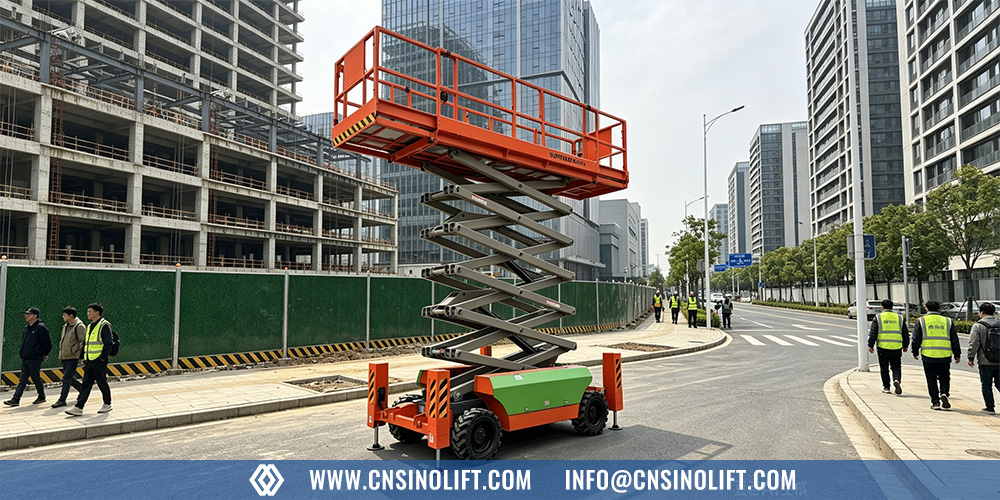
In recent years, major manufacturers have introduced electric-powered rough-terrain scissor lifts. These models combine the low-noise, zero-tailpipe-emission benefits of electric drive with the rough-terrain capability of an off-road chassis, offering a more environmentally friendly option for outdoor work.
Advantages:
Zero tailpipe emissions, low noise: Suitable for outdoor or semi-outdoor sites with environmental or noise restrictions (e.g., urban construction, nighttime operations).
Rough-terrain capable: Equipped with rugged tires, four-wheel drive, and oscillating axles to handle gravel, sand, and similar ground conditions.
Energy and maintenance costs are typically lower than comparable diesel models, provided electricity prices are reasonable and charging infrastructure is available.
Considerations:
Range is battery-limited: Extended, high-intensity operations require consideration of charging time, battery capacity, and spare battery options.
Best Applications:
Urban outdoor construction (with noise/emission restrictions) · Nighttime outdoor operations · Environmental compliance projects · Sites requiring rough-terrain capability with lower operating costs and noise
Hybrid rough-terrain scissor lifts integrate an internal combustion engine and an electric drive system on a rough-terrain chassis. Depending on the system design, they can manage power between low-emission operation and extended outdoor working cycles.
Core value:
Flexible switching between low-emission operation modes and extended-cycle operation modes
Extended operating cycles with reduced downtime
Potential fuel savings in appropriate operating conditions
Considerations: Upfront costs are typically higher and maintenance is more complex. Suitable for applications with frequent indoor/outdoor transitions, but not a universal solution.
| Factor | Self-Propelled Electric | Electric Rough-Terrain | Diesel Rough-Terrain | Hybrid Rough-Terrain |
|---|---|---|---|---|
| Energy replenishment | Charging | Charging | Refueling | Charging + Refueling |
| Tailpipe emissions | Zero tailpipe | Zero tailpipe | Engine emissions | Depends on operating mode |
| Noise level | Lower | Lower | Higher | Lower in electric mode |
| Suitable terrain | Hard, level ground | Rough terrain | Rough terrain | Rough terrain |
| Continuous operation | Battery-limited | Battery-limited | Continues after refueling | Depends on system design |
| Primary advantage | Indoor, low noise, zero emissions | Rough terrain + low emissions | Rough terrain + long cycle times | Operating mode flexibility |
Important Notes:
Platform Height is the maximum height to which the platform itself can be raised.
Working Height is typically estimated as the platform height plus the operator's effective reach; definitions and calculation methods may vary by manufacturer or standard. Always use the manufacturer's published working height for selection purposes.
Selection should be based on actual working height requirements, not on power type alone.
Beyond price, height, and capacity, the following factors are equally critical:
Equipment Dimensions & Accessibility: Before selecting, verify aisle widths, doorway clearances, rack spacing, and other site constraints. Check machine width, stowed height, turning radius, and platform dimensions to ensure the lift can enter the work area and maneuver safely.
Floor Loading Capacity: Large rough-terrain machines can weigh several tons. Before operating in warehouses, factories, or data centers, confirm that the floor can support the total machine weight and the localized loads generated by tire contact pressure.
Rated Platform Capacity: The rated platform capacity includes the combined weight of operators, tools, and materials. When selecting a model, add all three together and ensure the total does not exceed the machine's rated capacity.
Environment & Safety: Wind ratings (for outdoor operation), gradeability, platform dimensions, guardrails, emergency lowering systems, pothole protection, outriggers/leveling, fall protection, operator training, and local regulations should all be evaluated.
Before making a purchase decision, assess the following in order:
1. What ground conditions will the machine operate on most of the time?
Hard, level ground (warehouses, retail centers, paved surfaces) → Self-propelled models
Gravel, mud, sand, slopes, uneven ground → Rough-terrain models
Mixed conditions → Choose between electric rough-terrain, hybrid, or other suitable models based on primary operating environment, ground condition split, size constraints, and frequency of use
2. What are the noise and emission requirements on site?
Indoor occupied spaces, hospitals, schools, nighttime operations → Usually prioritize electric or low-emission solutions that meet site requirements
Remote outdoor sites with no environmental restrictions → Diesel is an acceptable option
3. What height and capacity do you need?
Select based on actual working height (using the manufacturer's published working height) and capacity requirements, not by power source alone
4. Is charging or refueling more convenient on site?
Power outlets available → Electric/hybrid has an advantage
Remote locations without power → Diesel is generally more convenient; hybrid depends on specific system design and energy configuration
Returning to the core question of this guide:
Choose an electric scissor lift if:
The work surface is hard, level ground (warehouses, retail centers, paved surfaces)
There are strict requirements for low noise and zero tailpipe emissions (indoor occupied spaces, hospitals, schools, nighttime operations)
Power outlets are available for charging on site
You want to minimize daily energy and maintenance costs
Choose a diesel scissor lift if:
The work surface is gravel, mud, sand, slopes, or other uneven outdoor ground
Extended continuous operation is required and no charging infrastructure is available on site
Higher working height and capacity are required (but verify against specific model specifications)
There are no strict noise or emission restrictions
Consider a hybrid scissor lift if:
Operations require switching between low-emission scenarios and extended outdoor work cycles
You want to reduce emissions and noise while retaining the extended operating cycle capability of an internal combustion engine
Budget allows for higher upfront investment, and you have the maintenance capability to support it
Final Recommendation:
Terrain capability is the first priority -- confirm the ground conditions first, then choose the power type based on noise, emissions, costs, and energy replenishment convenience. No single machine covers every scenario. Match the equipment to your actual operating conditions.
SINO LIFT can help you compare working height, platform capacity, drive type, power source, and site conditions to identify a suitable configuration for your project requirements.
Contact SINO LIFT for expert guidance, or request a quote to get started.