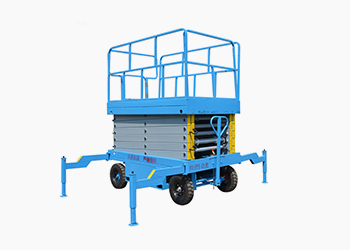
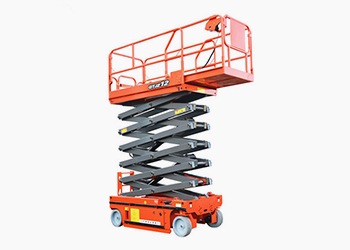
Choosing the right scissor lift comes down to four core factors: working height, platform capacity, machine dimensions, and job site conditions. Start by determining the maximum working height you need, then verify load capacity, access clearance, and ground conditions before selecting a specific model.
Guide New to scissor lifts? Start with our comprehensive Scissor Lift Procurement Guide: Price, Types, Applications & Comparison to understand the full landscape of available options.
| Selection Factor | What to Confirm | Why It Matters |
|---|---|---|
| Working Height | Maximum elevation required for the task | Determines how tall the machine must be |
| Platform Load | Total weight of personnel + tools + materials | Determines the required rated capacity |
| Machine Dimensions | Width, length, stowed height | Affects site access and transport feasibility |
| Job Site Environment | Indoor / outdoor, smooth or rough terrain | Determines the right machine type and configuration |
Core principle: Always select equipment based on the manufacturer's published rated working height and platform capacity — never rely on rough estimates. When in doubt, consult the specific model's datasheet.
This is the most common mistake in lift selection. Platform height is the vertical distance from the ground to the platform floor. Working height is the total reachable height when an operator stands on the platform, which includes the operator's standing reach.
For example, a 19-ft-class scissor lift does not necessarily provide a 19-ft working height. The actual working height depends on the manufacturer's definition and machine design.
As a general rule of thumb, working height is often about 6–7 ft (1.8–2.1 m) greater than platform height, but this is not a universal standard. Different manufacturers may define and calculate working height differently.
Correct approach:
Required platform height ≈ required working height − operator reach allowance
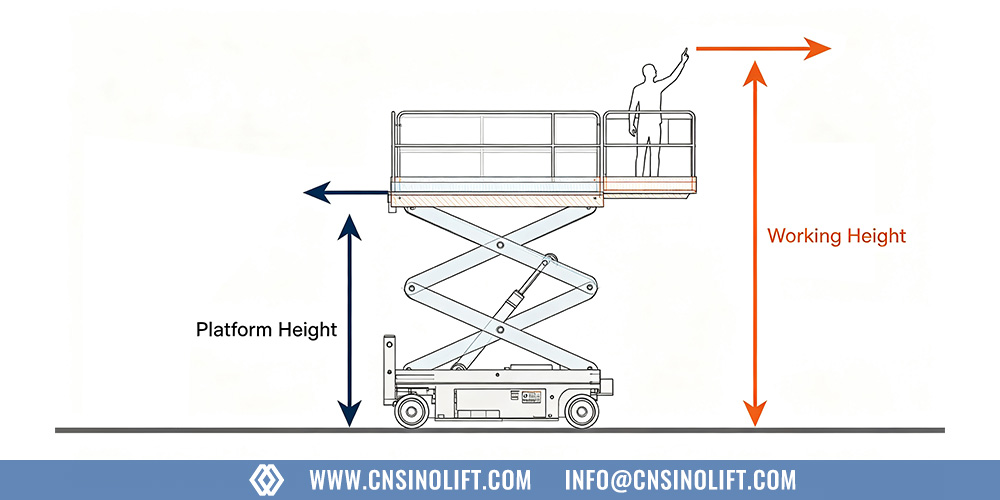
For detailed specifications, please refer to: How High Can an Electric Scissor Lift Go?
Real-world product data examples (industry reference models):
| Industry Reference Model | Platform Height | Rated Working Height | Rated Capacity | Width |
|---|---|---|---|---|
| Genie GS-1932 | 19 ft (≈5.8 m) | 24 ft 6 in (≈7.5 m) | 500 lb (≈227 kg) | 32 in (≈0.81 m) |
| Genie GS-2632 | 26 ft (≈7.9 m) | 31 ft 9 in (≈9.7 m) | 500 lb (≈227 kg) | 32 in (≈0.81 m) |
| Genie GS-2669 RT | 26 ft (≈7.9 m) | 32 ft 2 in (≈9.8 m) | 1,500 lb (≈680 kg) | 69 in (≈1.75 m) |
Key tip: Don't choose equipment by maximum height alone. Make sure the rated working height meets your job requirements, while allowing adequate overhead clearance, and always operate within the manufacturer's specified conditions.
Many buyers ask by ceiling height rather than working height. Here's a quick reference. Important: the machine type is determined by the job site environment, not solely by height. For example, at 40 ft working height, you may choose a towable, self-propelled or crawler lift depending on whether you work indoors or outdoors, on flat or rough terrain.
Guide For a deeper dive into equipment types and their ideal applications, see our Scissor Lift Procurement Guide which covers towable, self-propelled, crawler and rough-terrain models in detail.
| Ceiling Height | Working Height Needed | Common Machine Category |
|---|---|---|
| 15 ft (≈4.6 m) | ~15 ft | Compact electric scissor lift |
| 20 ft (≈6.1 m) | ~20 ft | Compact electric scissor lift |
| 25 ft (≈7.6 m) | ~25 ft | Compact / standard electric scissor lift |
| 30 ft (≈9.1 m) | ~30 ft | Standard electric scissor lift |
| 40 ft (≈12.2 m) | ~40 ft | Towable, self-propelled or crawler lift (type depends on site) |
| 50 ft (≈15.2 m) | ~50 ft | Towable, self-propelled or crawler lift (type depends on site) |
Important: The table above is a starting point, not a universal specification. Always cross-check against the manufacturer's published rated working height for final confirmation. Equipment type must be selected based on your specific working environment, not height alone.
"Size" isn't just about height — it also involves how much weight the platform can safely carry. Exceeding the rated platform load creates serious stability and safety risks.
Add up the total weight of all people, tools and materials that will be on the platform, then select a model whose rated platform capacity covers your actual job load. Always check the manufacturer's restrictions on the number of occupants and extension-deck loads.
Total required load = (number of persons × average body weight) + weight of tools + weight of materials
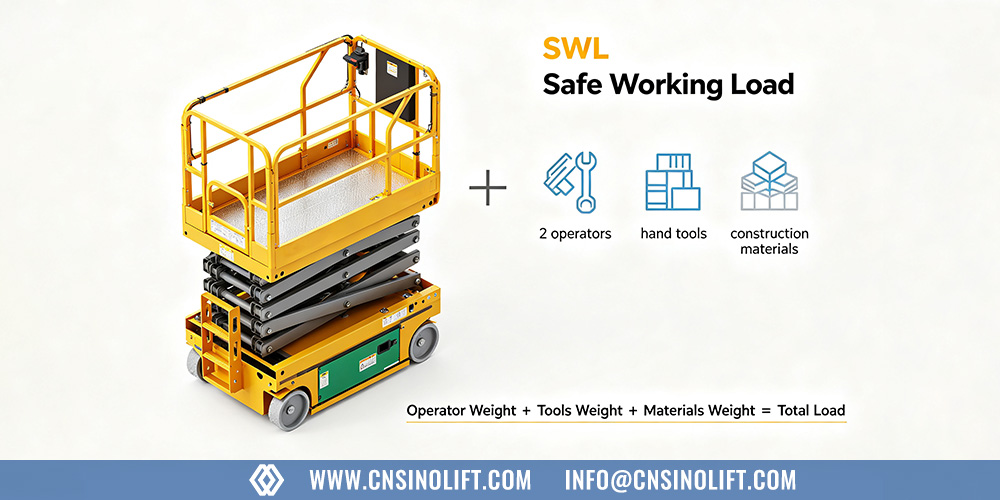
To learn more about load capacity: Electric Scissor Lift Capacity vs Operator Weight – Complete Safety Guide
Important note: A taller scissor lift does not necessarily have a higher load capacity. Compare the two reference models mentioned earlier: both have working heights around 32 ft (≈9.8 m), but the GS-2632 is rated at 500 lb, while the GS-2669 RT is rated at 1,500 lb. Their load limits and overall dimensions are completely different. Your choice must be based on actual job load and site access conditions, not just height.
A machine that meets height and capacity requirements is useless if it cannot reach the work area. Width is the most frequently overlooked dimension.
| Dimension | Why It Matters |
|---|---|
| Stowed width | Must fit through doorways, corridors and elevators |
| Stowed height | Headroom clearance for doorways and overhead obstructions |
| Machine length | Affects turning radius and storage footprint |
| Machine weight | Impacts floor loading capacity and transport requirements |
Measure every access point from the storage area to the work zone:
Pro tip: Consult the manufacturer's turning radius data and evaluate it against the actual access route. Clearance should be based on the machine's steering geometry (e.g., some compact models have a zero inside turning radius), rather than simply adding a fixed margin to the machine width.
The table below provides a preliminary reference. Always use the specific model's datasheet for final selection. Remember: the machine type (towable, self-propelled, crawler, or rough-terrain) must be chosen based on your working environment, not just height.
| Required Working Height | Typical Applications | Common Machine Category |
|---|---|---|
| ~20–25 ft | Retail maintenance, office lighting, general indoor work | Compact electric scissor lift |
| ~25–32 ft | Warehouse racking, HVAC repair, ceiling installation | Standard electric scissor lift |
| ~32–40 ft | High-bay warehouses, exterior building maintenance | Self-propelled or towable (depending on site) |
| ~40 ft and above | Construction, infrastructure projects | Towable, self-propelled or crawler (site-dependent) |
These are approximate ranges. Always select based on the machine's published rated working height and your specific job site conditions.
The platform is your work area for personnel and materials. Platform dimensions affect both site access and usable work space.
| Platform Usage | Considerations |
|---|---|
| 1 person + hand tools | Compact platform (narrow width) |
| 2 persons working together | Larger platform with appropriate load capacity |
| Long materials (drywall, pipe, light fixtures) | Extension deck or extended platform |
| Bulky or heavy materials | Wider platform with higher rated capacity |
| Narrow access (doorways, aisles) | Narrow platform width (30–32 in) |
Selection tip: Ensure the platform length can accommodate materials while leaving safe standing space for personnel. For long materials, confirm that the platform (including extension) provides adequate length.
Narrow scissor lifts: Compact width (30–32 in, ≈0.76–0.81 m). Fit through standard doorways and narrow warehouse aisles. Ideal for single-operator tasks and tight indoor spaces.
Wide scissor lifts: Wider platform accommodates two persons, large tools and bulk materials, while providing greater ground stability for outdoor use.
The machine's physical dimensions and configuration must match the working terrain. This is the primary factor that determines whether you need a towable, self-propelled, crawler, or rough-terrain lift.
| Factor | What to Check |
|---|---|
| Floor loading | Verify building floor load ratings; older buildings may have strict weight-per-square-foot limits |
| Tyre type | Use non-marking polyurethane tyres to protect finished floors |
| Power source | Electric models are preferred for indoor work as they produce zero direct emissions during operation |
| Common sizes | Compact to mid-size electric lifts with narrow widths (32–46 in) for standard passageways |
| Factor | What to Check |
|---|---|
| Ground conditions | Flat, hard outdoor surfaces (paved or concrete) are suitable for electric slab-type lifts. Rough or soft ground may require crawler or rough-terrain machines with four-wheel drive, oscillating axles and appropriate tyres. |
| Stability system | Outdoor stability depends on more than width. Check the chassis design, ground clearance, gradeability, axle configuration and rated operating conditions. |
| Wind load rating | Before outdoor work, verify the maximum allowable wind speed for the specific model. |
Guide For a complete comparison of towable, self-propelled, crawler and rough-terrain lifts, including their ideal working environments, read our Scissor Lift Procurement Guide.
Related resources:
The following example shows how to select a machine based on specific job conditions.
Job requirements:
| Requirement | Details |
|---|---|
| Required working height | 25 ft (≈7.6 m) |
| Personnel | 2 persons (≈360 lb / 163 kg combined) |
| Tools and materials | ≈100 lb (≈45 kg) |
| Access width | Doorway 40 in (≈1.02 m) |
| Ground condition | Flat concrete floor |
Analysis:
Total job load ≈ 460 lb (≈209 kg). Select a model with a rated capacity that meets or exceeds this load, while complying with the manufacturer's restrictions on occupant count and extension-deck loading.
Machine width must be ≤ 40 in to pass through the doorway.
Indoor work typically favours electric drive and non-marking tyres, especially on finished surfaces.
Recommended configuration:
A 19-ft-class electric scissor lift is a common starting point for indoor maintenance when the required working height is around 25 ft. However, the final choice depends on platform capacity, access width, ground conditions and the specific model's rated working height. Choose a model whose rated platform capacity covers the calculated load (460 lb). For indoor flat floors, a standard self-propelled electric lift is usually the best fit.
Machine dimensions affect logistics and long-term storage.
Transport method depends on machine weight, dimensions, local road regulations, and the towing capacity of the tow vehicle and trailer. Always confirm the machine's shipping weight and dimensions before arranging transport.
| Machine Type | Typical Weight | Transport Suggestion |
|---|---|---|
| Compact electric lift | ≈3,500 lb (1,588 kg) or less | Often transportable with a heavy-duty pickup and suitable trailer |
| Standard and rough-terrain lifts | ≈8,000 lb (3,629 kg) and above | Usually require a flatbed or low-boy trailer |
Estimate storage space as follows:
Storage area = (machine length + clearance margin) × (machine width + clearance margin)
Allow adequate clearance around the machine (typically 2–3 ft / 0.6–0.9 m on each side) for safe storage and maintenance access. Always refer to the specific model's stowed dimensions.
| Mistake | Consequence | How to Avoid |
|---|---|---|
| Confusing platform height with working height | Purchasing a machine that is too short | Use the manufacturer's rated working height, not a fixed formula |
| Underestimating total load weight | Overloading creates stability and safety risks | Weigh everything and check load tables and occupant restrictions |
| Ignoring door and aisle widths | Machine cannot reach the work area | Measure all access points and verify turning radius |
| Choosing a rough-terrain lift for indoor use | May damage floors, too wide, or poor manoeuvrability | Select the machine type based on your actual working environment — indoor flat floors typically need self-propelled electric lifts, not rough-terrain models |
| Using an indoor electric machine on rough terrain | Machine gets stuck or becomes unstable | Choose a crawler or rough-terrain model with appropriate drive and tyres for the ground conditions |
| Selecting by height alone, ignoring terrain | May get the wrong machine type for the site | Always consider ground conditions, access, and mobility requirements alongside height |
Further reading:
For a 20-ft working height requirement, look for a compact scissor lift with a rated working height of at least 20 ft. Depending on the manufacturer's specifications, this may correspond to a platform height in the mid-teens range. Always select based on the machine's published rated working height, not just platform height.
For a 30-ft ceiling, the required working height is approximately 30 ft. Look for a scissor lift with a rated working height of at least 30 ft. This typically corresponds to a platform height in the 24–26 ft range, but always verify against the manufacturer's published specifications.
Platform height is the distance from the ground to the platform floor. Working height is the total reachable height when an operator stands on the platform, usually about 6–7 ft higher than platform height, though definitions vary by manufacturer. Always use the manufacturer's rated working height for selection.
A 19-ft-class self-propelled electric scissor lift is a common starting point for indoor maintenance, especially when the required working height is around 25 ft. However, the final choice depends on platform capacity, access width, ground conditions and the specific model's rated working height. For indoor flat floors, self-propelled electric models are typically the best fit.
| Machine Type | Minimum Doorway Width |
|---|---|
| Compact electric scissor lift | 32–36 in (≈0.81–0.91 m) |
| Standard size | 46–48 in (≈1.17–1.22 m) |
Always measure the actual doorway, and note that the machine width should be calculated in the stowed configuration (including guardrails).
Compact electric scissor lifts may fit into some commercial elevators, but you must verify both the machine dimensions and the elevator's load capacity. Measure the elevator door opening, interior space and rated capacity, then compare against the lift's stowed dimensions and operating weight.
| Machine Type | Typical Weight Range |
|---|---|
| Compact electric scissor lift | ≈2,500–4,500 lb (1,134–2,041 kg) |
| Standard electric scissor lift | ≈5,000–8,000 lb (2,268–3,629 kg) |
| Crawler or rough-terrain scissor lift | ≈8,000–16,000 lb (3,629–7,257 kg) |
Always confirm that the floor, trailer and elevator can support the specific machine's weight.
Before renting or purchasing a scissor lift, verify each item:
Required working height: What is the highest point the operator needs to reach? (Check against the manufacturer's rated working height.)
Total load: What is the combined weight of personnel, tools and materials? (Must be ≤ rated platform capacity.)
Machine width: What is the narrowest doorway, aisle or elevator opening?
Terrain: Indoor flat, outdoor flat, or rough / uneven ground? (This determines the machine type.)
Gradeability: Is there a slope on site? (Check the machine's maximum gradeability.)
Floor loading: Can the floor, mezzanine or elevator support the machine's operating weight?
Wind load: If working outdoors, what is the expected wind speed? (Check the machine's maximum allowable wind speed rating.)
Machine type: Does the site require a towable, self-propelled, crawler, or rough-terrain lift? (Choose by environment, not height alone.)
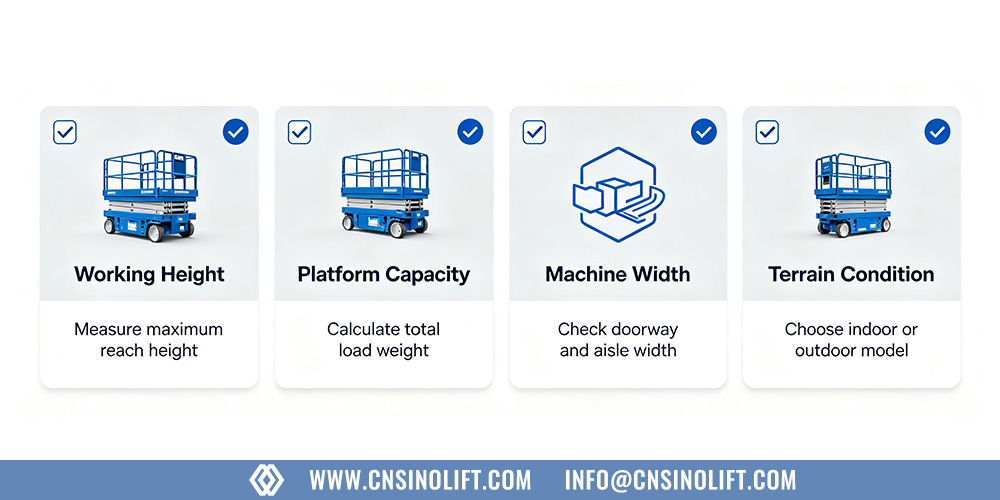
Choosing a scissor lift is about more than just height. Required working height, platform capacity, machine width, terrain and job site environment all influence the final configuration.
Send us your project requirements, including:
Required working height
Platform load
Access width
Indoor or outdoor use
Ground conditions
SINO LIFT team can recommend a suitable scissor lift configuration based on your actual working conditions and performance requirements.
HENAN SINO LIFT is committed to providing customers with high-quality and high-performance industrial equipment. Over the years, we have adhered to technological innovation and product quality, earning the trust and support of our customers.
We manufacture Scissor Lift, Mast Lift, Boom Lift, Cargo Lift, Loading Ramp, Wheelchair Lift, and Warehouse Handling Equipment. If you need these products, please let us specify a suitable solution for you.