When you import self-propelled scissor lifts from China, the number of machines loaded into one container can have a direct impact on your freight cost per unit and total landed cost.
The answer depends on the model. The biggest difference comes from the machine’s stowed width, length, and weight, not simply its lifting height.
Short answer: Based on the SINO LIFT models covered in this guide, approximately 1–9 self-propelled scissor lifts can fit in a 20ft container, while 3–19 units can fit in a 40ft container. These are confirmed loading quantities from actual export shipments, not theoretical volume calculations.
These figures are not universal for every scissor lift manufacturer. Different models can have very different chassis dimensions even when they offer a similar lifting height. If you are still comparing suppliers or are unsure about the reliability of Chinese scissor lifts, this guide on whether Chinese scissor lifts are reliable covers what buyers should check before importing.
This guide uses SINO LIFT self-propelled scissor lifts as the reference and explains the loading quantities that are used in real container shipments.
The following calculations use typical dimensions and weight limits for standard dry cargo containers (General Purpose, GP). These are the most common container types used in scissor lift export shipments.
| Container | Internal Dimensions (L × W × H) | Typical Door Opening | Approx. Max Gross Weight | Approx. Tare Weight | Approx. Max Payload |
|---|---|---|---|---|---|
| 20ft GP | 5.90 × 2.35 × 2.39 m | about 2.34 × 2.28 m | about 30,480 kg | about 2,200 kg | about 28,200 kg |
| 40ft GP | 12.03 × 2.35 × 2.39 m | about 2.34 × 2.28 m | about 30,480 kg | about 3,700 kg | about 26,780 kg |
Max Gross Weight is the total permitted weight of the container plus its cargo, including securing materials. Tare Weight is the weight of the empty container. Max Payload is the maximum cargo weight the container can carry, calculated as:
Max Gross Weight − Tare Weight = Max Payload
For example, a typical 20ft GP container has a max gross weight of about 30,480 kg and a tare weight of about 2,200 kg, giving a max payload of about 28,200 kg. A typical 40ft GP container has the same max gross weight but a higher tare weight of about 3,700 kg, so its max payload is lower, at about 26,780 kg.
This is why a 40ft container does not simply carry twice the cargo weight of a 20ft container, even though it is roughly twice as long. Both containers usually share the same maximum gross weight, but the 40ft container itself is heavier, which reduces the available payload for cargo.
Always check the actual container’s CSC plate for maximum gross weight and payload before loading. Container specifications can vary slightly between container owners and production batches.
The dimensions above are useful for estimating loading quantities, but actual container dimensions can vary slightly. The door opening also needs to be checked separately because it can be smaller than the container’s internal height. If you also need to move the lift into a building or through a freight elevator after arrival, this guide on whether a scissor lift can fit in a freight elevator explains what to measure.
For container loading, three dimensions are especially important:
Important note on stowed dimensions: In actual export loading, some machines may have stowed dimensions that appear slightly larger than a standard container opening. The ladder or other removable parts can be detached before shipment to reduce the overall dimensions. The confirmed loading quantities below already take this practice into account.
The following SINO LIFT models cover lifting heights from 5.8 m to 15.8 m. For container loading, the most important figures are the stowed dimensions and machine weight. Lifting height is mainly a product selection parameter. Stowed dimensions are a shipping parameter.
| Model | Lifting Height | Platform Size (m) | Load Capacity | Stowed Size for Container Loading (L × W × H) | Weight |
|---|---|---|---|---|---|
| GTJZ06S | 5.8 m | 1.67 × 0.74 | 230 kg | 1.85 × 0.76 × 1.85 m | 1,350 kg |
| GTJZ-6A | 5.8 m | 2.30 × 0.84 | 380 kg | 2.30 × 0.84 × 1.73 m | 1,880 kg |
| GTJZ-6 | 5.8 m | 2.30 × 1.13 | 550 kg | 2.48 × 1.19 × 1.68 m | 2,150 kg |
| GTJZ-8A | 7.8 m | 2.29 × 0.84 | 230 kg | 2.30 × 0.84 × 1.85 m | 2,030 kg |
| GTJZ-8 | 7.8 m | 2.29 × 1.13 | 450 kg | 2.48 × 1.19 × 1.82 m | 2,300 kg |
| GTJZ-10 | 9.8 m | 2.30 × 1.13 | 320 kg | 2.48 × 1.19 × 1.92 m | 2,530 kg |
| GTJZ-12 | 11.8 m | 2.29 × 1.13 | 320 kg | 2.48 × 1.19 × 2.05 m | 2,870 kg |
| GTJZ-14 | 13.8 m | 2.67 × 1.13 | 227 kg | 2.84 × 1.40 × 2.06 m | 3,340 kg |
| GTJZ-16 | 15.8 m | 2.94 × 1.13 | 227 kg | 3.25 × 1.56 × 2.26 m | 4,200 kg |
The stowed sizes listed above are the dimensions used for actual container loading. For some models, this is slightly shorter than the standard machine length because the ladder is removed before shipment. If you are comparing models for a first purchase, our scissor lift purchasing guide covers lifting height, platform size, load capacity, and site conditions in more detail.
Before loading, the platform should be fully lowered and the guardrails folded. This keeps each machine in its normal loading configuration and provides sufficient clearance for container entry.
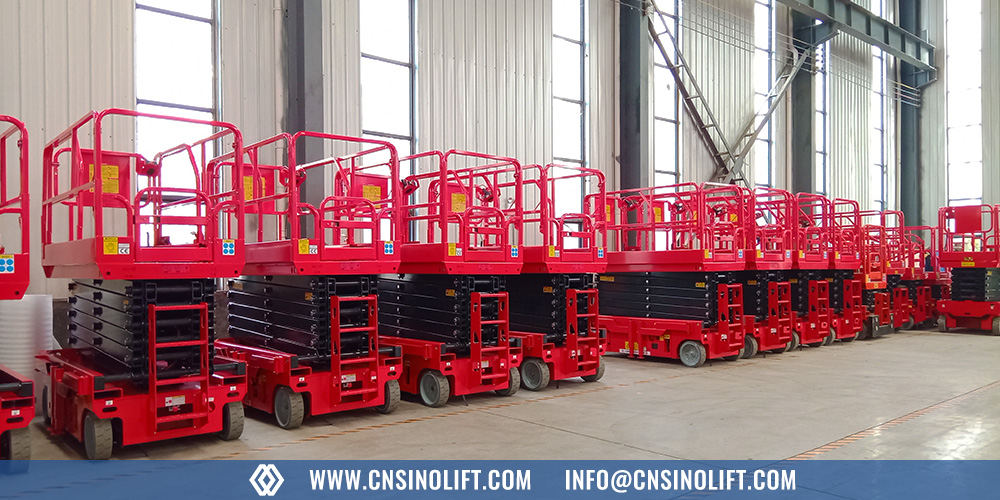
The following table gives confirmed loading quantities from actual SINO LIFT export shipments. The figures already account for practical loading methods, including guardrail folding, ladder removal where required, and securing space.
| Model | Stowed Size for Loading | 20ft Container | 20ft Cargo Weight | 40ft Container | 40ft Cargo Weight |
|---|---|---|---|---|---|
| GTJZ06S | 1.85 × 0.76 × 1.85 m | 9 units | 12.15 t | 19 units (20 units would be overweight) | 25.65 t |
| GTJZ-6A | 2.30 × 0.84 × 1.73 m | 6 units / 7 units (7 units requires a 5.95 m container) | 11.28 t / 13.16 t | 14 units | 26.32 t |
| GTJZ-6 | 2.48 × 1.19 × 1.68 m | 4 units | 8.60 t | 10 units | 21.50 t |
| GTJZ-8A | 2.30 × 0.84 × 1.85 m | 6 units / 7 units (7 units requires a 5.95 m container) | 12.18 t / 14.21 t | 13 units (14 units would be overweight) | 26.39 t |
| GTJZ-8 | 2.48 × 1.19 × 1.82 m | 4 units | 9.20 t | 10 units | 23.00 t |
| GTJZ-10 | 2.48 × 1.19 × 1.92 m | 4 units | 10.12 t | 10 units | 25.30 t |
| GTJZ-12 | 2.48 × 1.19 × 2.05 m | 4 units | 11.48 t | 9 units (10 units would be overweight) | 25.83 t |
| GTJZ-14 | 2.84 × 1.40 × 2.06 m | 2 units | 6.68 t | 4 units | 13.36 t |
| GTJZ-16 | 3.25 × 1.56 × 2.26 m | 1 unit | 4.20 t | 3 units | 12.60 t |
Notes in parentheses indicate non-standard container requirements or weight-limited quantities.
The quantities shown are confirmed loading quantities from SINO LIFT export shipments. They already account for practical loading methods, guardrail folding, ladder removal where required, and securing space.
The cargo weight figures are based on the listed unit weight multiplied by the confirmed loading quantity. They are not container payload limits. The actual permissible cargo weight must be confirmed against the container’s CSC plate and any applicable road weight restrictions.
The table gives the quickest answer to the main question. The details below show how these quantities are determined.
A 40ft container is roughly twice the length of a 20ft container, but the loading quantity does not always double exactly.
Container loading uses whole machines, not just total available length. The remaining space after each machine is positioned can affect the final quantity. Weight limits and actual container length also matter.
For example, the GTJZ-16 has a stowed length of 3.25 m:
So the confirmed quantity is 1 unit in a 20ft container and 3 units in a 40ft container, rather than 1 and 2.
Door clearance, machine positioning, and securing requirements also need to be considered before the final loading quantity is confirmed.
These three models have narrow stowed widths of 0.76–0.84 m, which allows more units across the container and higher loading quantities.
GTJZ06S: Stowed size 1.85 × 0.76 × 1.85 m, weight 1,350 kg. For a 20ft container, the confirmed loading quantity is 9 units (12.15 t). For a 40ft container, the confirmed loading quantity is 19 units (25.65 t). The loading arrangement uses three rows across the container width, with six columns along the length. Six columns take up 11.10 m of the 12.03 m internal length. The remaining 0.90 m allows one more unit to be placed crosswise, giving 19 units in total. A 20-unit load would be 27.00 t and would exceed the standard container payload limit. The standard-compliant quantity is therefore 19 units.
GTJZ-6A and GTJZ-8A: Both have a stowed width of 0.84 m. The standard machine length is 2.48 m, but the ladder can be removed before shipment to reduce the loading length to about 2.30 m, which allows the machines to be placed crosswise in the container. For a standard 20ft container with an internal length of 5.90 m, the confirmed loading quantity is 6 units. If the container has an internal length of about 5.95 m, 7 units can be loaded. For a 40ft container, the GTJZ-6A can load 14 units (26.32 t), which stays within the standard payload limit. The GTJZ-8A can load 13 units (26.39 t). A 14-unit load would be 28.42 t and would exceed the standard container payload limit, so 13 units is the standard-compliant quantity.
These four models all have a stowed width of 1.19 m. Two machines side by side would require 2.38 m, which is slightly wider than the typical 2.35 m internal width of a standard container. Instead, they are normally loaded one across.
For these models, the confirmed loading quantities are:
For the GTJZ-12, the container dimensions would allow up to 10 units in a 40ft container. However, 10 units would weigh 28.70 t, which would exceed the standard container payload limit. The standard-compliant loading quantity is therefore 9 units (25.83 t).
The GTJZ-14 has a stowed size of 2.84 × 1.40 × 2.06 m and weighs 3,340 kg. Its 1.40 m width means only one machine can be positioned across the container. The confirmed loading quantities are 2 units in a 20ft container and 4 units in a 40ft container.
The GTJZ-16 has a stowed size of 3.25 × 1.56 × 2.26 m and weighs 4,200 kg. Its 1.56 m width means it must be loaded one across. The confirmed loading quantities are 1 unit in a 20ft container and 3 units in a 40ft container. Its stowed height of 2.26 m is close to the typical door opening height, so the actual container door opening and loading method should be checked before shipment.
When estimating container loading, buyers often focus on machine length. Width can be just as important, and in some cases it makes a much bigger difference.
Consider two machines with similar stowed lengths.
A 0.84 m-wide machine can be loaded two across:
0.84 × 2 = 1.68 m
A 1.19 m-wide machine cannot practically be loaded two across:
1.19 × 2 = 2.38 m
The second figure is already wider than the typical 2.35 m internal container width.
As a result, machines with similar stowed lengths can have very different loading quantities. For example, the GTJZ-6A and GTJZ-8A can load 6 or 7 units in a 20ft container, while the GTJZ-6, GTJZ-8, GTJZ-10, and GTJZ-12 load 4 units under the same standard container length.
For importers, this means that stowed dimensions are more useful for shipping calculations than lifting height alone.
Yes. Different scissor lift models can be loaded in the same container, but mixed loading needs to be planned according to the actual dimensions of each machine.
The main factors are:
For example, one GTJZ-16 uses 3.25 m of container length, while one GTJZ-8 uses 2.48 m. Together they use 5.73 m, which is within the typical 5.90 m internal length of a 20ft container.
However, this is a dimensional example, not a confirmed loading plan. Actual mixed loading should also account for machine width, door access, positioning, wheel chocks, lashing, and the final loading sequence.
For mixed-model orders, a simple loading diagram is often the safest way to confirm the arrangement before the container is booked. If your site has narrow corridors or tight access points, check the turning radius of a scissor lift before finalizing the model selection.
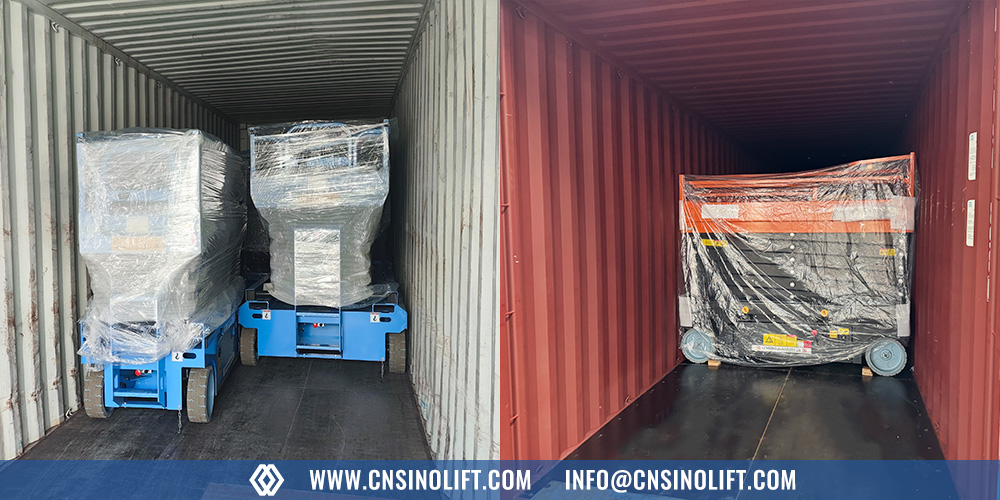
Machine weight is another important part of the loading calculation.
The SINO LIFT self-propelled scissor lifts covered here weigh from 1,350 kg to 4,200 kg.
For example:
Container loading therefore needs to be checked from both a space and weight perspective. For a detailed breakdown of how machine weight changes with lifting height, see our guide on how much a 40-foot scissor lift weighs.
There are three different weight considerations:
A shipment may have enough physical space for the machines but still require a lower loading quantity because of weight restrictions. For example, 14 units of GTJZ-8A and 10 units of GTJZ-12 in a 40ft container would exceed the standard container payload limit. The confirmed loading quantities are therefore 13 units and 9 units respectively, both of which remain within the standard limit.
The final loading plan should therefore consider both:
Available container space and total cargo weight
rather than looking at container volume alone.
Yes, especially for larger scissor lifts.
A standard container may have an internal height of around 2.39 m, but the door opening is lower. This means a machine can have enough clearance once inside the container but still have difficulty passing through the door.
The GTJZ-16 is a good example. Its stowed height is 2.26 m, which is close to the typical door opening height.
Before loading a machine with a stowed height close to the door limit, check:
Do not use the container’s internal height alone to determine whether a scissor lift can be loaded.
Proper preparation can make the loading process easier and help prevent damage during transportation.
The platform should be completely lowered before the machine enters the container. This keeps the machine in its normal loading configuration and reduces the overall height.
Depending on the model and loading arrangement, the guardrails should be folded to provide sufficient door clearance and to reach the stowed dimensions listed above.
The exact folding procedure should be confirmed for the specific machine before loading.
Some stowed dimensions may appear slightly larger than a standard container opening. In actual export loading, the ladder can be detached to reduce the overall length. This is a normal practice for container shipment and is already considered in the confirmed loading quantities above.
Make sure the battery has enough charge for the loading operation. This allows the machine to be driven into position without unnecessary manual handling.
The machines should be secured against movement during ocean transportation.
Wheel chocks, tension belts, and suitable protective materials should be used according to the loading and securing plan.
When several machines are loaded close together, protective padding can also help prevent contact between components.
There is no single answer. The better container depends on the model, quantity, and loading arrangement.
A 20ft container can make sense when:
A 40ft container is often more suitable when:
The key point is not simply whether a 40ft container costs more. Compare the freight cost per machine.
For example:
Container freight ÷ number of machines = approximate freight cost per machine
A 40ft container can have a higher total freight cost but still provide a lower freight cost per machine if the additional space is used efficiently. For current FOB price ranges across different scissor lift types and heights, refer to our scissor lift price guide.
The final choice should be based on the actual machine models, quantities, freight quotation, and destination requirements.
Before booking a container for self-propelled scissor lifts, check the following:
For the SINO LIFT models covered in this guide:
Planning a shipment? Send us your model list, quantity, and destination. We can check the container loading plan and estimated cargo weight before shipment.
Yes. Many self-propelled scissor lifts can be loaded into a standard 20ft container when properly stowed and prepared for transport. The exact quantity depends mainly on the machine’s stowed length, width, height, and the container door clearance.
Using the GTJZ06S as an example, its stowed size of 1.85 × 0.76 × 1.85 m allows a confirmed loading quantity of 9 units in a 20ft container.
For the SINO LIFT models covered in this guide, a confirmed 3 to 19 units can fit in a 40ft container, depending on the model. Compact narrow models load higher quantities, while wider and heavier models load fewer units.
Yes. Mixed loading is possible, but the arrangement needs to consider machine length, width, height, weight, door clearance, and the space required for securing the machines. For mixed-model orders, a loading layout should be confirmed before shipment.
Yes. Container loading is not only about available floor space. The total weight of the machines must remain within the container’s rated payload and any applicable transportation weight limits at the destination.
Yes. The guardrails should be folded before loading to reach the stowed dimensions and to provide sufficient door clearance. The exact folding procedure should be confirmed for the specific model before loading.
There is no single container size for every scissor lift. A 20ft container may be suitable for smaller orders or larger machines, while a 40ft container can be more efficient when loading several compact machines. The correct choice depends on the model, quantity, stowed dimensions, total weight, and freight cost.
HENAN SINO LIFT manufactures self-propelled scissor lifts and other lifting and access equipment for customers in different markets. Our product range includes Scissor Lifts, Mast Lifts, Boom Lifts, Cargo Lifts, Loading Ramps, Wheelchair Lifts, and Warehouse Handling Equipment.
Because these machines are shipped by container every week, we can help buyers check stowed dimensions, confirmed container loading quantities, and total cargo weight before shipment. If you have an order in progress, send us your model list, quantity, and destination, and we can review the loading plan with you.
Email: info@cnsinolift.com
Website: www.cnsinolift.com