Turning radius is an important specification when a scissor lift needs to work in narrow aisles, crowded warehouses, or confined job sites. A machine that cannot move through the available space can slow down work, create safety risks, and limit where it can be used.
This guide explains what turning radius means for scissor lifts, typical values by lift type, and how to match a machine to your workspace. The model references and figures in this article are based on SINO LIFT scissor lift specification sheets. They describe SINO LIFT equipment and are intended as product-line reference values. Actual performance can vary with configuration, tire type, platform extension, and operating conditions.
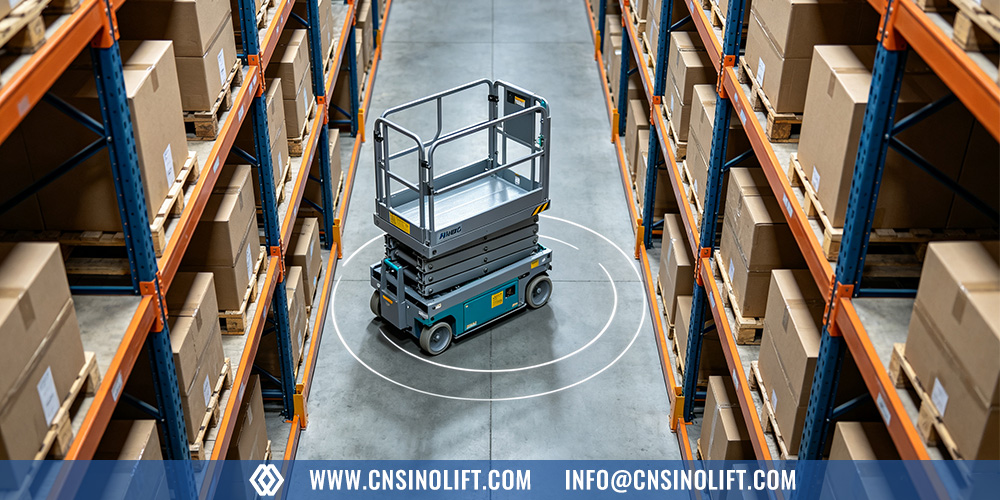
For SINO LIFT scissor lifts, the published turning radius ranges are:
Self-propelled scissor lifts: inside turning radius of 0 m; outside turning radius of about 1.64 m to 3.16 m, depending on model and platform height.
Tracked scissor lifts (rubber or steel tracks): these models can rotate 360° in place. The inside turning radius is 0 m. The outside turning radius depends on the machine's overall dimensions and the rotation center, so check the model-specific length and width to estimate the swept area.
Rough-terrain scissor lifts: inside turning radius of about 2.1 m to 3.67 m; outside turning radius of about 4.2 m to 6.36 m.
Mini scissor lifts: manual four-swivel-wheel models can rotate 360° in place, with an inside turning radius of 0 m; the outside turning radius depends on the machine's overall dimensions. Electric rear-drive models have an inside turning radius of 0 m and an outside turning radius of 1.2 m.
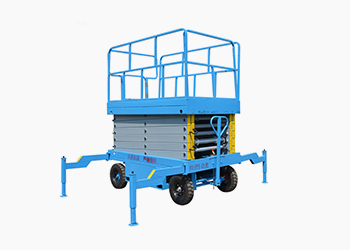
Towable scissor lifts (standard SJY series): these models have no self-propelled driving function. They are moved by an external vehicle or external force. They are generally larger in size and are not intended for narrow spaces.
Always confirm the exact specification for the model you plan to use.
Turning radius is the smallest circular path a machine needs to complete a turn. For scissor lifts, it is usually divided into two measurements.
The inside turning radius is the radius of the circle traced by the innermost wheel during a turn. A zero inside turning radius means the machine can pivot within a very small area. This is useful in narrow aisles, corridors, and indoor work zones.
The outside turning radius is the distance from the turning center to the outermost point of the machine during a turn. The exact measurement method can vary by manufacturer, so always check the model-specific specification. For site planning, the outside turning radius is one of the key measurements for estimating how much floor space is needed to complete a turn without hitting walls, racking, or other equipment.
Most scissor lifts use a rigid chassis and a fixed steering configuration. Lifting the platform does not physically change the turning radius, but many models limit drive speed and steering angle when elevated for stability.
Turning radius and turning diameter are related but different measurements. The turning radius is the distance from the center of the turn to the outside edge of the path. The turning diameter is twice that distance.
For example, if a scissor lift has an outside turning radius of 2 m, the outside turning diameter is approximately 4 m. This means the machine needs a circular path about 4 m wide to complete a full turn.
When reading a specification sheet, check whether the figure is given as a radius or a diameter. Mixing them up can lead to incorrect site planning. A machine with a 2 m turning radius needs more space than a machine with a 2 m turning diameter.
Turning radius varies by lift category. The table below summarizes the ranges found in SINO LIFT scissor lift specifications. For a broader overview of how these categories differ in mobility, power type, and construction applications, see our guide on 5 types of scissor lifts.
| Scissor Lift Type | Inside Turning Radius | Outside Turning Radius | Notes |
|---|---|---|---|
| Self-propelled scissor lifts | 0 m | 1.64–3.16 m | Compact models are used for indoor aisles and doorways |
| Tracked scissor lifts (rubber or steel) | 0 m | Depends on model dimensions | Can rotate 360° in place; check overall length and width |
| Rough-terrain | 2.1–3.67 m | 4.2–6.36 m | Wider chassis and larger tires for outdoor stability |
| Mini scissor lifts (manual four-swivel-wheel) | 0 m | Depends on model dimensions | Can rotate 360° in place by manual movement |
| Mini scissor lifts (electric rear-drive) | 0 m | 1.2 m | Two rear drive wheels, electric drive |
| Towable (standard SJY series) | Not applicable | Not applicable | No self-propelled driving function; moved by external vehicle; larger size, not for narrow spaces |
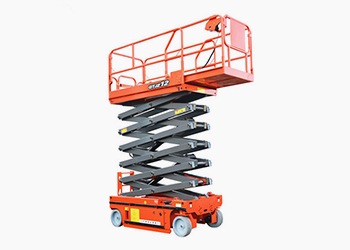
Self-propelled scissor lifts are common for indoor work in warehouses, offices, retail spaces, and maintenance areas. In the SINO LIFT self-propelled series, these models list a zero inside turning radius. The outside turning radius grows as platform height and machine size increase.
For example, the Mini GTJZ06M has an outside turning radius of 1.64 m. This makes it suitable for narrow aisles and tight indoor spaces. The GTJZ14 lists an outside turning radius of 2.7 m, and the GTJZ16 lists 3.16 m. These larger models offer higher working heights, but they need more clearance to turn. For detailed specifications on the full self-propelled electric scissor lift range, including platform dimensions and load capacities, refer to the product page.
A zero inside turning radius does not mean the lift can turn in any space. The outside turning radius and the machine's overall width still determine whether it can complete a turn in a given aisle.
SINO LIFT tracked scissor lifts include rubber-tracked models such as the GTJZ04TE and GTJZ08TE, as well as steel-tracked models such as the GTJZ06LD and GTJZ08LD. Both types use track-based steering and are designed for indoor and outdoor transitions.
These models can rotate 360° in place. The inside turning radius is 0 m. The outside turning radius depends on the machine's overall dimensions and the rotation center. When planning a job site, check the model-specific overall length and width to estimate the swept area. The rubber-tracked models list a maximum climbing ability of 30% and a travel speed of 2.5 km/h in the folded state.
Rubber tracks can be useful on sensitive floors and uneven ground. Steel tracks are often chosen for heavier duty cycles. In both cases, the turning path should still be verified against the site layout.
Rough-terrain scissor lifts use four-wheel drive, larger tires, and heavier frames for outdoor work. They have a larger turning footprint than self-propelled models, but they offer more stability on uneven ground.
In the SINO LIFT rough-terrain series, the GTJZ8RE lists a 2.1 m inside turning radius and a 4.2 m outside turning radius. The GTJZ20RE, with a 22 m working height, lists a 3.67 m inside radius and a 6.36 m outside radius. These figures reflect the wider chassis and larger tires needed for outdoor construction, roadwork, and open-site tasks.
Rough-terrain models are not usually the first choice for narrow indoor aisles. They are better suited to sites where ground conditions and outdoor stability are the main concerns.
SINO LIFT also manufactures towable scissor lifts and mini scissor lifts. The turning radius for these lines depends on the specific model and drive type.
Mini scissor lifts are available in two configurations. Manual four-swivel-wheel models can rotate 360° in place, with an inside turning radius of 0 m. The outside turning radius depends on the machine's overall dimensions. Electric rear-drive models have an inside turning radius of 0 m and an outside turning radius of 1.2 m. For example, mini scissor lifts have a table size of 1170 × 600 mm and overall dimensions starting around 1300 × 740 mm.
Towable scissor lifts (standard SJY series) have no self-propelled driving function. They are moved by an external vehicle or external force. They are generally larger in size and are not intended for narrow spaces. Towable models range from 4 m to 20 m lifting height with platform sizes from 2100 × 830 mm to 3500 × 1900 mm. These dimensions help determine whether the lift can enter a doorway, aisle, or work area when moved into position.
Several design and operational factors influence a scissor lift's turning radius. The points below focus on practical selection rather than general machine theory.
A shorter wheelbase and narrower chassis reduce the turning radius. Compact indoor models use a shorter wheelbase and narrower body to turn in tight spaces. Rough-terrain models use a longer wheelbase and wider chassis for stability, which increases the space needed to turn.
Most scissor lifts use two-wheel steering. Some compact models use optimized steering geometry to reduce the inside turning radius. Four-wheel steering, found on some models, can further improve maneuverability. The final turning radius depends on the complete machine design, so compare published specifications rather than assuming a certain steering type will always perform the same way.
Small solid or non-marking tires on self-propelled lifts are common for indoor use. Large rough-terrain tires increase ground contact and stability, but they also widen the turning footprint. Tire choice is often a trade-off between indoor floor protection and outdoor traction.
A platform extension can increase the amount of clearance needed around the machine. When planning access, consider the machine's maximum overall dimensions and the position of the platform extension.
Warehouse aisles can be narrow. A scissor lift with a smaller outside turning radius can move through these aisles without repeated reversing. A larger rough-terrain model may not fit. Check both the machine width and the outside turning radius against the actual aisle.
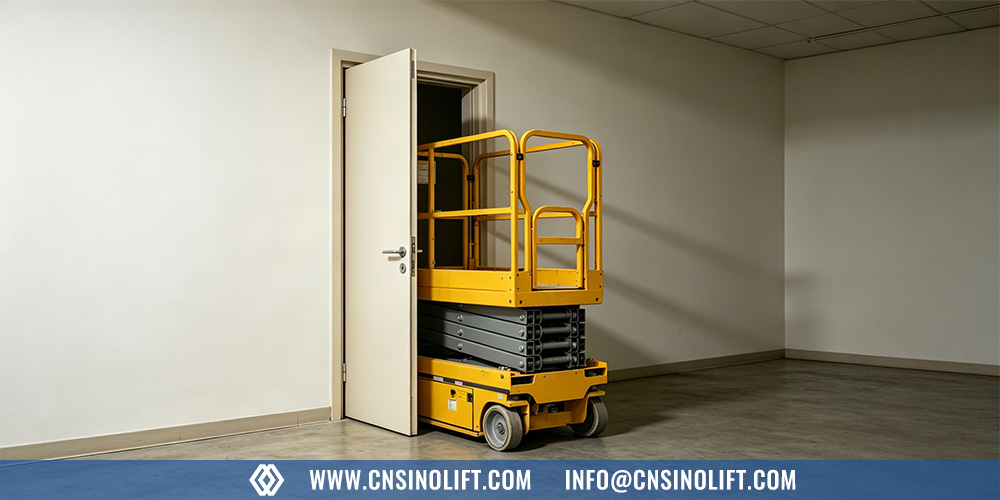
Compact self-propelled scissor lifts can fit through standard doorways and into freight elevators. This is important for multi-floor indoor work. Mini and self-propelled models are often selected for this reason. For a detailed check on doorway clearance and standard door dimensions in different regions, see our guide on whether a scissor lift will fit through a door. If the work is on an upper floor, the related question of fitting a scissor lift in a freight elevator covers the dimensional and weight checks that matter.
A lift that is too large for its turning space can hit walls, racking, piping, or building structures. Poor maneuverability can also lead to sudden steering corrections and tip-over risks. Matching the lift to the workspace is part of safe operation.
A lift with a tighter turning path can reposition faster. This reduces downtime in narrow aisles, crowded construction zones, and areas with multiple obstacles.
Many indoor job sites, shopping malls, and industrial facilities have equipment access standards. Checking the turning radius and overall dimensions before delivery helps avoid access problems.
When selecting a scissor lift, consider these steps. For a complete walkthrough of selection criteria including height, load, power type, and site conditions, our scissor lift purchasing guide covers the full process.
Measure the narrowest access point. Check doorways, aisles, corridors, and gates. Compare these measurements with the machine's overall width and outside turning radius.
Plan the full turning path. The outside turning radius determines how much floor space is needed to complete a turn. In a narrow aisle, even a zero inside turning radius model may need extra outside clearance.
Match the lift type to the environment. For indoor work in tight spaces, choose a self-propelled or mini model. For outdoor work on uneven ground, choose a rough-terrain model and allow more turning space. Tracked models can rotate in place but may still need clearance for the overall machine dimensions.
Check floor loading limits. Compact models with tighter turning radii are often lighter. This matters when working on elevated floors or sensitive surfaces.
Confirm the platform extension. If the platform extension affects the machine's overall clearance, use the maximum applicable dimensions for clearance planning.
Leave additional clearance. Beyond the published turning radius, allow extra space for walls, racks, people, floor conditions, and operator movement. The required clearance depends on the actual site layout and operating conditions.
Scissor lifts: Rigid chassis, compact design, and often a zero inside turning radius. Suitable for many indoor and flat-surface tasks.
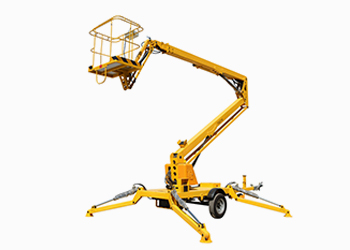
Boom lifts: Need more clearance to swing the boom. Good for reach, but less suited to narrow indoor spaces.
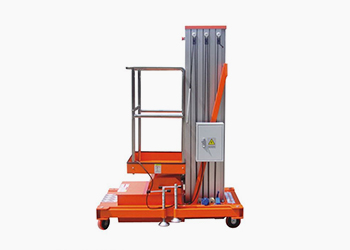
Vertical mast lifts: Compact and useful in very narrow aisles, but with lower platform capacity than many scissor lifts.
Aluminum alloy lifts: Lightweight and compact. Used for lower-height maintenance in lobbies, corridors, and similar areas.
SINO LIFT manufactures scissor lifts, mast lifts, boom lifts, cargo lifts, loading ramps, wheelchair lifts, and warehouse handling equipment. The right choice depends on working height, platform capacity, floor conditions, and available turning space.
Turning radius is a safety specification, not only a convenience figure. Operating a lift in a space that is too tight can lead to:
Collisions with structures or personnel
Tipping from abrupt steering corrections
Damage to the machine's steering components
Damage to racking, walls, piping, or finished floors
Modern scissor lifts use tilt sensors, load sensing, and proportional controls to help operators maintain stability. Always read the operator's manual and conduct a site assessment before using any aerial work platform in a confined space.
Q: Do scissor lifts have a zero turning radius?
A: Many self-propelled scissor lifts have a zero inside turning radius. Rubber-tracked and steel-tracked models can rotate 360° in place, which also gives them a zero inside turning radius. Manual four-swivel-wheel mini models can also rotate 360° in place. The outside turning radius still determines the total space needed for a turn.
Q: Is inside or outside turning radius more important?
A: Outside turning radius is the main figure for site clearance because it determines the minimum space needed for a complete turn. Inside turning radius is useful for understanding corner maneuverability.
Q: Does lifting the platform change the turning radius?
A: The physical turning radius does not change. However, many lifts limit drive speed and steering angle when the platform is elevated for stability. This can increase the practical space needed to maneuver.
Q: How much clearance do I need for a scissor lift turn?
A: Use the outside turning radius as a starting point, then add clearance for walls, racks, people, floor conditions, and operator movement. The exact clearance depends on the site layout and operating conditions. Check the machine's published specifications and conduct a site assessment.
Q: What turning radius do I need for a 2.4 m aisle?
A: A 2.4 m aisle does not automatically mean that a lift with a 1.8 m outside turning radius will be able to make a complete turn. You also need to check the machine's overall width, the aisle geometry, whether the aisle is open-ended, the turning maneuver, wall and rack clearance, and the steering configuration. Compare the actual site layout with the machine's published dimensions before selecting a model.
Q: Does a smaller turning radius mean a less capable lift?
A: Not always. Compact electric lifts can offer good maneuverability while still providing useful working heights and capacities. However, very small lifts usually have lower platform capacities and working heights than larger models.
Q: How does turning radius compare between scissor lifts and boom lifts?
A: Scissor lifts are often easier to maneuver in confined, flat-surface work areas because they have a compact chassis and do not require boom swing clearance. However, the actual turning radius varies by model, so compare the published specifications when selecting equipment.
Turning radius affects where a scissor lift can work and how efficiently it can move. Self-propelled models can have a zero inside turning radius and an outside turning radius starting around 1.64 m. Rough-terrain models need more space, with outside turning radii from about 4.2 m to 6.36 m. Rubber-tracked and steel-tracked models can rotate 360° in place, giving them a zero inside turning radius, but their outside turning radius depends on overall dimensions. Mini scissor lifts have two configurations: manual four-swivel-wheel models can rotate 360° in place, while electric rear-drive models have an inside turning radius of 0 m and an outside turning radius of 1.2 m. Standard towable models have no self-propelled driving function, are moved by an external vehicle, and are generally larger in size, so they are not intended for narrow spaces.
Before renting or buying, measure your narrowest access points and compare them with the machine's published specifications. Budget is another factor in the selection process; our scissor lift price guide covers typical price ranges by type and working height. If you need help matching a scissor lift to your workspace, you can contact SINO LIFT for a suitable solution.
HENAN SINO LIFT is committed to providing customers with high-quality and high-performance industrial equipment. Over the years, we have adhered to technological innovation and product quality, earning the trust and support of our customers.
We manufacture Scissor Lift, Mast Lift, Boom Lift, Cargo Lift, Loading Ramp, Wheelchair Lift, and Warehouse Handling Equipment. If you need these products, please let us specify a suitable solution for you.
Email: info@cnsinolift.com
Website: www.cnsinolift.com