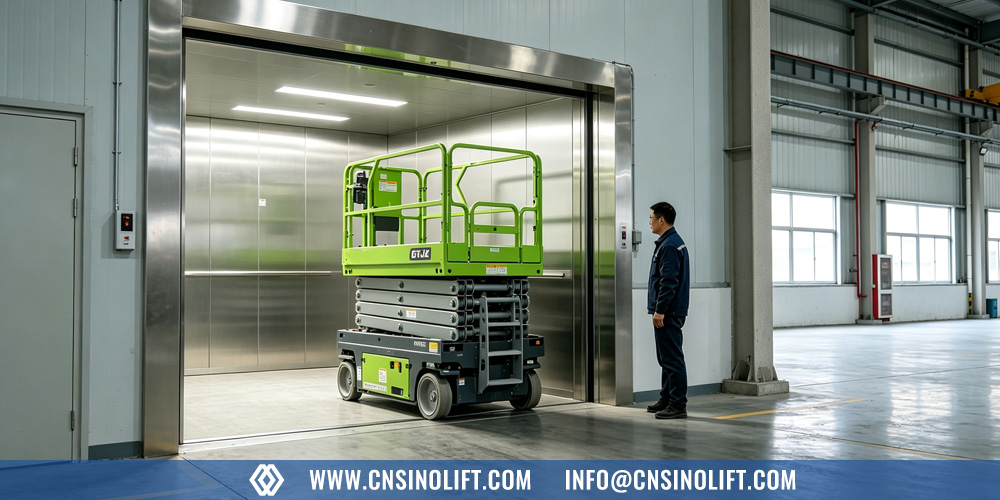
If you work in facility maintenance, warehouse operations, or building construction, you may face a practical problem: the work is on an upper floor, but the loading area is on the ground floor. Can a scissor lift fit into the freight elevator and travel safely?
Quick answer: Sometimes. Compact and medium electric scissor lifts can fit in some freight elevators after a full inspection. Large heavy-duty models often cannot. Physical fit is only the first condition. Weight, floor loading, door clearance, turning space, equipment condition, and operating rules decide whether the move is safe.
This article walks through the checks that matter before you drive a scissor lift into a freight elevator.
Freight elevators are not standardized. A 2,000 kg elevator in one building may have a different cabin size from a 2,000 kg elevator in another. Door openings also vary. Some have wide bi-fold doors; others have narrow openings that reduce clearance.
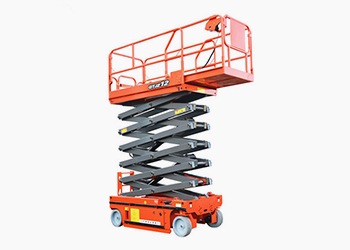
Scissor lifts vary even more. A compact electric model may be around 0.84 m wide and weigh about 1,350 kg. A larger model can be over 3 m long, 1.5 m wide, and weigh more than 4,500 kg. The safest approach is to compare the exact lift model with the exact elevator.
If you are still at the selection stage and have not yet chosen a model, our scissor lift purchasing guide covers height, load, power type, and site conditions in more detail.
All measurements must be based on the lift in its fully folded and retracted state. That is the smallest size of the machine.
You need three key dimensions:
Do not rely only on a brochure. Measure the actual machine, including tires, guardrail posts, bottom frame brackets, and any tail wires or protruding parts.
A small safety gap on each side helps during entry, but the exact clearance should follow the elevator manufacturer, building rules, and site risk assessment. The folded height should be lower than the clear height of the elevator door and cabin. The exact margin depends on the site. If the machine is close to the limit, treat it as a no-go until confirmed.
A common mistake is to check only the elevator cabin. The door opening is often the tighter point. Many freight elevators have narrow doors but spacious cabin interiors. If the lift cannot pass through the door, it cannot enter, no matter how much space is inside.
Also check the door type. A bi-fold or center-opening door may reduce the clear opening when the door panels are not fully retracted. The actual clear width and height matter more than the nominal door size.
The same logic applies to standard building doorways. If you also need to move the lift through interior doors before reaching the elevator, see our guide on whether a scissor lift will fit through a door.
Door width greater than machine width does not mean the machine can enter. The lift must approach the elevator straight enough to fit through the door. If the corridor in front of the elevator is narrow, the machine may need to turn to align with the entrance. That turning space can be the limiting factor.
In the GTJZ range, the outer turning radius varies by model, from about 1.64 m on the compact end to about 3.16 m on the larger end. A narrow hallway or a tight corner can block a machine even when its width fits the door. Before transport, check the approach path, the space in front of the elevator, and the turning area at each floor. Remove temporary accessories such as toolboxes or extension platforms to reduce the overall size.
Dimensional compliance does not mean safe transport. Overloading the elevator is a serious risk. Freight elevators have a fixed rated load. Any overload can cause elevator failure, structural damage, or a sudden stop.
The total weight includes three parts:
Do not estimate the weight roughly. Check the equipment nameplate and count all additional loads.
Operator weight is a variable that is often underestimated. Our guide on scissor lift capacity vs. operator weight explains how to calculate the usable capacity after accounting for people and tools.
The total load should stay below the rated load of the freight elevator. Some sites prefer a safety margin, but the exact margin should follow the elevator manufacturer, building management, and local rules. As an example only, if a freight elevator is rated at 2,000 kg, a plan that uses nearly all of that capacity leaves little room for error. The safe approach is to confirm the total weight and the site requirements before the move.
Also check the floor bearing capacity of the elevator cabin. A scissor lift puts concentrated weight on its wheels. Local pressure can damage the elevator floor even when the total weight is within the rated limit. Spreader plates or mats may be required in some buildings.
Before entering the elevator, the scissor lift must be in normal working condition. A faulty machine can fail during transport and cause a stuck elevator or an accident.
Check these items:
For a structured pre-use check, see our self-propelled scissor lift daily inspection checklist.
The elevator environment and access passage affect the safety of the move.
Keep the passage from the parking point to the elevator entrance clear. Remove obstacles, loose materials, and sharp objects. Check the ground flatness of the passage and elevator cabin. The slope must be within the equipment’s allowable driving range to prevent sliding or tilting.
For elevators with thresholds, confirm that the threshold height will not affect the equipment. A low ground clearance machine may bottom out on the ramp.
Confirm that the freight elevator is working normally. The doors should open and close smoothly, and the leveling accuracy should meet the standard. Do not use an elevator that is faulty, under maintenance, or privately modified.
Check the elevator interior for protruding parts, anti-collision strips, or other structures that could collide with the lift.
The table below uses SINO LIFT’s self-propelled electric scissor lift range (GTJZ series) as the reference. These are manufacturer specifications for these models, not universal industry figures. Confirm the exact unit before planning transport.
| Model | Working Height Max | Platform Height Max | Safe Working Load | Folded Overall Size (L×W×H) | Weight |
|---|---|---|---|---|---|
| Mini GTJZ06M | 7.8 m | 5.8 m | 230 kg | 1.85×0.84×1.85 m | 1350 kg |
| GTJZ06 | 7.8 m | 5.8 m | 380 kg | 2.48×0.84×1.73 m | 1880 kg |
| GTJZ06 | 7.8 m | 5.8 m | 550 kg | 2.48×1.19×1.68 m | 2150 kg |
| GTJZ08Z | 9.8 m | 7.8 m | 230 kg | 2.48×0.84×1.85 m | 2030 kg |
| GTJZ08 | 9.8 m | 7.8 m | 450 kg | 2.48×1.19×1.82 m | 2300 kg |
| GTJZ10 | 11.8 m | 9.8 m | 320 kg | 2.48×1.19×1.92 m | 2530 kg |
| GTJZ12 | 13.8 m | 11.8 m | 320 kg | 2.48×1.19×2.05 m | 2870 kg |
| GTJZ14 | 15.8 m | 13.8 m | 227 kg | 2.84×1.40×2.06 m | 3340 kg |
| GTJZ16 | 17.8 m | 15.8 m | 320 kg | 3.25×1.56×2.26 m | 4590 kg |
Use the table as a starting point, not as a final answer. Follow these steps:
If any value is close to the limit, do not treat it as a pass. Confirm with the elevator owner, building management, and the lift manufacturer.
Consider a freight elevator with a clear door opening of 1.20 m wide × 2.10 m high and a cabin interior of 1.50 m wide × 2.20 m deep × 2.30 m high. A GTJZ10 has a folded size of 2.48 m long × 1.19 m wide × 1.92 m high and weighs 2,530 kg.
In this case, the elevator cabin is too shallow for the GTJZ10. A shorter model or a different transport method would be needed. This example shows why door width alone is not enough. The cabin depth and the total weight must also be checked.
If the lift does not fit, consider these options:
Do not force a lift into an elevator. Damage to the elevator, the lift, or the building can be expensive and dangerous.
If the elevator is the main constraint, check our scissor lift price guide before deciding on a model. A smaller unit that fits the elevator may also be the lower-cost option.
Even when all conditions are met, poor operation can create risks. Follow these rules during entry, transport, and exit.
Sometimes. A compact electric scissor lift may fit if its folded width, height, and weight are within the elevator’s limits. Larger models often do not fit.
There is no universal minimum. You need interior width greater than the lift width, interior depth greater than the lift length, interior height greater than the folded height, and capacity greater than the lift plus operator and tools.
In the SINO LIFT GTJZ range, weights run from about 1,350 kg for the Mini GTJZ06M to 4,590 kg for the GTJZ16. Always check the specific model’s nameplate.
Yes, if the lift fits and the elevator can carry the weight. Drive slowly, keep the platform stowed, and use a spotter.
No, unless the elevator manufacturer and lift manufacturer specifically approve it. Transport the lift in the stowed position only.
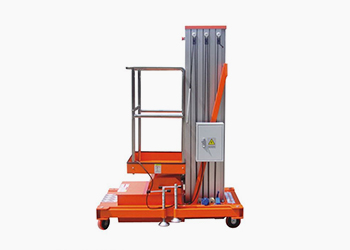
Use a smaller lift, a mast lift, a crane, or another route. Do not force it.
A compact electric scissor lift can enter and travel in a freight elevator when dimensions, weight, equipment condition, site conditions, and operating rules all meet the requirements. Large heavy-duty models often cannot. The key is not only whether the machine can physically fit inside the cabin, but whether the full transport plan is safe.
Before each elevator move, complete a full inspection. Check the elevator, the lift, the load, the route, and the turning space. If you are unsure whether a specific scissor lift will fit your freight elevator, send us the following details:
Email: info@cnsinolift.com
Website: www.cnsinolift.com
You can also reach us through our contact page to get a direct response from our team.
HENAN SINO LIFT is committed to providing customers with high-quality and high-performance industrial equipment. Over the years, we have adhered to technological innovation and product quality, earning the trust and support of our customers.
We manufacture Scissor Lift, Mast Lift, Boom Lift, Cargo Lift, Loading Ramp, Wheelchair Lift, and Warehouse Handling Equipment. If you need these products, please let us specify a suitable solution for you.
Email: info@cnsinolift.com
Website: www.cnsinolift.com