Choosing between a scissor lift and a vertical mast lift is not about finding a universal winner. The practical question is simpler: what kind of access do you have, how high do you need to work, how much platform space do you need, and how often will the machine move?
A scissor lift typically offers a larger platform and higher load capacity. A vertical mast lift is commonly designed for compact access and maneuverability. Both are mobile elevating work platforms used for maintenance, installation, and inspection. Their designs, however, serve different priorities.
This guide compares the two types using standard specifications from SINO LIFT's product range to help you decide which one fits your project.
| Factor | Scissor Lift (GTJZ Series) | Vertical Mast Lift (GTWY Series) |
|---|---|---|
| Working height | 7.8 m to 17.8 m | 5.7 m to 25.7 m (depending on mast configuration) |
| Platform height | 5.8 m to 15.8 m | 4 m to 24 m |
| Safe working load | 227 kg to 550 kg | 125 kg to 300 kg |
| Platform size | Approx. 1.67 × 0.74 m to 3.05 × 1.56 m | Approx. 0.64 × 0.58 m to 1.60 × 0.85 m (depending on mast configuration) |
| Machine width | 0.84 m to 1.56 m | 0.80 m to 1.60 m |
| Power | Electric, self-propelled | AC electric, optional battery and auxiliary drive |
| Typical use | Multi-person, heavier loads, wider areas | Single operator, light loads, narrow spaces |
Specifications shown are based on SINO LIFT standard models. Actual performance may vary by configuration and options.
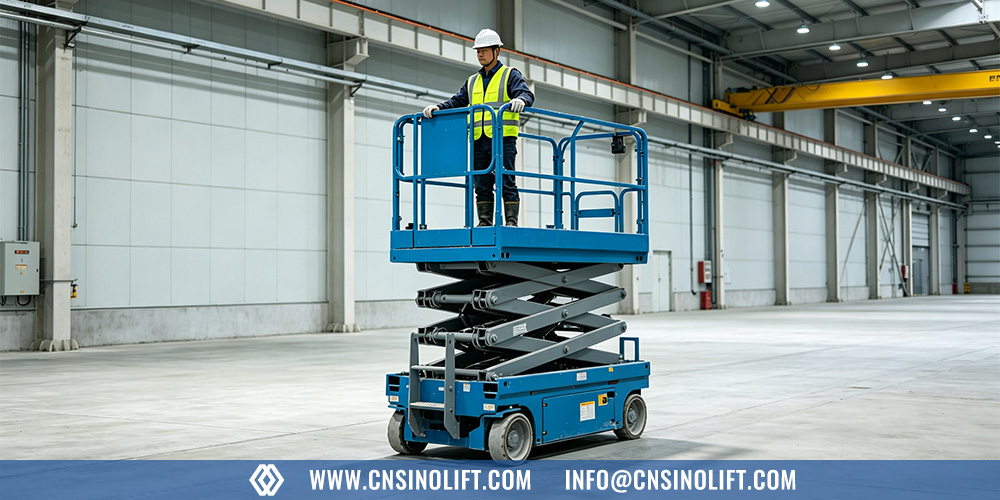
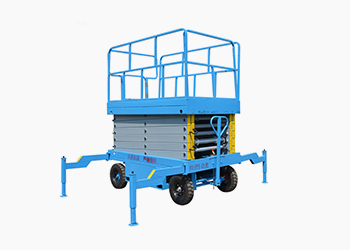
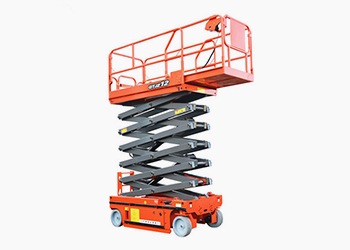
A scissor lift raises the platform vertically, while some models can include an extendable deck for additional working space. This design provides a stable lifting structure and allows the platform to be wider than that of many compact mast lifts.
SINO LIFT's GTJZ series covers self-propelled electric scissor lifts. It is built for work that needs a larger platform, higher load capacity, and stable support for tools and materials.
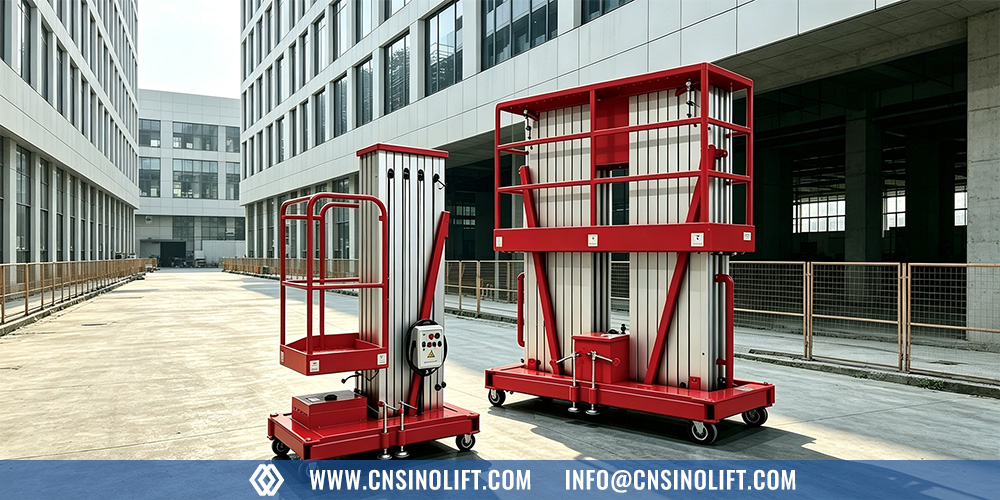
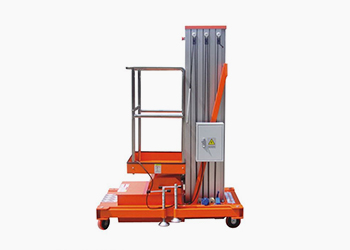
A vertical mast lift raises its platform along a single mast or a set of vertical masts. The platform is designed to remain compact and within the machine's general footprint, so the machine does not reach over obstacles. Its strength is access.
SINO LIFT's GTWY series is an aluminum mast lift. It includes single-mast, double-mast, three-mast, four-mast, and six-mast configurations. GTWY models can be configured with AC power, with battery options available for selected models. Some models can be fitted with auxiliary drive, insulated guardrails, extended platforms, outrigger limit switches, and inclinometers.
The standard machine is compact and light compared with a scissor lift, which makes it suitable for indoor work where floor space and access are limited. The main advantage is access, not platform size.
No. A vertical mast lift describes how the platform is raised. An aluminum lift describes the material and common construction style. Many vertical mast lifts are made from aluminum because it keeps the machine light and easy to move indoors, but not every vertical mast lift is aluminum. Some are steel. Some are self-propelled. Some are stationary or push-around.
For SINO LIFT, the GTWY series is an aluminum mast lift. It falls under the vertical mast lift category. When you compare a GTJZ scissor lift with a GTWY aluminum mast lift, you are comparing a self-propelled scissor lift with a compact aluminum mast lift. That is the comparison this article focuses on.
Both types cover a wide range of heights. Scissor lifts in the GTJZ series reach up to 17.8 m working height. Vertical mast lifts can go higher with multiple masts, up to 25.7 m in the GTWY series. However, height should always be compared using the same specification: platform height versus working height.
Working height includes the operator's reach. Platform height is the height of the platform floor. When comparing models, make sure you are comparing working height with working height, and platform height with platform height. These figures are not interchangeable.
Scissor lifts offer larger platforms and higher load capacities, which allows two or more workers to bring tools, parts, or materials to height.
Vertical mast lifts are commonly designed for one operator with a limited set of tools, and their platforms are much smaller. If the job requires carrying heavy equipment or multiple workers, a scissor lift is the more suitable choice.
Vertical mast lifts are built for tight spaces. Their narrow chassis and compact footprint allow them to pass through standard doors and operate in narrow aisles.
Scissor lifts are wider. While some models can fit through wide doors, they generally require more clearance for turning and positioning. If your application involves very tight aisles or doorways, it is worth comparing how standard and narrow scissor lift models differ before ruling out a scissor lift entirely.
Vertical mast lifts are commonly electric and intended for indoor use on flat, hard surfaces. They are not recommended for windy or uneven outdoor conditions.
Scissor lifts come in electric models for indoor use and rough-terrain models for outdoor sites. The GTJZ series is electric and self-propelled, suitable for indoor and semi-outdoor applications on level ground.
For smaller indoor applications, vertical mast lifts are often more economical to transport and operate. However, the actual purchase and rental cost depends on working height, configuration, capacity, and options.
Vertical mast lifts have a simpler mast structure with fewer wear points. Scissor lifts generally require a higher initial investment, but they can offer better productivity when the job requires a larger platform and higher capacity. For a detailed breakdown of what affects scissor lift pricing, you can review the scissor lift price guide. Maintenance for scissor lifts includes hydraulic systems and scissor arm pivot points, which require regular inspection.
1. Do you need more platform space and higher load capacity?
Yes → A scissor lift is likely the better fit.
No → A vertical mast lift may be enough.
2. Do you need to work in narrow indoor spaces or pass through standard doorways?
Yes → A vertical mast lift is usually more practical.
No → A scissor lift may offer more working space.
3. Do you need a machine suited to larger work areas or heavier tools?
Yes → A scissor lift is the more suitable choice. You can find a more detailed scissor lift purchasing guide to help with the decision.
No → A vertical mast lift can handle many indoor maintenance tasks.
| Application | Recommended Option |
|---|---|
| Narrow warehouse aisles | Vertical mast lift |
| Warehouse lighting maintenance | Scissor lift |
| Factory maintenance | Scissor lift |
| Retail store maintenance | Vertical mast lift |
| Hotel, airport, hospital indoor work | Vertical mast lift |
| Electrical installation | Both—depends on space and load |
| Ceiling maintenance | Both—depends on height and access |
| Heavy tools or materials | Scissor lift |
| Outdoor or rough terrain | Confirm model capability |
| Multi-person work | Scissor lift |
If your application focuses on warehouse operations, you may also find how to choose a scissor lift for warehouse maintenance useful for a more focused selection process.
What is the main difference between a scissor lift and a mast lift?
A scissor lift uses a crisscross mechanism and usually offers a larger platform and higher capacity. A mast lift uses one or more vertical masts and is commonly designed for compact access and single-operator work.
Which lift is better for indoor maintenance?
Both can be used indoors. A vertical mast lift is often more practical in narrow spaces, while a scissor lift is more suitable when the job requires a larger platform or heavier tools.
Is a scissor lift better than a vertical mast lift?
No. A scissor lift is better for larger platforms, higher capacity, and larger work areas. A vertical mast lift is better for narrow spaces, single-person work, and indoor maintenance.
Which is better for narrow aisles?
A vertical mast lift, because of its compact footprint and maneuverability.
Can a scissor lift be used indoors?
Yes. Many electric scissor lifts are designed for indoor maintenance, installation, and warehouse work.
Can a vertical mast lift be used outdoors?
It is mainly for indoor use. Some models may work on flat, windless surfaces, but you must confirm with the manufacturer.
Which is better for warehouse maintenance?
Wide aisles and large work areas favor a scissor lift. Narrow aisles and frequent movement favor a vertical mast lift.
There is no universal winner. Choose a scissor lift when you need a larger platform, higher capacity, or a machine suited to larger work areas. Choose a vertical mast lift when you need compact access, easy maneuverability, and efficient single-person indoor work. Match the machine to the job.
If you need help selecting a suitable lift, send us your required working height, platform load, platform size, indoor or outdoor working conditions, and access dimensions. Our team can recommend a suitable model based on these requirements. You can reach us through our contact page with your project details.
HENAN SINO LIFT is committed to providing customers with high-quality and high-performance industrial equipment. Over the years, we have adhered to technological innovation and product quality, earning the trust and support of our customers.
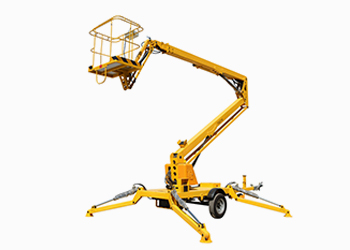
We manufacture Scissor Lift, Mast Lift, Boom Lift, Cargo Lift, Loading Ramp, Wheelchair Lift, and Warehouse Handling Equipment. If you need these products, please let us specify a suitable solution for you.
Email: info@cnsinolift.com
Website: www.cnsinolift.com