A safe scissor lift is not defined by a single feature. It depends on how the machine handles overload, uneven ground, emergency situations, movement limits, and operator mistakes. Operator error, uneven terrain, overloading, and unexpected system failures can all create safety risks during scissor lift operation.
SINO LIFT focuses on practical safety design rather than slogan-based marketing. Across its scissor lift range, the company integrates layered safety configurations that address real working conditions. This article breaks down the main safety features on SINO LIFT scissor lifts, explains how each mechanism reduces risk, and clarifies which functions are standard equipment, which are optional, and which depend on the model and configuration. If you are evaluating different equipment categories before making a purchasing decision, the scissor lift purchasing guide provides a systematic comparison of types, parameters, and applications.
All model references and specifications in this article are based on SINO LIFT’s published product data. Actual configurations may vary by model, order, and application.
Scissor lift operation involves several inherent risks: platform overload, unstable ground, accidental control input, structural over-travel, and sudden system failure. Basic safety setups cover only minimum risk prevention. For rental companies, construction teams, and facility managers, stronger safety configurations can help reduce equipment damage, unplanned downtime, and the risk of workplace incidents.
Advanced safety features add multiple layers of protection. Every safety mechanism on a SINO LIFT scissor lift targets a specific real-world risk, helping the equipment detect unsafe conditions, warn the operator, limit movement, or stop operation before a hazard escalates. Understanding what can go wrong is the first step toward prevention. A review of common scissor lift accidents shows that most incidents are linked to a small number of root causes, many of which safety features are designed to address.
Modern scissor lifts combine electronic monitoring, mechanical protection, hydraulic safety systems, and operator protection features. Depending on the model and application, common safety configurations include overload protection, tilt detection, pothole protection, emergency systems, limit switches, warning devices, and platform protection.
Some safety functions are standard on specific models, while others may vary by configuration or application. The following sections explain how SINO LIFT applies these safety features across its scissor lift range. For a closer look at the self-propelled electric models referenced throughout this article, see the self-propelled electric scissor lift product range.
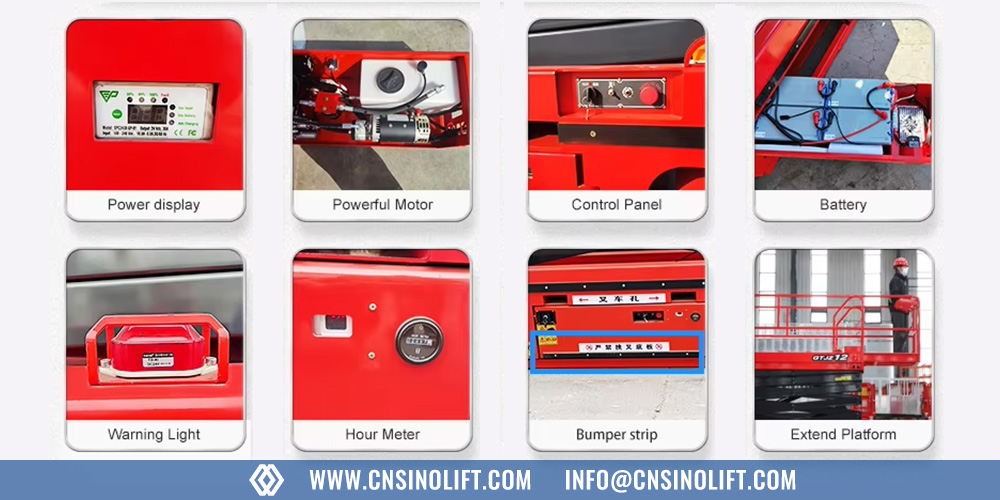
SINO LIFT’s safety design logic focuses on full-process risk control: preventing unsafe operation before it happens, limiting hazards during operation, and enabling safe emergency response when failures occur. The following sections break down the core safety configurations used across SINO LIFT scissor lift product lines, with clear differentiation between standard and optional features.
Overloading is one of the most common causes of platform deformation, hydraulic system damage, and tip-over accidents. SINO LIFT scissor lifts include overload protection components, while active load sensing and automatic overload protection may vary by model and configuration. On models equipped with active overload sensing, the system monitors platform load during operation.
When the load exceeds the equipment’s rated capacity, the system can limit lifting and traveling actions and trigger visual and audible warnings when an overload condition is detected. This helps reduce the chance of structural damage and stability risks caused by overloading. For a detailed breakdown of how operator weight, tools, and extension deck loading affect platform capacity, refer to the capacity and operator weight guide.
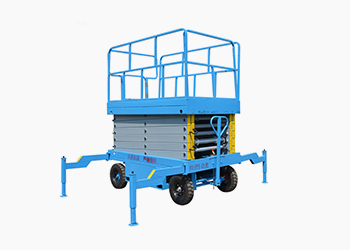
Rated capacity varies by model. Towable scissor lifts such as the SJY0.5-4 are rated at 500 kg, while the SJY1.0-6 is rated at 1000 kg. Self-propelled models cover a range of capacities, including 230 kg, 320 kg, 380 kg, 450 kg, and 550 kg depending on platform size and model. The overload protection setting is matched to the rated capacity and design of each model.
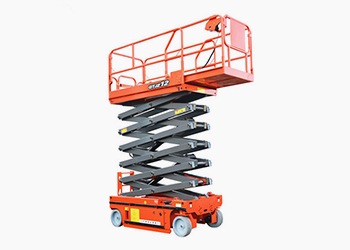
Working on sloped ground is a major risk for self-propelled scissor lifts. Self-propelled models in the SINO LIFT range are equipped with a tilt protection system as standard equipment. The angle sensor monitors chassis inclination in real time.
When the machine exceeds its preset safe tilt threshold, the system disables lifting and traveling functions, retains safe lowering function, and activates alarm reminders. This helps reduce the risk of tipping caused by operation on excessively sloped terrain and allows operators to return to ground level safely. For a broader discussion of stability factors and tipping risks, see Do Electric Scissor Lifts Tip Over Easily?
The allowable working angle varies by model. Most self-propelled scissor lifts allow approximately 1.5° of longitudinal tilt and 3° of lateral tilt. Some models allow 2° of longitudinal tilt and 3° of lateral tilt. Tracked electric models are typically rated at 1.5° of longitudinal tilt and 2.5° of lateral tilt. Rough-terrain models with outriggers can level further; some models list outrigger leveling ranges up to 6° vertical and 12° horizontal, depending on model. These limits reflect the machine’s stability envelope under rated load and platform height.
Pothole protection is a terrain-adaptive safety design for self-propelled scissor lifts working on uneven ground. Self-propelled scissor lifts in the SINO LIFT range are equipped with an automatic pothole protection system as standard. The mechanical protection mechanism deploys when the platform is elevated.
The protective baffles reduce the equipment’s effective ground clearance, helping prevent the chassis from dropping suddenly or becoming unstable when the wheels pass over pits, grooves, or uneven surfaces. This supports stability when the machine moves across uneven ground or surface depressions. For outdoor construction sites and unfinished ground, this configuration improves operational stability and helps reduce the risk of instability caused by sudden terrain changes.
For rough-terrain applications, the GTJZ8RE through GTJZ20RE series uses hydraulic outriggers to provide additional leveling capability. These outriggers work together with the tilt protection system to keep the machine stable on demanding ground conditions. The 4x2 drive configuration provides rear-wheel drive for stable traction and gradeability, supporting reliable movement on uneven ground.
SINO LIFT scissor lifts are designed with emergency stop controls at both the platform and ground control stations. This allows emergency shutdown from either location.
The platform-mounted emergency stop allows the operator to stop machine movement immediately if abnormal vibration, system failure, or unexpected hazards occur during high-altitude operation. The ground emergency stop button allows ground supervisors to intervene immediately in special situations. The emergency stop function provides a direct way to stop machine movement when an unsafe condition occurs.
Power failure or electrical control failure may trap operators on an elevated platform. SINO LIFT scissor lifts are equipped with an emergency lowering button and emergency lowering system as standard equipment, independent of the normal electrical control system.
When the equipment loses normal power or an electrical control failure occurs, operators or ground personnel can manually activate the lowering valve to lower the platform in a controlled manner to the ground. The manual lowering speed is mechanically limited to avoid sudden drops, supporting safe evacuation in emergency shutdown scenarios.
To prevent the lifting mechanism from moving beyond its designed limits, SINO LIFT installs limit switches as standard equipment on its scissor lift models. These include upper and lower limit protection.
When the platform rises to the maximum rated height or descends to the preset lowest position, the limit switch automatically cuts off the corresponding power action. This prevents over-lifting or collision with the chassis. Some models also include travel limit auxiliary switches to restrict abnormal movement in special working modes, protecting the scissor structure, hydraulic cylinder, and electrical components from mechanical impact.
Self-propelled scissor lifts in the SINO LIFT range also use safety switches that can automatically stop the platform during the lifting and lowering process, supporting operator safety.
Platform enclosure protection is central to preventing falls from height. SINO LIFT’s standard platform safety structure includes high-strength guardrails, middle rails, and anti-skid toe boards, designed to provide the required protection for operators working at height, with configurations available for different market requirements. The guardrails use welded construction and anti-loosening fastening to reduce the risk of loosening during long-term vibration.
The platform self-closing, self-locking gate is standard equipment. A gate that closes automatically reduces the risk of an operator leaving the gate open. Folding guardrails are also standard on many models, allowing the machine to pass through standard doorways while maintaining platform protection during work. The extension platform increases the available working area and can be deployed when needed; on certain models, the pothole protection plate opens automatically when the platform is raised.
Custom enhanced platform protection is available on selected heavy-duty and high-lift models, including reinforced anti-collision guardrails, retractable safety gates, and thickened anti-skid platform plates. Toe boards help prevent tools, parts, and debris from rolling off the platform and injuring ground personnel. They also reduce the risk of a worker’s foot slipping off the platform edge. Whether a personal fall protection harness is additionally required depends on local regulations and site conditions; see Do I Need to Wear a Safety Harness in a Scissor Lift? for details.
Non-marking tires are standard on many SINO LIFT scissor lift models designed for indoor work. They are suitable for warehouses, shopping malls, data centers, and indoor decoration projects. Unlike ordinary rubber tires, non-marking tire material leaves fewer black marks or scratches on epoxy floors, marble, and cement floors.
On tracked models such as the GTJZ04TE and GTJZ06TE, non-marking rubber tracks are standard. The rubber track design distributes machine weight over a larger contact area, reducing ground pressure on sensitive floor surfaces.
SINO LIFT uses both audible and visual warning devices on its scissor lifts. Many SINO LIFT models include a buzzer, horn, strobe light, indicator lights, and alarms as standard equipment. These cover lifting and traveling status reminders, overload warnings, and tilt hazard alarms.
When the equipment is operating, the flashing warning light and alarm remind surrounding personnel to avoid entering the operating area. Enhanced intelligent alarm systems are available on selected models, adding fault code prompts, low battery reminders, and abnormal hydraulic pressure warnings. The graded warning design helps operators distinguish normal operating conditions, warning conditions, and urgent faults.
SINO LIFT scissor lifts use a dual-control design. The platform control handle allows the operator to control lifting, lowering, and travel from the platform. The upper control includes protection against accidental operation. The platform control handle uses proportional control, allowing travel speed to adjust based on handle movement for smoother, more precise operation. On self-propelled models, the platform can be driven while elevated at a reduced speed; see Can I Move an Electric Scissor Lift Platform While Elevated? for the operating conditions and limits.
In addition to the platform control system, these scissor lifts are equipped with an independent ground control panel. The ground control panel supports lifting, lowering, and emergency reset, providing dual-operation backup. When the upper control fails or the operator cannot operate normally, ground staff can take over equipment control to complete platform reset, emergency lowering, or safe shutdown. This dual-control arrangement provides an additional layer of operational backup.
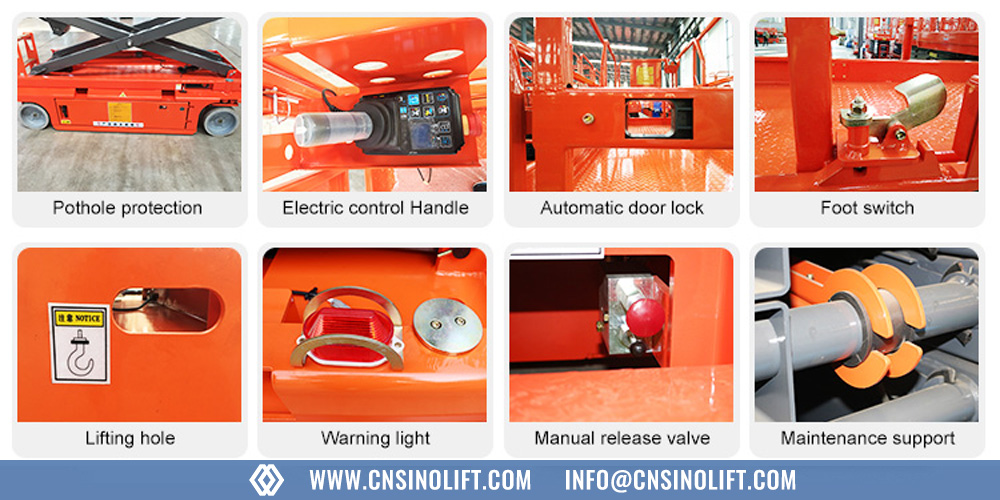
SINO LIFT scissor lifts include several hydraulic and electrical safety features as standard equipment. Hydraulic hose burst protection helps prevent uncontrolled descent if a hydraulic hose bursts. An automatic braking system engages when the machine stops or the control handle is released, helping prevent unintended rolling. The proportional valve cylinder control supports smoother lifting and lowering, reducing sudden movement. The charging protection system helps protect the battery and electrical system during charging. The anti-static strap is also checked as part of the electrical safety inspection.
The fault diagnosis system supports early detection of abnormal conditions. While it is not a primary safety device, it helps maintenance personnel identify issues before they develop into unsafe operating conditions.
The safety maintenance support bar is standard equipment on SINO LIFT scissor lifts. Before performing maintenance work underneath the platform, the safety arm should be fully engaged according to the equipment manual. Personnel should never rely solely on the hydraulic system when working under the lift. The safety arm provides a mechanical barrier against unexpected platform lowering during maintenance.
SINO LIFT also recommends daily maintenance, periodic maintenance, and troubleshooting. Daily maintenance includes cleaning the lift, checking components, and lubricating moving parts. Periodic maintenance includes changing hydraulic oil, replacing seals, and inspecting electrical circuits. Troubleshooting includes checking electrical circuits, hydraulic systems, and mechanical components. A work-hour meter records operating time and usage data, supporting maintenance scheduling and fleet management. Standard forklift pockets allow the machine to be lifted and transported by forklift. For a model-specific daily inspection routine, see the self-propelled scissor lift daily inspection checklist.
Safety features are only effective when the machine is properly inspected before operation. SINO LIFT recommends the following checks before each shift. Note that operating a scissor lift may require employer-provided training and authorization depending on your jurisdiction; see license and OSHA training requirements for further guidance.
Visual and structural inspection
Functional checks
Work area checks
A proper pre-shift inspection can identify many problems before they require a safety system to intervene.
Important: Safety features are designed to reduce specific operating risks, but they do not replace operator training, pre-operation inspections, safe operating procedures, or the requirements of applicable local regulations. Always operate the machine according to the manufacturer’s instructions and the limits specified for the specific model.
SINO LIFT approaches scissor lift safety as a combination of multiple protection systems rather than relying on a single safety device. Overload protection helps prevent operation beyond the rated load, while limit switches help prevent excessive mechanical travel. Tilt protection and pothole protection adapt to complex terrain risks. Emergency stop and emergency lowering systems help operators respond to emergency situations. Dual controls and alarm systems provide full-process monitoring.
SINO LIFT matches differentiated safety configurations according to equipment tonnage, lifting height, and application scenario. Indoor models can be configured for clean floor environments and confined working areas. Outdoor heavy-duty models strengthen terrain adaptation and structural risk resistance. For SINO LIFT, equipment safety is a system that covers design, production, inspection, and after-sales use. For a reference on how configuration choices influence equipment cost, see the scissor lift price guide.
1. Are all SINO LIFT scissor lifts equipped with tilt and overload protection?
Overload protection components are included across SINO LIFT scissor lift models. Active overload sensing may vary by model and configuration. Tilt protection is standard on most self-propelled models. Fixed and lightweight manual models may not use tilt monitoring because their operating characteristics differ from self-propelled models.
2. Is pothole protection necessary for indoor scissor lift operation?
Pothole protection is mainly for uneven outdoor terrain and complex construction sites. For flat indoor environments such as warehouses and workshops, a model without pothole protection may be suitable, depending on the machine design and application. Users can select models with pothole protection or outrigger leveling according to on-site ground conditions.
3. Can the emergency lowering system work without electricity?
Yes. The emergency lowering system on SINO LIFT scissor lifts is mechanically controlled and does not depend on the normal electrical control system. It allows the platform to be lowered during a power failure or electrical control failure.
4. Do SINO LIFT non-marking tires affect equipment stability?
When properly matched to the machine and application, non-marking tires are designed to maintain the required traction and load-bearing performance while reducing floor marking. They are suitable for high-cleanliness indoor operation scenarios.
5. What is the allowable tilt angle for SINO LIFT scissor lifts?
The allowable tilt angle depends on the specific model. Most self-propelled models allow approximately 1.5° of longitudinal tilt and 3° of lateral tilt, while some models and rough-terrain configurations have different limits. Always refer to the specific model’s specifications or contact SINO LIFT for the exact operating limits.
6. Are scissor lifts safe on uneven ground?
Some scissor lifts can operate on uneven ground when the machine is designed and configured for that application. Tilt protection, pothole protection, and outrigger leveling are the main features that help reduce risk. The allowable ground conditions and tilt angle depend on the specific model. Operators should always confirm the ground conditions and the machine’s limits before operation.
7. What should I check before operating a scissor lift?
A pre-operation check should include visual inspection of the machine structure, hydraulic hoses, battery, tires, and guardrails. Test the emergency stop buttons at both platform and ground controls, verify the alarm and horn, and confirm the work area is within the machine’s allowable operating limits. Also check that the load is within the rated capacity. If any safety device, control, structural component, or hydraulic/electrical system does not work as expected, the machine should not be operated until the issue has been checked and resolved.
HENAN SINO LIFT is committed to providing customers with high-quality and high-performance industrial equipment. Over the years, we have adhered to technological innovation and product quality, earning the trust and support of our customers.
We manufacture Scissor Lift, Mast Lift, Boom Lift, Cargo Lift, Loading Ramp, Wheelchair Lift, and Warehouse Handling Equipment. If you need these products, please contact us and let us specify a suitable solution for you.
Contact us: