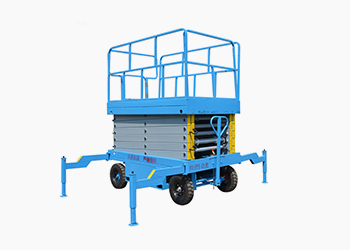
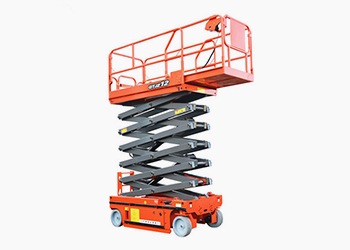
A typical charging cycle for SINO LIFT electric self-propelled scissor lifts takes about 7 to 8 hours with maintenance-free lead-acid batteries. Actual charging time depends on battery capacity, charger output, depth of discharge, temperature, and battery condition.
This figure applies to SINO LIFT's standard configuration and is not a universal specification for every scissor lift. Other brands may use different battery capacities, charger ratings, or battery types, so always check the operator manual for the specific machine. If you are still comparing equipment options, the scissor lift purchasing guide covers selection criteria in more detail.
For the electric self-propelled scissor lifts discussed here, a full charging cycle takes about 7 to 8 hours with the standard 24V/30A charger and maintenance-free lead-acid batteries. Partial charges take less time. A battery that is half discharged may take around 3 to 5 hours to recharge, depending on the battery and charger.
The final part of a lead-acid charging cycle is slower because the charger reduces current during the absorption stage. This brings the battery to full charge without overcharging it.
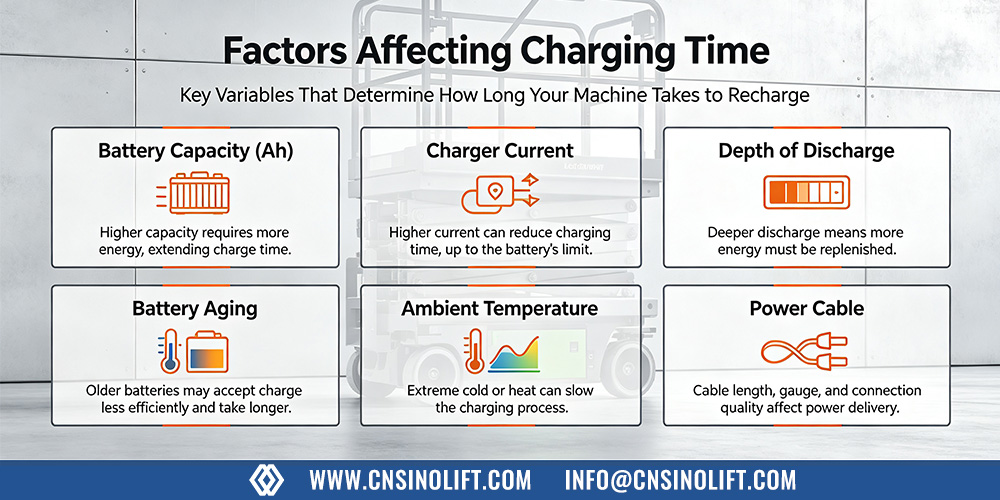
Charging time is not a single fixed number. It depends on a few main factors:
1. Battery capacity (Ah) A larger battery pack holds more energy and generally takes longer to fill. Capacity is measured in amp-hours. Common scissor lift battery packs range from around 80Ah to over 300Ah, depending on the model and platform height.
2. Charger output (A) The charger delivers current to the battery. A higher-output charger fills the battery faster, provided it is matched to the battery's acceptance profile.
3. Depth of discharge A battery that is 50% discharged will generally charge faster than one that is 80% discharged. The absorption phase at the end of a lead-acid charge is slow by design, so the final part of the cycle adds time.
4. Battery age and condition Older batteries often take longer to charge. Sulfation and increased internal resistance reduce efficiency. If charging time consistently exceeds the normal window, the battery may be nearing the end of its service life. For a closer look at expected battery lifespan, see the scissor lift battery lifespan guide.
5. Ambient temperature Charging works best at moderate temperatures, roughly 10–30°C (50–86°F). Cold slows the chemical reaction inside the battery. A frozen battery should not be charged. High heat can cause the charger to reduce output or shut down. If the machine is stored or used outdoors, it is also worth understanding how rain exposure affects electric scissor lifts.
6. Power supply and cables Using a long or thin extension cord can cause voltage drop, which slows charging and may overheat the cable. Plug the charger directly into a properly rated outlet when possible.
Electric self-propelled scissor lifts can use different battery types. Lead-acid batteries are still common, but the exact configuration depends on the brand and model. Not every scissor lift uses the same battery type, and not every lead-acid battery is maintenance-free. The operator manual is the best source for the specific machine.
SINO LIFT's standard configuration uses maintenance-free lead-acid batteries. These batteries are sealed and do not require water topping. That removes the regular watering step associated with flooded lead-acid batteries.
For customers who request lithium batteries, SINO LIFT can customize a lithium battery version. In our configuration, the charging time is kept close to that of the lead-acid version. This charging setup is designed with battery service life in mind.
If you are using a machine from another manufacturer, check the manual before assuming the battery type or maintenance requirements. For details on the equipment itself, the self-propelled electric scissor lift product page lists platform heights, load capacities, and standard features.
Charging time only matters in relation to how long the machine works afterward. A fully charged electric scissor lift typically runs for 6 to 8 hours under normal indoor conditions. Intermittent use may extend that window. Rough terrain, frequent driving, and continuous lifting under load reduce it.
Cold weather reduces lead-acid capacity. The exact percentage depends on temperature and battery condition. If the machine is used in a cold environment, runtime will be shorter even after a full charge. A more detailed breakdown of runtime by application is available in this guide to scissor lift runtime per charge.
For most single-shift jobs, one overnight charge is enough. A full charging cycle fits into a typical off-shift period.
Following a consistent charging routine helps the battery last longer and keeps the machine ready for work.
| Mistake | Result |
|---|---|
| Leaving batteries discharged for days | Sulfation and permanent capacity loss |
| Frequent deep discharges below 20% | Shorter cycle life |
| Using a mismatched charger | Slow charging, overheating, battery damage |
| Charging a frozen battery | Case cracking and battery damage |
| Mixing old and new batteries | Weak battery drags down the pack |
| Using long, thin extension cords | Voltage drop and slow charging |
For the SINO LIFT electric self-propelled scissor lifts referenced in this article, a typical charging cycle takes about 7 to 8 hours with lead-acid batteries. Partial charges take less time depending on the battery's state of charge. Other brands and configurations may differ.
Yes. Overnight charging is a common routine for lead-acid scissor lifts. Many automatic chargers switch to a maintenance or float-charge mode after the battery is fully charged.
SINO LIFT's standard configuration uses maintenance-free lead-acid batteries, which are sealed and do not require water topping. If you are using a machine with flooded lead-acid batteries, check the operator manual for watering instructions.
No. Do not operate an electric scissor lift while it is connected to the charger.
Common causes include aged batteries, low ambient temperature, dirty charger connectors, a faulty charger, or a mismatched power supply. If charging time consistently exceeds the normal window, check the battery and charger before assuming a replacement is needed.
Signs of a worn battery can include a significant reduction in runtime, noticeably longer charging times, visible damage, or poor performance under load. Battery replacement should be based on battery condition and manufacturer recommendations rather than runtime alone.
SINO LIFT can customize lithium battery options on request. In our configuration, the charging time is kept close to that of the lead-acid version, a setting designed with battery service life in mind.
For the SINO LIFT electric self-propelled scissor lifts referenced in this article, a typical charging cycle takes about 7 to 8 hours. Charging time can vary with battery capacity, charger output, depth of discharge, temperature, and battery condition.
This figure is a useful reference for planning charging schedules, but it is not a universal specification for every scissor lift on the market. Check the operator manual for the machine you are using.
If you are comparing equipment options, the scissor lift price guide outlines typical cost ranges by type and platform height. For buyers evaluating Chinese-made electric lifts, this 2026 buying analysis covers cost, quality, durability, and after-sales support.
If you need help matching a scissor lift to your shift schedule or charging setup, contact us with your requirements.
HENAN SINO LIFT manufactures scissor lifts, mast lifts, boom lifts, cargo lifts, loading ramps, wheelchair lifts, and warehouse handling equipment. Contact us if you need product specifications, pricing, or help selecting the right model.
Email: info@cnsinolift.com
Website: www.cnsinolift.com